Showing posts with label Jehovah. Show all posts

Thursday, September 15, 2011

Tiny Silver Scrolls (or Amulets) = Oldest Biblical Text

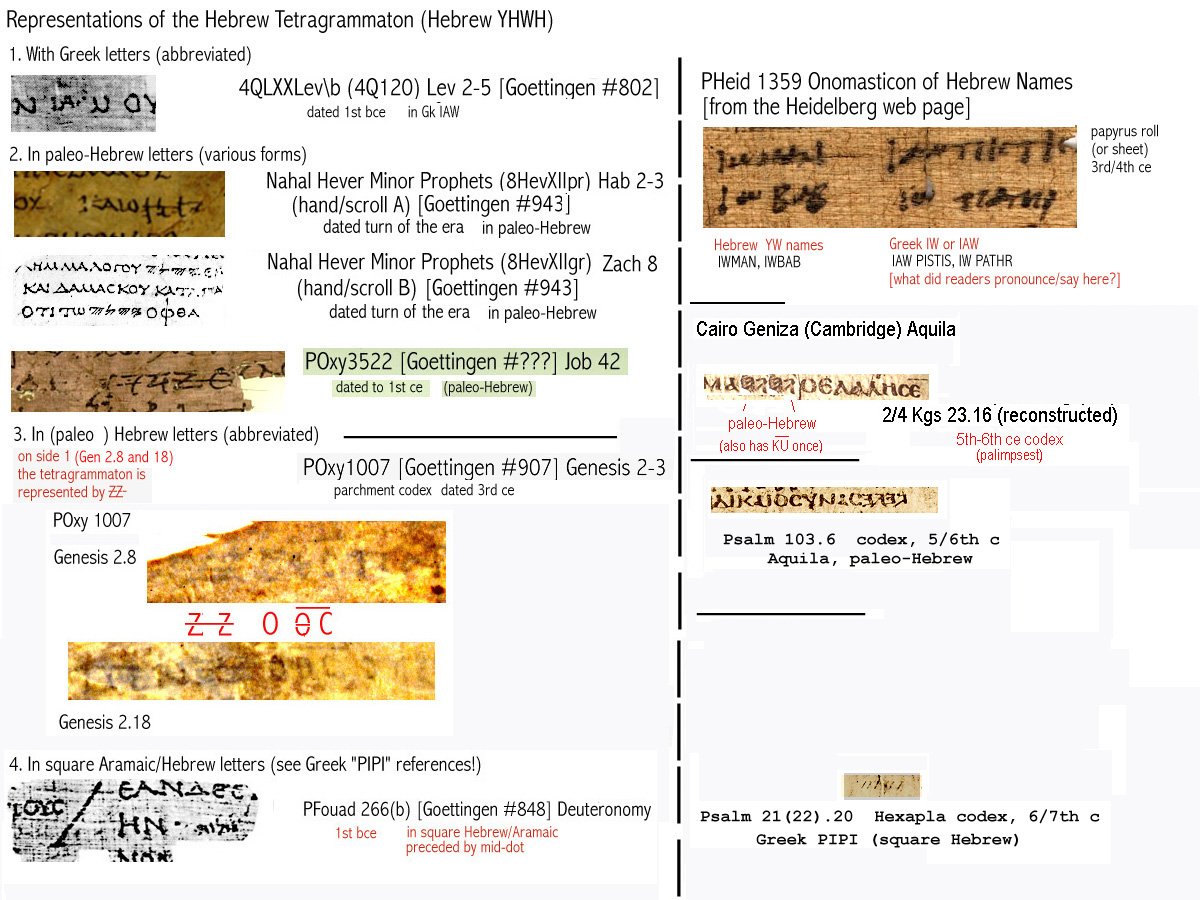
Today when asked about the oldest available evidence for any part of a text from a biblical book, it is not unlikely the response may be, “The Dead Sea Scrolls.” While these Scrolls do contain many ancient treasures, treasures which preserve among other things various forms of the name of the God of Moses in special, but often very recognizable and quite pronounceable forms (unlike what we read in many modern English Bibles such as the NIV, for reasons that are not altogether unknown). But when it comes to the most ancient of all presently known biblical texts, be sure not to forget these tiny silver scrolls or amulets dated to the late 7th/early 6th century BCE, and known variously as the “Ketef Hinnom Scrolls” or “Amulets.”

However, with all otherwise due deference to the site linked above for hosting images of these treasures, the site has also meaningfully hidden the greatest treasure, that is, the treasure within the text itself. While the actual images of these silver scrolls are fine (which is why I use this link to show them), the translation of their preservation of Numbers 6:24-26 (among other texts), three times using “Lord” rather than an actual form of the name used in these texts, is a great mistake in the representation of this God.

Further, at least one other popular site’s translation of these silver scrolls (last accessed on September 15, 2011) uses a form of the divine name (“Yahweh”) which is not at all based on the best available evidence, but which is nonetheless popular and used and misused in place of other, better forms of the name, including the Anglicized forms “Jah,” “Jaho(h),” “Jaho(h)-ah” and even the more popular “Jehovah” (see notes 3 and 6 on pages 2 and 4, respectively, in Chapter 1 of my Jehovah’s Witnesses Defended, Third Edition [available online here]).

The form of the name “Yahweh” is really in large part the product of inaccurate assumptions about the pronunciation and use of the divine name by ancient Jews of various periods, as well as the result of assumptions about the origin of the name itself. In fact, such a pronunciation of the name (“Yahweh”) contradicts nearly all known (certainly the best available) evidence having to do with the history of the pronunciation of the name by both Jews and non-Jews, of similar and different times, and in similar and in different locations. See, again, my Jehovah’s Witnesses Defended, Third Edition, Chapter 1, in particular pages 28-56; see also my more recent, “‘Christian’ Witnesses of Jah, Jaho(h)-ah God,” Watching the Ministry (April 2, 2011).

Christian Witnesses of Jah base pronunciations of the divine name on the best phonetic evidence; we do not assume anything (other than for convenience after already having presented our good reasons/evidence) about the forms of the name; we intend to consider what can be shown through credible means to be the best available evidence. Evidence which for the divine name involves multiple forms throughout history (three in ancient Hebrew/Aramaic alone [namely, YHWH, YHW, and YH]), but all of which can be traced through quite a reasonably accurate extent (better than many if not better than most other, similar ancient names’ histories can be traced) from ancient Semitic and other languages of the ancient world through to the present. That is why we should consider the best available evidence: It is very good and it is available!

I believe the best available evidence, which I have regularly presented (see the links throughout this article and also under “D, Divine Name,” in the Elihu Books Topical Index), supports by far the recently Anglicized form, “Jaho(h)-ah,” as the form which English speakers should use. It provides great utility to the user, allowing anyone to represent the pronunciation of all three of the best English pronunciations in this one form, namely, “Jaho(h)-ah” itself, “Jah,” and “Jaho(h),” the last of which is the least known form/pronunciation of the divine name, yet it is perhaps in line with the best available evidence, as explained most recently in my Addendum, “On the Use of ‘Jah,’ ‘Jaho(h),’ and ‘Jaho(h)-ah’ as Anglicized Pronunciations of the Divine Name,” a little past the middle of my online article, “‘Christian’ Witnesses of Jah, Jaho(h)-ah God.” 

Each of the three forms of the divine name can be seen and pronounced appropriately, in a given language, just from just the use of the one form (in English), “Jaho(h)-ah.” That is why I try most often to use this form of the name, along with the already familiar form, “Jah.”


None of these phonetically based forms of the divine name require any disassociation of any of the verbal ideas otherwise and everywhere associated with the God of Moses in biblical and in any other accurately related histories. Compare R. Laird Harris, who also wrote the divine “Name is explained by the attributes of God revealed in the” Bible (see “The Pronunciation of the Tetragram,” in The Law and the Prophets: Old Testament Studies Prepared in Honor of Oswald Thompson Allis, ed. John H. Skilton [Phillipsburg, New Jersey: Presbyterian and Reformed Publishing, 1974], page 223). An assumed verbal root is not needed for the name that is, in fact, best supported by the available phonetic evidence and which name at all times, also, conveys all of this God’s “revealed” attributes to those who know him. These attributes are those so known or understood in relation to his person and to Jaho(h)-ah’s historical acts, such as those done through Moses and others including, we believe, Jesus of Nazareth. For reliable, historical evidence of the latter’s fulfillment of the role of biblical “Messiah” or “Christ,” see my online article, “Micah 5:1(2): Reliable Prophecy and Real Personal Preexistence,” Watching the Ministry (November 24, 2010).
 

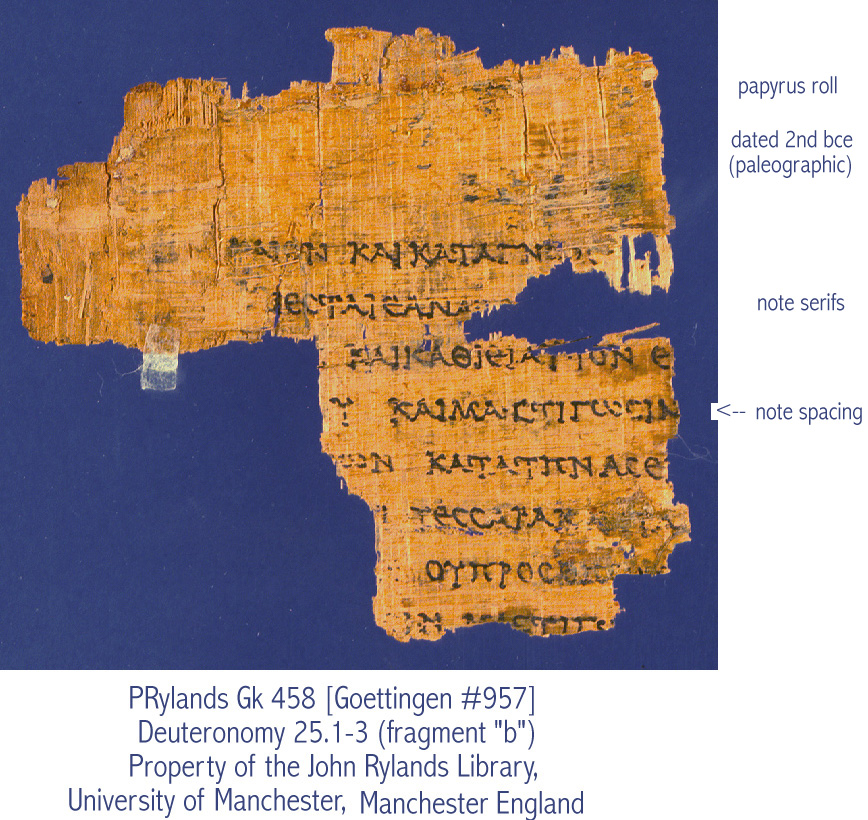
But, remember, when it comes to biblical writings the oldest available text is presently that which is preserved on tiny silver scrolls (or amulets) which are 400-600 years older than the oldest of the Dead Sea Scrolls, namely, several texts which are dated to the 2nd century BCE (examples include 4LXXDeut and PRyl458). Other credible evidence roughly equal or better in age and in quality also exists to support many biblical accounts, including the Nabonidus Cylinder (555-540 BCE), the Moabite Stone (or Mesha Stele) dated to the early 9th century (around 890) BCE, and other documents or findings from the ancient world which more than reasonably verify the history of the ancient people “of the house of David” and the God, theophorically named on these late 7th/early 6th century BCE clay seals, whom they and others have at various times formally worshipped. Still other evidence may further and strongly support various biblical accounts or claims, but some of this evidence is not yet above the level of critical review to use or to accept fully, yet. See, “Oldest Hebrew Text Is Evidence for Bible Stories?” by Mati Milstein in Elah Valley, Israel for National Geographic News (November 3, 2008); and, “4,000-Year-Old Tombs Found Near Jerusalem Mall,” by Mati Milstein for National Geographic News (November 21, 2006).


For more on some of these and other features of biblical history and texts like those found on these tiny silver scrolls or amulets, see the second page of the PDF of the tract, “Beliefs Based on the Best Available Reasons.” See also the listings in the Elihu Books Topical Index under “A, Archaeology: Biblical.” For further, extended discussions of issues related to the history, use, and pronunciation of the name of the God of Moses, see my Jehovah’s Witnesses Defended, Third Edition, Chapter 1 (available online here), along with my more recent online article, “‘Christian’ Witnesses of Jah, Jaho(h)-ah God.”

Wednesday, January 13, 2010

New World Translation Footnotes to John 8:58

In the New Testament (NT) Jesus of Nazareth is presented to us as a preexistent Son of God who “stepped out of heaven” to do only the God Jah’s will (John 3:13; 7:16-18; 8:47, 54: 12:49). Jesus’ real, personal preexistence can be seen in his identity as “the Word” and “Wisdom” of God according to the Bible (Proverbs 8:22-31; Micah 5:1-2; John 1:1; Revelation 19:3; see also my Third Edition of Jehovah’s Witnesses Defended: An Answer to Scholars and Critics [Murrieta, CA: Elihu Books, 2009], Chapter 4, pages 308-316, and Chapter 5, pages 406-418). This teaching is also consistent with what Jesus is recorded as having said in John 8:58 (see Jehovah’s Witnesses Defended, Third Edition, Chapter 3, pages 223-225).

As for whether Jesus claimed to have eternally preexisted or to have preexisted “before Abraham was born,” or whether Jesus used “I AM” as a divine name in John 8:58 and also for an extended discussion about how John 8:58 should be translated into English, see pages 274-296 of my Third Edition of Jehovah’s Witnesses Defended. See also my recent answer to the question, “Why do different editions of the New World Translation (NWT) contain different footnotes to its rendering of John 8:58?” published December 17, 2009, online through Elihu Books’ “Upon the Lampstand.”

The question and the answer in the above referenced “Lampstand” article indicates that since its first edition of the New World Translation (NWT) New Testament (NT) in 1950 to its latest 1984 Reference Bible and 1985 Kingdom Interlinear Translation (KIT), the Watchtower Bible and Tract Society (the publisher of the NWT and the KIT) has had more than one footnote in its English translation of John 8:58. In my recent “Lampstand” Q&A I provide an extended evaluation of these different NWT/KIT footnotes to John 8:58, in response to many harsh and unfounded criticisms made over the past 50+ years by scholars and critics of Jehovah’s Witnesses. Indeed, scholars and critics of Jehovah’s Witnesses through to this past year 2009 have published what is demonstrably false and which contradicts readily available information, including the originally misunderstood and misused 1950 John 8:58 (NWT) footnote’s use of the incontrovertibly clear English expression “rendered in.”

First, consider how Ron Rhodes captioned the 1950 NWT’s use of “perfect indefinite tense” in his 1993 book Reasoning from the Scriptures with the Jehovah’s Witnesses (Eugene, OR: Harvest House, 1993), page 116:
Scholars agree that the Watchtower Society has no justification for translating ego eimi in John 8:58 as “I have been.”
The above has been removed from Rhodes’ 2009 edition of his Reasoning from the Scriptures with the Jehovah’s Witnesses (Eugene, OR: Harvest House, 2009), which is a positive indication. Indeed, Rhodes must now realize that many scholars not only agree with the NWT translation of John 8:58, but it has been sufficiently demonstrated that Rhodes’ preferred “I am/AM” translation of John 8:58 is unacceptable for many good reasons. For example, after categorizing the Greek idiom correctly as an “Extension from Past” (also known as a “Present of Past Action Still in Progress”) in which the present verb eimi (“I am”) is “used with an expression of either past time or extent of time with past implications” (as in “before Abraham was born”), K.L. McKay gives an English rendering that is almost identical to the NWT’s, namely, “I have been in existence since before Abraham was born” (Kenneth L. McKay, A New Syntax of the Verb in New Testament Greek [SBG 5; New York: Peter Lang, 1994], pages 41-42).

As I attempted to make plain in my online Q&A, “Why do different editions of the New World Translation (NWT) contain different footnotes to its rendering of John 8:58?” page 11, note 9, while addressing some of the claims made by Robert M. Bowman, Jr.:
As I have shown on pages 283-284 of my Third Edition of Jehovah’s Witnesses Defended, Bowman misquotes every single one of the Greek grammars he cites in connection with his claim, “most grammars specifically state that accompanying the present tense verb is some adverbial expression indicating the extent of the duration of the time indicated by the verb” (Bowman, Jehovah’s Witnesses, Jesus Christ, and the Gospel of John, page 105 [underlining added]). Each one of Bowman’s referenced grammars makes it clear that a past expression and a present verb together denote duration from the past point of reference (“before Abraham was born”) to the present (“I am”). Yet, not one of the grammars cited by Bowman on this point says anything about “the extent of the duration of the time” being indicated by the adverbial, past-referring expression. Shifting the focus (as Bowman does) from a past expression modifying a present verb to “a clause beginning with prin” ignores the role of the present verb in relation to the adverbial clause. By doing this, Bowman can disconnect “‘duration’ up to the present” from the past expression. But the adverbial “prin clause” is not considered in isolation from the present verb! It is, in fact, the present verb which denotes duration (though not always the extent of the duration) from the time indicated by the past-referring adverbial clause.
You may review for yourself the what I recently referenced again in my new “Upon the Lampstand” Q&A regarding NWT footnotes to John 8:58 (see page 7), and in my Third Edition of Jehovah’s Witnesses Defended (see Chapter 3, pages 277-294), namely, the following writers who describe or who classify the Greek idiom of John 8:58 just as the Watchtower Society now does:

1) J.A. Bengel, Gnomon of the New Testament, vol. 2 (Edinburgh: T&T Clark, 1858), page 370.

2) A. Tholuck, Commentary on the Gospel of John (Edinburgh: T&T Clark, 1859), page 243.

3) H.A.W. Meyer, Critical and Exegetical Hand-Book to the Gospel of John, trans. William Urwick (New York: Funk & Wagnalls, 1884), page 293.

4) G.B. Winer, A Grammar of the Idiom of the New Testament, trans. J. Henry Thayer (Andover: Warren Draper, 1897), page 267.

5) F. Blass, A. Debrunner, and R.W. Funk, A Greek Grammar of the New Testament and Other Early Christian Literature, trans. Robert W. Funk (Chicago: University of Chicago Press, 1961), page 168, sec. 322. (Note: John 8:58 is cited erroneously in the grammar’s text, in the referenced section, as John 5:58.)

6) N. Turner, A Grammar of New Testament Greek, vol. 3, Syntax (Edinburgh: T&T Clark, 1963), page 62, sec. 1(c).

7) J.N. Sanders and B.A. Mastin, A Commentary on the Gospel According to St. John (New York: Harper & Row, 1968), page 236.

8) Kenneth L. McKay, “Time and Aspect in New Testament Greek,” NovT 34 (1992), page 212.

A New Syntax of the Verb in New Testament Greek (SBG 5; New York: Peter Lang, 1994), pages 41-42.

— “‘I am’ in John’s Gospel,” ExpT 107.10 (1996), page 302.

Rhodes neglected to consider each and every single one of the above in connection with this issue in his 1993 edition (which means Rhodes would not have had available to him only the last two cited sources) and Rhodes does not consider or reference any of them in his 2009 edition of Reasoning from the Scriptures with the Jehovah’s Witnesses. Yet, in 1993 Rhodes wrote that “scholars agree” there is “no justification” for the NWT rendering! Then sixteen (16) years later in 2009 Rhodes still hides available references which clearly support the NWT rendering and/or the Greek idiom cited explicitly by the Watchtower Society since its 1984 NWT Reference Edition was published.

In so doing, Rhodes makes it nearly impossible for his readers to completely and accurately understand these issues. Therefore, I believe for the above and for other reasons stated elsewhere in documents referenced in this Bog that Ron Rhodes and those who support his work against Jehovah’s Witnesses are misleading people by what Rhodes writes about the NWT and about John 8:58.

Further concerning John 8:58 and the NWT, consider the following from Rhodes’ 1993 edition of his Reasoning from the Scriptures with the Jehovah’s Witnesses, page 116 (with my underlining added):
It is highly revealing that at one time, the Jehovah’s Witnesses attempted to classify the Greek word eimi as a perfect indefinite tense rather than a present tense.
The above words are gone from Rhodes’ 2009 edition. Indeed, at no time have Jehovah’s Witnesses or the Watchtower Society attempted to “classify the Greek word eimi as a perfect indefinite tense rather than a present tense”!

Rhodes’ claim is a fabrication, one easily contradicted by the expressed use of “rendered in” in the very same 1950 NWT footnote to John 8:58 which is the source of the issue Rhodes’ writes about above concerning the “perfect indefinite tense”! The original fabrication begun by Dr. Walter Martin on this issue has been carried forward by many of Martin’s disciples since at least 1957, and possibly as early as 1953 (see notes 1, 2, 24, and 25 in my “Why do different editions of the New World Translation (NWT) contain different footnotes to its rendering of John 8:58?”). Unless Martin was intending to deceive people by his treatment of John 8:58 in the NWT, his false claims could have been avoided had Martin and his research staff understood the simple English expression, “rendered in,” which expression plainly reveals that “perfect indefinite tense” in the 1950 NWT footnote to John 8:58 has to do with the English translation, not with “the Greek word eimi as a perfect indefinite tense.”

Even more outrageous is the following 1993 description of the alleged reaction by Jehovah’s Witnesses to Martin’s false claims concerning the 1950 NWT footnote to John 8:58, which alleged reaction is portrayed by Rhodes as follows:
However, this claim proved to be very embarrassing when Greek scholars pointed out to the Jehovah’s Witnesses that there is no such thing as a perfect indefinite tense in Greek grammar. [Rhodes, Reasoning from the Scriptures with the Jehovah’s Witnesses (1993), page 116].
The above has now been eliminated from Rhodes’ 2009 edition, not because it no longer fit with the text and overall scope and subject of Rhodes’ work on Jehovah’s Witnesses (obviously). Rather, it seems clear that the change was made because Rhodes’ claim “proved to be very embarrassing when” English-speaking persons pointed out to Rhodes and to the Christian Research Institute which Martin founded that the NWT’s use of “perfect indefinite tense” had nothing to do with “Greek grammar”! 

Many of these same and other Trinitarian apologists and scholars still seem unable or unwilling to try and further unwind Walter Martin’s mishandling of NWT footnotes to John 8:58. The result is the NWT is continuously tainted unfairly over this issue when, in true and unfortunate irony, the NWT’s footnotes to John 8:58 should continue to serve as an embarrassing reminder of the false and misleading claims made by many Trinitarian scholars and critics of Jehovah’s Witnesses.

Rhodes has a note at the end of the above quotation (note 63) which refers to Robert M. Bowman, Jr.’s 1989 publication Jehovah’s Witnesses, Jesus Christ, and the Gospel of John (Grand Rapids: Baker, 1989), pages 90-98. Yet, Bowman’s publication reveals the truth of the matter (in part) involving the 1950 NWT’s use of “perfect indefinite tense” in its footnote to John 8:58. Note Bowman’s weak but revealing admission on his page 94, “it may be ... that the expression ‘rendered in’ in [the 1950 NWTNT] footnote should be understood to refer to the tense of the English rendering.”

It not only “may be,” it is clearly true (based on the 1950 NWT footnote’s use of “rendered in”) that “the expression should be understood to refer to the tense of the English rendering.” Further ‘embarrassment’ for many Evangelicals, such as those who support the claims made by Martin, Rhodes, Bowman, Morey, Ankerberg, Weldon, and others who followed Dr. Martin down this path in varying degrees, can be seen in Martin’s book, The Kingdom of the Cults, Revised Edition (Minneapolis, Minnesota: Bethany Fellowship, 1977 [1965]), page 78. Here Martin alleges “the term ‘perfect indefinite tense’ is an invention of the author of the note.” 

Yet, twenty (20) years after the publication of Martin’s The Kingdom of the Cults in 1965, in Martin’s 1985 Revised edition, his strong allegation has been significantly changed. In fact, the change made in the 1985 edition of The Kingdom of the Cults still remains in editions of Martin’s work published almost forty (40) years after the book was first published according to the Revised, Updated, and Expanded Edition of Martin’s book edited by Ravi Zacharias (Grand Rapids: Bethany, 2003). Consider the following comparison of these editions of Martin’s Kingdom of the Cults (with underlining added):
1977 (1965) Kingdom of the Cults, pages 77-78:

It is difficult to know what the author of the note [on page 312 of the 1950 NWT] means since he does not use standard grammatical terminology, nor is his argument documented from standard grammars. The aorist infinitive as such does not form a clause. It is the adverb Prin which is significant here, so that the construction should be called [a] Prin clause. The term “perfect indefinite” is an invention of the author of the note, so it is impossible to know what is meant.
1985 Kingdom of the Cults, page 88:

It is difficult to know what the author of the note [on page 312 of the 1950 NWT] means since he does not use standard grammatical terminology, nor is his argument documented from standard grammars. The aorist infinitive as such does not form a clause. It is the adverb Prin which is significant here, so that the construction should be called a Prin clause. The term “perfect indefinite” is not a standard grammatical term and its use here has been invented by the authors of the note, so it is impossible to know what is meant.
2003 Kingdom of the Cults, page 111:

It is difficult to know what the translator means, since he does not use standard grammatical terminology, nor is his argument documented from standard grammars. The aorist infinitive as such does not form a clause. It is the adverb prin that is significant here, so that the construction should be called a prin clause. The term “perfect indefinite” is not a standard grammatical term, and its use here has been invented by the authors of the note, so it is impossible to know what is meant.
Note that in the later edition of Martin’s work it is not said the NWT translators ‘invented’ “the term ‘perfect indefinite tense.’” Rather, in the 1985 edition of Kingdom of the Cults Martin’s charge is that the NWT footnote authors “invented” the perfect indefinite’s “use here” in John 8:58! As I wrote in my recent Q&A on NWT footnotes to John 8:58:
It is unclear how those responsible for the 1985 and later 2003 editions of Martin’s work (quoted above) could have made such a change (but without any retraction for Martin’s false claim that the NWT authors invented “the term ‘perfect indefinite tense’”), but at the same time fail in their research (all the way up to at least 2003) to note the explanation of the NWT authors’ “use” of “perfect indefinite” given by the Watchtower Bible and Tract Society in its 1978 letter to Firpo Carr. In fact, this 1978 letter (which I discuss in the main body of this article) is referenced and considered in part by Robert M. Bowman, Jr., in his 1989 book Jehovah’s Witnesses, Jesus Christ, and the Gospel of John (Grand Rapids: Baker, 1989), pages 93-94, and 100. So it was not “impossible to know what” was meant in 2003, that is, had those responsible for editing Martin’s work bothered to fully research the matter according to the published explanation given by the Society over thirty (30) years ago, and subsequently critiqued by Bowman twenty (20) years ago! [Greg Stafford, “Why do different editions of the New World Translation (NWT) contain different footnotes to its rendering of John 8:58?,” note 1 continued on page 9.]
I have attempted to fairly consider issues pertaining to Jehovah’s Witnesses, the NWT, and John 8:58 in my three editions of Jehovah’s Witnesses Defended (1998, 2000, and 2009), in my answer to the December 17, 2009, “Upon the Lampstand” question, “Why do different editions of the New World Translation contain different footnotes to its rendering of John 8:58?” and now here in this Blog. I plan on continuing to engage all demonstrably false teachers over this or concerning any other important biblical text or issue, in order to try and help those who are truly attempting to learn about the best available reasons for beliefs concerning Jah God, Jesus of Nazareth, and the Bible.

In closing, I will here again produce a listing of several English translations which are similar to NWT’s rendering of John 8:58 in that they, too, attempt to express Jesus’ preexistence rather than an identity as “I AM” or an explicit claim to have existed eternally. Neither of these latter conclusions have any place in John 8:58, for neither of them come from the grammar or from any of the clear teachings of this text in its context, as I have repeatedly and expressly shown:

“From before Abraham was, I have been”
George R. Noyes, The New Testament (Boston: A. Williams and Company, 1871).

“Before Abraham was born I was already what I am” and (in the 1904 edition) “I was”
The Twentieth Century New Testament (Chicago: Fleming H. Revell Company, 1904).

“I have existed before Abraham was born”
James Moffatt, The Bible: A New Translation (New York: Harper & Brothers, 1935).

“I am here – and I was before Abraham!”
J.A. Kleist and J.L. Lilly, The New Testament (Milwaukee: The Bruce Publishing Company, 1956).

“I was before Abraham”
William F. Beck, The New Testament in the Language of Today (St. Louis: Concordia Publishing House, 1963).

“I was in existence before Abraham was ever born”
Kenneth N. Taylor, The Living Bible (Wheaton, Illinois: Tyndale, 1979).

“I am from before Abraham was born!”
Richard Lattimore, The Four Gospels and the Revelation (New York: Farrar, Straus, Giroux, 1979).

“I existed before Abraham was born”
C.B. Williams, The New Testament in the Language of the People (Nashville: Holman Bible Publishers, 1986).

“I have been in existence since before Abraham was born”
Kenneth L. McKay, A New Syntax of the Verb in New Testament Greek (SBG 5; New York: Peter Lang, 1994), page 42.

For more on the history and meaning of John 8:58, and on the use of ego eimi by Jesus and by others in the New Testament and in related literature, see my Chapter 3, “Jesus of Nazareth: The Christ from Heaven,” in the Third Edition of Jehovah’s Witnesses Defended: An Answer to Scholars and Critics (Murrieta, CA: Elihu Books, 2009), and also my online Q&A, “Why do different editions of the New World Translation (NWT) contain different footnotes to its rendering of John 8:58?”

Speakers, Speech Patterns, and God’s “Spirit” in Isaiah with Special Reference to Isaiah 48:16

In the Bible book bearing his name, from the opening chapter to the final one, Isaiah regularly speaks for and as God using first person ref...