Showing posts with label Moses. Show all posts

Thursday, September 15, 2011

Tiny Silver Scrolls (or Amulets) = Oldest Biblical Text

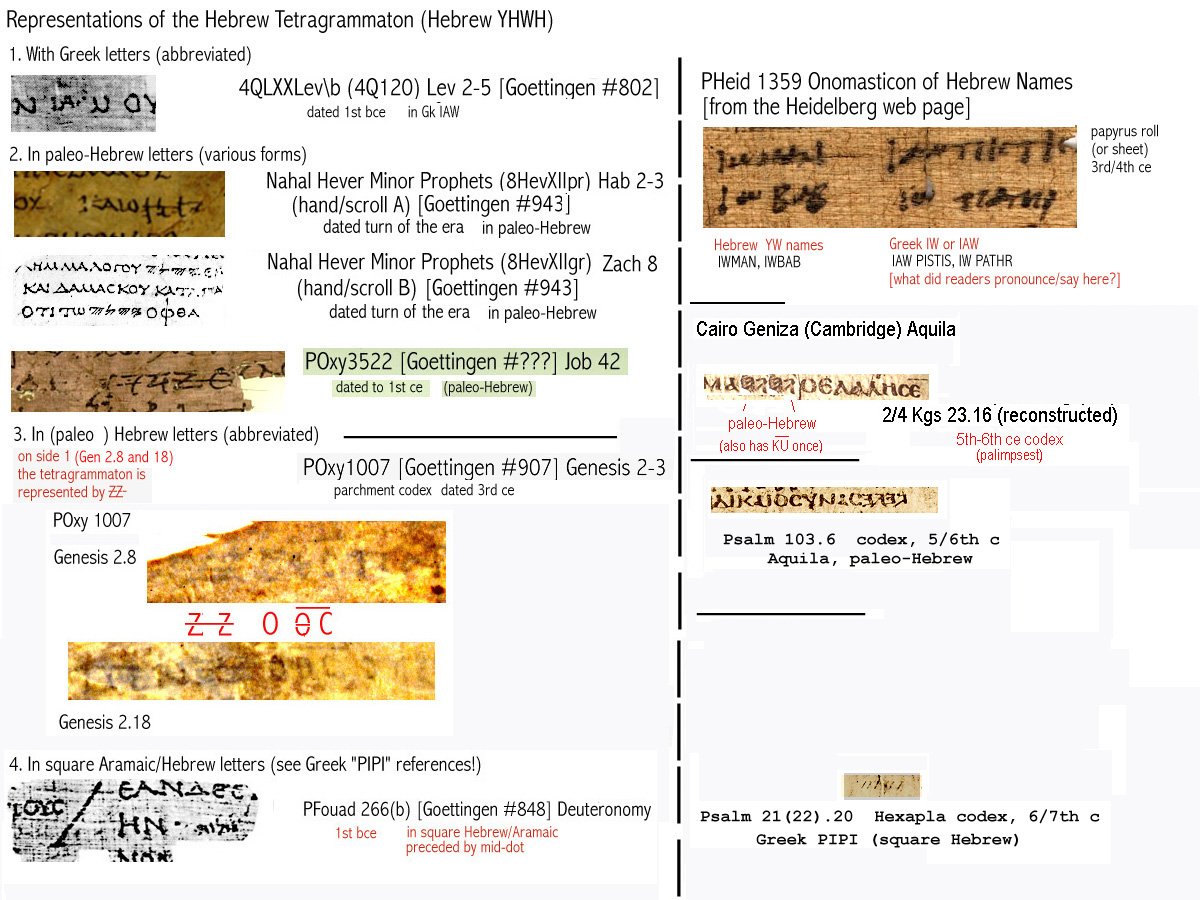
Today when asked about the oldest available evidence for any part of a text from a biblical book, it is not unlikely the response may be, “The Dead Sea Scrolls.” While these Scrolls do contain many ancient treasures, treasures which preserve among other things various forms of the name of the God of Moses in special, but often very recognizable and quite pronounceable forms (unlike what we read in many modern English Bibles such as the NIV, for reasons that are not altogether unknown). But when it comes to the most ancient of all presently known biblical texts, be sure not to forget these tiny silver scrolls or amulets dated to the late 7th/early 6th century BCE, and known variously as the “Ketef Hinnom Scrolls” or “Amulets.”

However, with all otherwise due deference to the site linked above for hosting images of these treasures, the site has also meaningfully hidden the greatest treasure, that is, the treasure within the text itself. While the actual images of these silver scrolls are fine (which is why I use this link to show them), the translation of their preservation of Numbers 6:24-26 (among other texts), three times using “Lord” rather than an actual form of the name used in these texts, is a great mistake in the representation of this God.

Further, at least one other popular site’s translation of these silver scrolls (last accessed on September 15, 2011) uses a form of the divine name (“Yahweh”) which is not at all based on the best available evidence, but which is nonetheless popular and used and misused in place of other, better forms of the name, including the Anglicized forms “Jah,” “Jaho(h),” “Jaho(h)-ah” and even the more popular “Jehovah” (see notes 3 and 6 on pages 2 and 4, respectively, in Chapter 1 of my Jehovah’s Witnesses Defended, Third Edition [available online here]).

The form of the name “Yahweh” is really in large part the product of inaccurate assumptions about the pronunciation and use of the divine name by ancient Jews of various periods, as well as the result of assumptions about the origin of the name itself. In fact, such a pronunciation of the name (“Yahweh”) contradicts nearly all known (certainly the best available) evidence having to do with the history of the pronunciation of the name by both Jews and non-Jews, of similar and different times, and in similar and in different locations. See, again, my Jehovah’s Witnesses Defended, Third Edition, Chapter 1, in particular pages 28-56; see also my more recent, “‘Christian’ Witnesses of Jah, Jaho(h)-ah God,” Watching the Ministry (April 2, 2011).

Christian Witnesses of Jah base pronunciations of the divine name on the best phonetic evidence; we do not assume anything (other than for convenience after already having presented our good reasons/evidence) about the forms of the name; we intend to consider what can be shown through credible means to be the best available evidence. Evidence which for the divine name involves multiple forms throughout history (three in ancient Hebrew/Aramaic alone [namely, YHWH, YHW, and YH]), but all of which can be traced through quite a reasonably accurate extent (better than many if not better than most other, similar ancient names’ histories can be traced) from ancient Semitic and other languages of the ancient world through to the present. That is why we should consider the best available evidence: It is very good and it is available!

I believe the best available evidence, which I have regularly presented (see the links throughout this article and also under “D, Divine Name,” in the Elihu Books Topical Index), supports by far the recently Anglicized form, “Jaho(h)-ah,” as the form which English speakers should use. It provides great utility to the user, allowing anyone to represent the pronunciation of all three of the best English pronunciations in this one form, namely, “Jaho(h)-ah” itself, “Jah,” and “Jaho(h),” the last of which is the least known form/pronunciation of the divine name, yet it is perhaps in line with the best available evidence, as explained most recently in my Addendum, “On the Use of ‘Jah,’ ‘Jaho(h),’ and ‘Jaho(h)-ah’ as Anglicized Pronunciations of the Divine Name,” a little past the middle of my online article, “‘Christian’ Witnesses of Jah, Jaho(h)-ah God.” 

Each of the three forms of the divine name can be seen and pronounced appropriately, in a given language, just from just the use of the one form (in English), “Jaho(h)-ah.” That is why I try most often to use this form of the name, along with the already familiar form, “Jah.”


None of these phonetically based forms of the divine name require any disassociation of any of the verbal ideas otherwise and everywhere associated with the God of Moses in biblical and in any other accurately related histories. Compare R. Laird Harris, who also wrote the divine “Name is explained by the attributes of God revealed in the” Bible (see “The Pronunciation of the Tetragram,” in The Law and the Prophets: Old Testament Studies Prepared in Honor of Oswald Thompson Allis, ed. John H. Skilton [Phillipsburg, New Jersey: Presbyterian and Reformed Publishing, 1974], page 223). An assumed verbal root is not needed for the name that is, in fact, best supported by the available phonetic evidence and which name at all times, also, conveys all of this God’s “revealed” attributes to those who know him. These attributes are those so known or understood in relation to his person and to Jaho(h)-ah’s historical acts, such as those done through Moses and others including, we believe, Jesus of Nazareth. For reliable, historical evidence of the latter’s fulfillment of the role of biblical “Messiah” or “Christ,” see my online article, “Micah 5:1(2): Reliable Prophecy and Real Personal Preexistence,” Watching the Ministry (November 24, 2010).
 

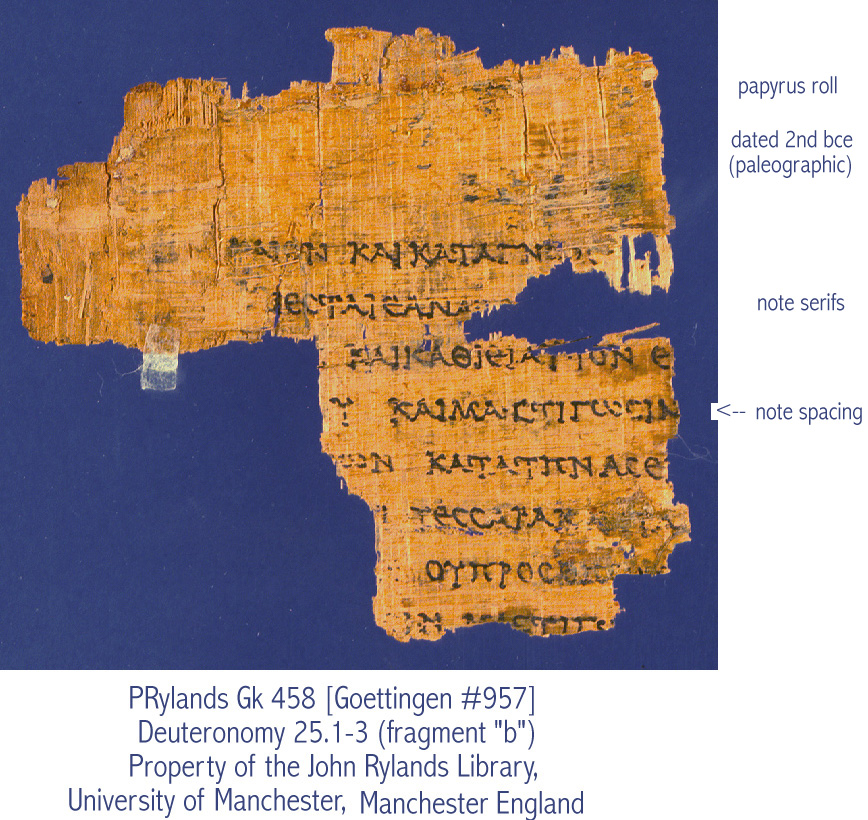
But, remember, when it comes to biblical writings the oldest available text is presently that which is preserved on tiny silver scrolls (or amulets) which are 400-600 years older than the oldest of the Dead Sea Scrolls, namely, several texts which are dated to the 2nd century BCE (examples include 4LXXDeut and PRyl458). Other credible evidence roughly equal or better in age and in quality also exists to support many biblical accounts, including the Nabonidus Cylinder (555-540 BCE), the Moabite Stone (or Mesha Stele) dated to the early 9th century (around 890) BCE, and other documents or findings from the ancient world which more than reasonably verify the history of the ancient people “of the house of David” and the God, theophorically named on these late 7th/early 6th century BCE clay seals, whom they and others have at various times formally worshipped. Still other evidence may further and strongly support various biblical accounts or claims, but some of this evidence is not yet above the level of critical review to use or to accept fully, yet. See, “Oldest Hebrew Text Is Evidence for Bible Stories?” by Mati Milstein in Elah Valley, Israel for National Geographic News (November 3, 2008); and, “4,000-Year-Old Tombs Found Near Jerusalem Mall,” by Mati Milstein for National Geographic News (November 21, 2006).


For more on some of these and other features of biblical history and texts like those found on these tiny silver scrolls or amulets, see the second page of the PDF of the tract, “Beliefs Based on the Best Available Reasons.” See also the listings in the Elihu Books Topical Index under “A, Archaeology: Biblical.” For further, extended discussions of issues related to the history, use, and pronunciation of the name of the God of Moses, see my Jehovah’s Witnesses Defended, Third Edition, Chapter 1 (available online here), along with my more recent online article, “‘Christian’ Witnesses of Jah, Jaho(h)-ah God.”

Tuesday, June 7, 2011

Three Things

In the article, The Intelligence in Life: Intent and Time, Watching the Ministry (February 8, 2010), I wrote:

Christian Witnesses of Jah do not define what we choose to believe by what we assume is true. We define our beliefs based on what we believe we can show or demonstrate is true or most likely true according to the best available reasons.

Once beliefs have been defined according to the best available reasons then, depending on the audience, a person may assume his or her beliefs for the sake of convenience in a discussion.

For this reason, in this article I will not again present the best available reasons for my belief in life (which is here now, and all of which has come from earlier life), nor will I here discuss those good reasons which show scientifically and without contradiction that the origin of life must be some already-living thing or person with intentional intelligence. Instead, here I will assume for the sake of the discussion which is to follow what I have already shown is likely true even according to the very same experiments done by those who have concluded differently from Christians and from others who believe that the Creator of human life is the God of Moses, the God whom (in English) we call, “Jah, Jaho(h)-ah.”

Let me start with the word “Christian,” one who by definition and according to the best available evidence accepts Jesus of Nazareth as the foretold Savior of humanity, the One who came in Jah’s name. Here, too, we base our views on the best available evidence and records for Jesus’ life and teachings and what was foretold would occur with the Messiah or Christ.Exodus 15:2; Deuteronomy 18:18-19; Psalm 2:1-3; 45:17; 115:18; 118:25-26; Isaiah 11:2-3; 12:2; Micah 5:1-4; Luke 24:44; John 5:43; 10:25; 12:13; Acts 4:19-31; 11:20-26; 26:21-28; 1 John 4:14; Revelation 19:1-6; 11-21. 

Our evidence for Jesus as a real historical person includes not only the four familiar New Testament accounts of Jesus’ life, but also non-biblical references to Jesus and to his teachings in the writings of early non-Christians, including:

1. Cornelius Tacitus (55-57 CE to 120 CE), ancient Rome’s greatest historian, wrote about Jesus in The Annals. Here Tacitus refers to “Christians” as those whose name came from Christus (Latin for “Christ”), whom Tacitus writes “suffered the extreme penalty during the reign of Tiberius” by “Pontius Pilate” (15.44). Tacitus’ record here is consistent with the New Testament record in Luke 3:1 and in 23:24-25, 33. Also, we have Pilate's name in the New Testament (Matthew 27:11-14), inscribed in stone from the same time period, and, more recently, on a metal ring found in the area Pilate governed. 

2. Flavius Josephus (CE 37 to 97), famous Jewish historian who was also a Roman citizen. In his Antiquities of the Jews (18.63-64) Josephus refers to a wise man”  called Jesusand that he was thought to be the Christ(emphasis mine). This is the reading of the 10th  century Arabic version and 12th Syriac version, which is nearly the same as Jerome's earlier translation of Josephus (see Alice Whealey, The Testimonium Flavianum in Syriac and Arabic,NTS 54, p. 581). 

Though, as Origen also notes (Against Celsus 1.47; Commentary on Matthew 10.17), Josephus did not believe Jesus was the Messiah, in these texts he nonetheless writes about Jesus being 'condemned by Pilate' (compare Tacitus' report in 1., above). Josephus also here writes about how Jesus' followers believed he "appeared to them three days after" his death. 

3. Flavius Josephus (CE 37 to 97) also wrote a little later in his Antiquities about a certain “James” whom he called “the brother of Jesus the so-called Christ” (Antiquities 20.9). This agrees with the New Testament letter to the “Galatians” (1:19), in which the early Christian known as the apostle Paul described James as “the Lord’s [Jesus’] brother.”

4. Pliny the Younger (c. 61 to 112 CE), a Roman, non-Christian official and adviser to then-Emperor Trajan, wrote a letter (Letters 10.96) to Trajan briefly describing the early Christians and asking the Emperor what he should do about them. See here for Trajan’s response.

5. C. Suetonius Tranquillus (c. 69 to sometime after 122 CE), wrote a work called, "The Lives of the Twelve Caesars." In it he refers to a Jewish 'instigator' whom he calls in Latin, Chrestus. In spite of what some wrongly believe, this is another form of the word Christus or "Christ," used by Tacitus in 1. above. We know this because of what the Latin writer Tertullian (160 to 220 CE) wrote in his Apology (Chapter 3), “Christian, so far as the meaning of the word is concerned, is derived from anointing. … it is wrongly pronounced by you, 'Chrestianus,' (for you do not even know accurately the name you hate)."—Translation by Rev. S. Thelwall (I italicized "Chrest" in "Chrestianus").

In this text Suetonius also writes that, because of the "disturbances" by Jews as the instigation of "Chrestus," then-Emperor Claudius "expelled them from Rome." This is exactly what we read about in the New Testament book of Acts 18:1-3, where the Christian Paul went out of his way to see a Jew named "Aquila," who was one of those Jews ordered out of Rome by Claudius. It is therefore likely this Jew named "Aquila" was also, like Paul, familiar with the one they called "Christ." Claudius, at this early date (41 to 53 CE), would not likely have seen any difference between the Christians and other Jewish sects of that time, so he would have undoubtedly considered them all "Jews."

6. Lucian of Samosata (c. 120 CE to 190 CE), though born in the second century CE, nonetheless provide some value insight about what he knew of the Christians at this time. Lucian was not a Christian. In fact, his writings show he looked down on them and even sought to infiltrate and to take advantage of them. Lucian wrote various dialogues in which he satirizes humanity and the philosophies of his day. In his work The Death of Peregrine (11) Lucian writes about the devotion of “the Christians” to “a man” who “was crucified” because of the “novel rites” introduced by the “crucified” man (Lucian, The Death of Peregrine, 11). Once again we find non-Christians familiar with and repeating to others the same story we find in Tacitus and in Josephus, namely, he was put to death in a torturous manner. 

[December 3, 2018 NOTE: See my "Non-Biblical Evidence for the Historicity of Jesus Christ" for a fuller discussion of the above information.]

We are not looking to myths for support or definition of our beliefs, but we do consider the best available evidence from all sources. This includes both Christian and non-Christian sources and references which compliment the biblical story of Jesus of Nazareth as a heavenly (spirit) being who came to the earth at the direction of the God of Moses, to live among us in the flesh or as a man (John 1:14; Philippians 2:6-9). Christian Witnesses of Jah believe this really did happen in ways supported and defined by the best available evidence. We believe these things were done in order to fulfill actual, still-available, and so also credibly datable pre-Christian prophetic texts. For examples with references to images of some of these pre-Christian texts, see numbers 1. The Law of Moses, 2. The Psalms, and 3. The Prophets in my article, Christian Witnesses of Jah, Jaho(h)-ah God.

Therefore, “Christian Witnesses of Jah” are those who accept, those who believe, and those who where necessary also publicly proclaim the following three things, without controversy or argument with each other, but with plenty of discussion everywhere in order to prove that:

1. Jah, Jaho(h)-ah (in English [other languages may use a form of God's name which is similarly based on the best available reasons]) is the “one,” “only true,” and really living “God.”—Exodus 15:2; Deuteronomy 6:4; Psalm 115:18; Isaiah 12:2; Malachi 2:10; John 8:54; 17:3; 1 Corinthians 8:6; Ephesians 4:6; 1 Timothy 2:5; Revelation 4:10-11; 19:1-6.

2. Jesus of Nazareth is Jahs “firstborn” Son in a heavenly sense. He is a real person who originally lived “with God” as a spirit known as “the Word” and as “Wisdom” in biblical and in related traditions (Proverbs 8:12-36; John 1:1; Revelation 19:13), who then became a man (John 1:14), and who was wrongly put to death (Luke 23:39-41), but to whom God eventually gave life “again” (John 5:26; 6:57; 10:17-18; 1 Corinthians 15:45). Christian Witnesses of Jah believe that what took place in connection with Jesus of Nazareth is part of the fulfillment of the pre-Christian prophecy of Genesis 3:15, which is a prophecy about the end of the cause of death among humankind. We believe what happened in Eden relates directly to Jesus’ death in legal ransom for the “sin” of humanity which Jah permits only for a time, until “the restoration of all things.”—Deuteronomy 32:8; Matthew 5:45; 19:28; 20:28; Mark 10:45; John 1:18; 10:17-18; Acts 17:26; 1 Corinthians Chapter 15; Ephesians 3:14; Philippians 2:6-11; Colossians 1:15-18; 1 Timothy 2:6.

3. Though we are imperfect, Christian Witnesses of Jah are committed to following Jesus’ and his earliest followers’ teaching that we should treat others the way we would also want to be treated.—Matthew 22:35-40; Mark 12:28-34; Luke 10:25-28; Romans 13:8-10; Galatians 5:14; James 2:8.

Apart from these three things, we are all ultimately the same (compare Ecclesiastes 3:17), Christian and non-Christian, in that we are each responsible for the choices we make during our life, though we believe Jah through Jesus will forgive us if we forgive others from our hearts (Matthew 6:14; 18:21-35). This means, too, that we do not view ourselves in comparison with any other person, for example, by thinking we are “better” than anyone else who is, like us, also made in Jah’s image (Genesis 1:27; Matthew 18:4; 23:11; Luke 18:9-14; Galatians 5:26-6:3-7). Rather, by treating others the way we want to be treated we first try to recognize and accept that we are all sinners, but that the best way to avoid sinning further and to receive forgiveness for sins already committed is to keep following (= have faith in) the life and teachings of Jesus of Nazareth, whom we believe will ultimately bring us to Jah.—Matthew 6:12-15; John 5:43; 8:54; 12:12-13; 14:1-6; compare Revelation 3:12, 20-21.

If the choices made by one or more Christian Witness of Jah ever begin to take away from the truth concerning 1., 2., or 3. as presented and defined above and below, then other Christian Witnesses of Jah, if that is who they claim to be/really are, will follow the model for dealing with difficulties given by Jesus of Nazareth (Matthew 18:16-18, 21-35). If any Christian teaches something which we can show is not true according to the best available evidence, then we can approach and even dispute with that person, first privately (if possible) and then if necessary publicly (Matthew 18:16-18; Acts 18:24-28), but always with the intent of ‘gaining’ the person or of reaching a better understanding of what is true, rather than creating occasions for disputing with others over what may be our own or the other person’s burden to carry.—Galatians 2:1-14; 6:1-10.

We do not shun others who simply do not agree with us, but like most everyone else we do not accept or associate ourselves with everyone, or with anything:
On the one hand, he who has faith eats all things, but the one who is weak eats [only] from plants. ... one person considers one day more than another day, while another considers each day the same. Each person must be fully convinced in his own mind. ... Therefore, each of us will give an account for himself to God. So may we no more be judging one another; but, rather, you should make it your goal not to place anything in your brother’s way that might cause him to fall. ... Because the kingdom of God is not food and drink; rather, it is righteousness, peace, and happiness in holy spirit ... The faith which you now have according to yourself, you must also be prepared to show as you stand before God. Happy is the one who does not condemn himself by what he approves.Romans 14:2, 5, 12-13, 17, 22). 
Each one of us must decide and deal with such things, all the while remaining sensitive to others to the extent that is both reasonable and possible in the light of our own unique life and circumstances. Only do not forget the One(s) to whom all the spirits of humankind will eventually return.—Job 34:14-15; Ecclesiastes 12:7; Luke 23:46; Acts 7:59.

Like most everyone else, Christian Witnesses of Jah have standards for our relationships, the primary one of which for us as a group is 3., listed above and below. Yet, apart from these three things each one of us is unique in Jah’s image and so also in many ways in our beliefs and in our personal practices, habits, or occasions for celebration. While we may not all believe or practice the same things, Christian Witnesses of Jah do all agree on these three things:
  1. Belief in “Jah, Jaho(h)-ah,” the God of Moses;
  2. Accept Jesus of Nazareth as the One about whom Moses wrote; and 
  3. Treat others the way we would also want to be treated.
Perhaps an easy way to remember these three things is with the word "BAT," here considered figuratively for what we might pick up and use in life when we face tough challenges that may quickly come our way, like a baseball speeding toward home plate or, worse, toward the batter! Of course, as with life it depends on who is throwing the pitch, and what are his or her intentions when the ball is released. But this is not about a game, only we might use part of a game to help remember the three things we consider most important when it comes to identifying who we are as we go through life alone (compare John 16:32), or with “two or three” or more.—Matthew 18:20.

Finally, here is a helpful "hymn" or song which you can put to your own voice and music, or even add to in ways which further make clear the three things Christian Witnesses of Jah all believe. In the future, those interested will be able to submit their own lyrics or music to the coming Christian Witnesses of Jah web site, to see if it fits with the catalog of songs and music others create to praise Jah:

Jah
The “only true” and
“Most High” God;
We ask for a little and
You give us a lot, Jah;
We Believe in you;
We Accept your Son (the only One);
And,
We’ll Treat our neighbors well,
Just like ourselves,  
Until the day,
When one day,
We’ll all be one
With everyone,
Under the sun and moon,
And stars above,
All who today and in that coming day with me will say,
“Praise Jah!”

While it may not strike the same cord with everyone, the way I sing it makes it come out alright!

Christian Witnesses of Jah promote not only freedom of conscience but also the accompanying individual responsibility for what it is you or I choose to do or to believe while we are on Jah’s earth (Ecclesiastes 12:13-14; Revelation 11:18; compare 1 Peter 2:16). When it comes to how we believe Jah or Jesus may judge others now (John 15:1-7) or later (Matthew 25:31-46), we do not practice or promote any attempt to prematurely or otherwise decide anything for them, nor do we write to excite others concerning ‘the times and/or the seasons’ which are Jah’s to fulfill, for there is no Belief in Jah, no Acceptance of Jesus, and no love in how we Treat our neighbors by means of such things.Luke 10:25-28; John 5:22; 8:49; Acts 1:6-7; Romans 15:7-9; 1 Corinthians 6:20; Galatians 5:18-25; 1 Thessalonians 5:1-2; James 2:8; 1 Peter 2:12; Revelation 4:11; 5:12.

For more information about the beliefs of Christian Witnesses of Jah, see my article, Christian Witnesses of Jah, Jaho(h)-ah God. 

Speakers, Speech Patterns, and God’s “Spirit” in Isaiah with Special Reference to Isaiah 48:16

In the Bible book bearing his name, from the opening chapter to the final one, Isaiah regularly speaks for and as God using first person ref...