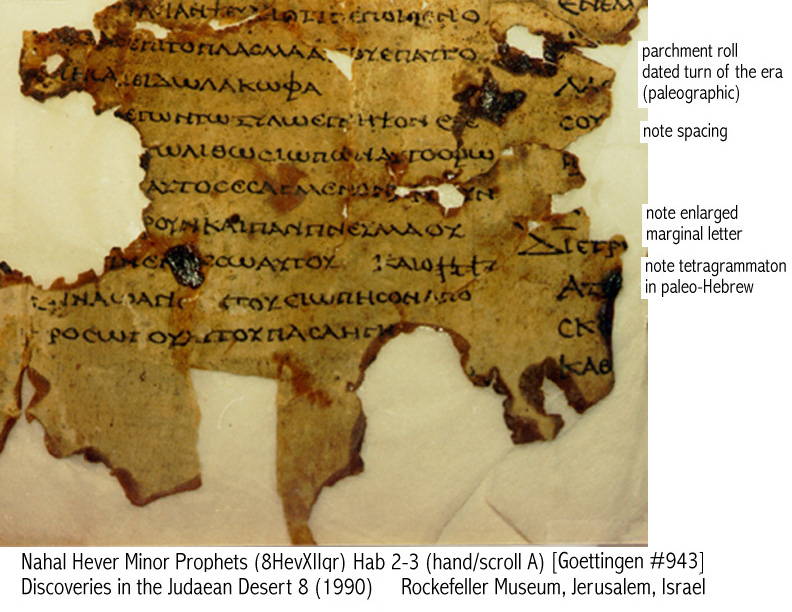
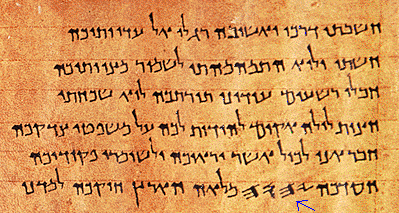
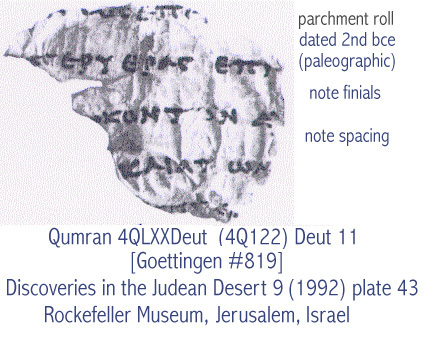
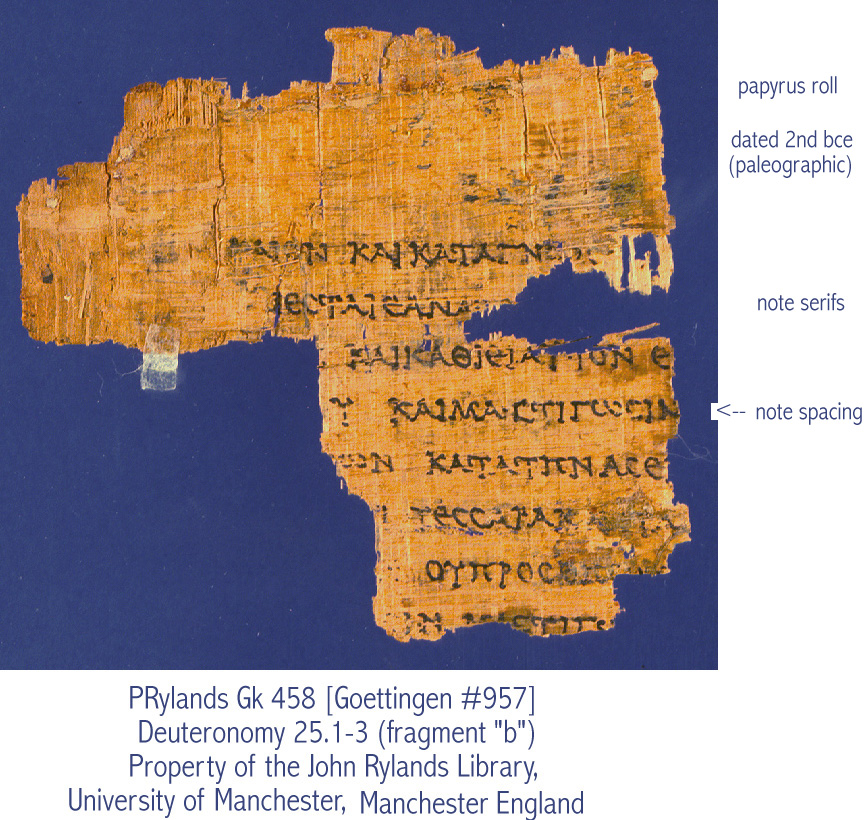
If you have heard anything about "Christian Witnesses of Jah," I am about to tell you a lot more, more as it relates to the meaning of our name, or why we call ourselves, "Christian," "Witnesses of Jah," and why we also use the form of the name, "Jaho(h)-ah" when speaking about the biblical God. Compare the use of these two forms of the divine name in Exodus 15:2; Psalm 45:17; 115:18; Isaiah 12:2; Revelation 19:1-6.
[06/08/2012 Update: See, "Why No 'Y' in Forms of the Divine Name in English," Watching the Ministry (June 3, 2012), for more information on the use of "J" rather than "Y" in English forms of the divine name.]
[07/03/2026 Update: Since the 2022 announcement of the discovery of a curse tablet dated to the 13th century BCE with the divine name as YHW and
related directly to a biblical account involving the Hebrews during the time of
Moses, I believe there is sufficient evidence now to proceed with using only "Jaho(h)" to represent both the three- (YWH) and four-letter forms (YHWH) of the divine name, as this find proves the divine name was not pronounced "Yahweh" or
"Yehowah" (= English "Jehovah"). This is because the name used in the
written curses of Mount Ebal by the Hebrews is YHW, from which it is impossible
to get the pronunciations "Yahweh" or "Yehowah." However, the form YHW on the curse tablet is entirely consistent with the pronunciation of the three- and
four-letter forms of the divine name during the biblical periods, namely, as "YAHO" in Hebrew, "IAO" in Greek, and so today "Jaho(h)"
in English. This is in addition to the two-letter form of the divine name, YH,
or "IA" in Greek," YAH," in Hebrew, and "Jah" in
English. However, because the form "Yehowah" has some support as I have explained in Chapter 1 of my Jehovah's Witnesses Defended editions, and since the form "Jaho(h)-ah" still contains "Jaho(h)," only with the added "-ah" for those who prefer "Yehowah" ("Jehovah"), I am leaving "Jaho(h)-ah" in the title and throughout the article wherever it was originally used. This note is to make clear my current position on the pronunciation of the three- and four-letter forms of God's name. See also the video, "*New* 13th Century BCE Find Shows God’s Name Pronounced as 'Yaho(h)' - NOT 'Yahweh' OR 'Yeh/Jehovah'" (06/20/2023), for more information on this 13th century BCE find and the current use of "Jaho(h)" rather than "Jaho(h)-ah."]
To do this, I am going to take us back, and then forward and back again a few times throughout history, specifically, as it relates to the origin and the understanding associated with the description, "Christian," as well as in discussing the use and the pronunciation of the divine name in biblical and in non-biblical but related texts.
If you are not very familiar with technical material or with multiple references cited regularly in reading paragraphs, please be patient with what follows, and so also with me, as I have tried to add as much supporting material as I believe is practical to give in this article's Blog format to help establish the credibility of the points under discussion. In spite of the supporting references, I have tried my best to keep the following presentation as simple as possible, since if we cannot relate to or understand what is being discussed or written, then it is of little to no use. If you are not interested in the extended discussion of issues provided in the cited references, then you can simply skip them or come back to them later and continue on with the main text here and as presented in the Addendum to this Blog.
However, I am convinced that while familiarity with issues may be a reason for not understanding points of discussion, if anyone chooses to spend the time needed to read through any of what follows and then test the type and the extent of claims made against the best available evidence, then no matter what your present level of education you will learn quickly and fairly easily about anything you choose to understand through patient effort. With this in mind, let us go back in time in the only way truly possible (outside of science fiction, that is), namely, by reviewing what has taken place according to the best available evidence found throughout our rather short, recorded history.
In the first century of our Common Era (CE), there lived a well-known Jewish, Greek philosopher named "Philo," of Alexandria (Greek: Philon [pronounced with a long "o," but which through Latin has become in English "Philo"]). Though I write "Jewish" I do not do so here in the complete sense of the Mosaic tradition held to by all other Jews alive during and prior to Philo's day, and which Mosaic tradition bears witness to a named God. For example, in Exodus 15:2-3 Moses' song reads, in part, "Jah [YH] is my strength and my song ... Jaho(h)-ah [YHWH] is his name." Compare the similar wording, including the use of both the two- and four-letter forms of the biblical God's name (in even closer relation) in Isaiah 12:2, "My strength and my song is Jah [YH], Jaho(h)-ah [YHWH]."
Similarly, by "Greek" I do not mean to suggest that Philo was by any means unrelated to biblical studies. Far from it. However, biblical figures preceding Philo of Alexandria such as Moses, Isaiah, and others regularly, expressly, but respectfully used the name of their God (Deuteronomy 18:18-19; Isaiah 11:1-3; Micah 5:1-3 [see below for a further discussion of each of these texts]). By contrast, the Jewish scholar Philo of Alexandria, in a book titled On the Life of Moses (1.75 [available online here]), gives the following presentation of God's reported conversation with Moses according to Exodus 3:14-15, as translated by David T. Runia in his article, "Philo of Alexandria and the Beginnings of Christian Thought" (with my underlining added):
‘First tell them [i.e. your people] that I am he who is, so that they may learn the distinction between being and non-being, and also be taught that no name at all properly describes me … But if through their natural weakness they seek a title, reveal to them not only this, that I am God, but also that I am the God of the three men whose names express their excellence, God of Abraham and God of Isaac and God of Jacob (Mos. 1.75-76).’ [In The Studia Philonica Annual: Studies in Hellenistic Judaism, vol. 7, David T. Runia, ed. (Atlanta, Georgia: Scholars Press, 1995), pages 143-160 (available online here).]
As I wrote in Chapter 1 of my Third Edition of Jehovah’s Witnesses Defended (page 94) after quoting the above representation of Exodus Chapter 3 from Philo, here words are added to the dialogue between God and Moses which are not actually a part of the biblical account as preserved in actual texts of the account of the Exodus of the ancient Hebrews from Egypt. Further, the words Philo here adds to the text expressly contradict what we otherwise know from biblical literature and, specifically, from the Mosaic traditions concerning the existence, the use, and the pronunciation of God's name.
Once more, Philo of Alexandria adds the words which teach "there is no name at all which properly describes" God (compare the translation of Philo's De Deo 1.4 in Folker Siegert, "The Philonian Fragment De Deo: First English Translation," in The Studia Philonica Annual: Studies in Hellenistic Judaism, vol. 10, David T. Runia, ed. [Atlanta, Georgia: Scholars Press, 1998], page 5; cited in my Third Edition of Jehovah's Witnesses Defended, Chapter 1, page 69, note 118). In so doing, Philo helped establish or further a Judaism which was becoming more and more detached from a named God, in part by changing the meaning of biblical texts such as Exodus 3:15, and then also by not using the name which is, in fact, used not only in Exodus 3:15 but all throughout the writings of Moses.
Once more, Philo of Alexandria adds the words which teach "there is no name at all which properly describes" God (compare the translation of Philo's De Deo 1.4 in Folker Siegert, "The Philonian Fragment De Deo: First English Translation," in The Studia Philonica Annual: Studies in Hellenistic Judaism, vol. 10, David T. Runia, ed. [Atlanta, Georgia: Scholars Press, 1998], page 5; cited in my Third Edition of Jehovah's Witnesses Defended, Chapter 1, page 69, note 118). In so doing, Philo helped establish or further a Judaism which was becoming more and more detached from a named God, in part by changing the meaning of biblical texts such as Exodus 3:15, and then also by not using the name which is, in fact, used not only in Exodus 3:15 but all throughout the writings of Moses.
So we have in Moses and in Philo of Alexandria two ancient forms of Judaism: the Mosaic tradition of naming God in song and to God's praise openly before others (Exodus 15:2-3) and the tradition depicted by Philo of Alexandria, who puts different words in the account in Exodus 3:14-15 so that it comes to teach that 'no name can properly be assigned to God' (On the Life of Moses 1.75 [see also Philo's On the Change of Names 11, 14 (available online here) in which Philo teaches that names are "symbols which indicate created beings"]). I can add a third but later form of Judaism which also "adjusted" the text of the Old Testament in Exodus 3:15 in order to keep God's name hidden, namely, Rabbinic Judaism which according to Samuel S. Cohen:
By a play on the word [le'olam ("throughout antiquity")] ... the Rabbis teach that the divine name must be kept secret. It must not be pronounced in the way in which it is written, but by a substitute word [from "The Name of God, A Study in Rabbinic Theology," HUCA 23.1, Seventy-fifth Anniversary Publication 1875-1950 (1950-1951), page 583 (5); underlining added].
Compare this with the discussion in Ephraim E. Urbach, The Sages: Their Concepts and Beliefs, Israel Abraham, trans. (Cambridge, Mass.: Harvard University Press, 1987), page 133, which reads in relevant part (with my underlining and partial addition of bracketed comments [some are original to Urbach]):
On the one hand, knowledge of the Name was regarded as indicative of a high religious and spiritual degree, and on the other, the dangers involved in the revelation of the Name, and even more so in its use, were recognized. Hence, restraint, which implied a foregoing of privilege, was decided upon. R. Johanan ruled: "the Tetragrammaton may be confided by the Sages to their disciples once in a septennate [a period of seven years].'" When Rava "proposed to expound it at a public lecture, a certain old man [elder] said: it is spelt [Exodus iii 15] lě' allēm [meaning, 'to conceal']." He alluded thereby to the exposition transmitted by Rav Nahman bar Isaac: '"This is my name forever [lě' ōllām, as used in Exodus 3:15]"; but it is spelt [by the Rabbis and the "elder"] lě' allēm ["to conceal"].'This form of Judaism, too, is not consistent with the expressed use of the divine name of Moses' God in his own writings, in the Psalms, and in the Prophets, writings which form the basis of the kind of Judaism which Christian Witnesses of Jah believe was practiced by Jesus of Nazareth. Indeed, according to all existing copies of the biblical book of Exodus in Hebrew or in Greek, God did not say, "There is no name at all which properly describes me." In fact, the Hebrew text of Exodus 3:15 has God saying to Moses, in part: "Now you will say to the sons of Israel, 'Jaho(h)-ah [YHWH] ... has sent me to you. This is my name [Hebrew: zeh-shemiy] throughout antiquity [Hebrew: le'olam], and this is my memorial for generation after generation" (according to my translation of this text in BHS, 4th edition, which is in agreement in relevant part with the Dead Sea Scroll text of Exodus 3:15 in 4QGen-Exoda [4Q1] and 4QExodb [4Q13]).
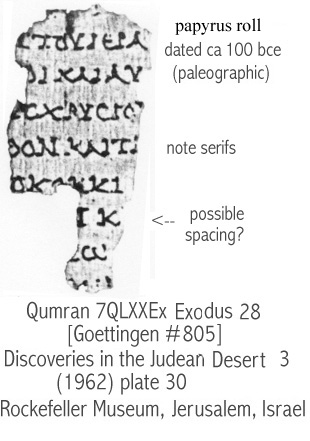
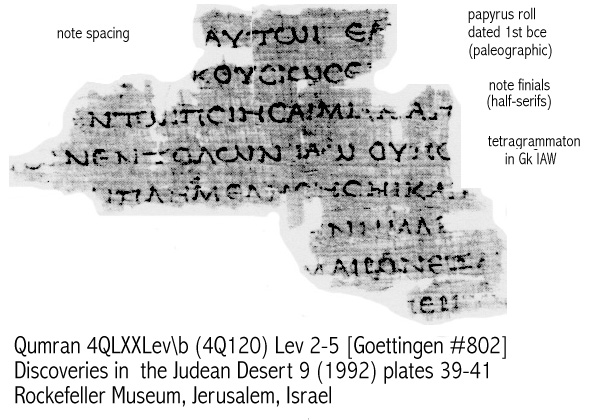
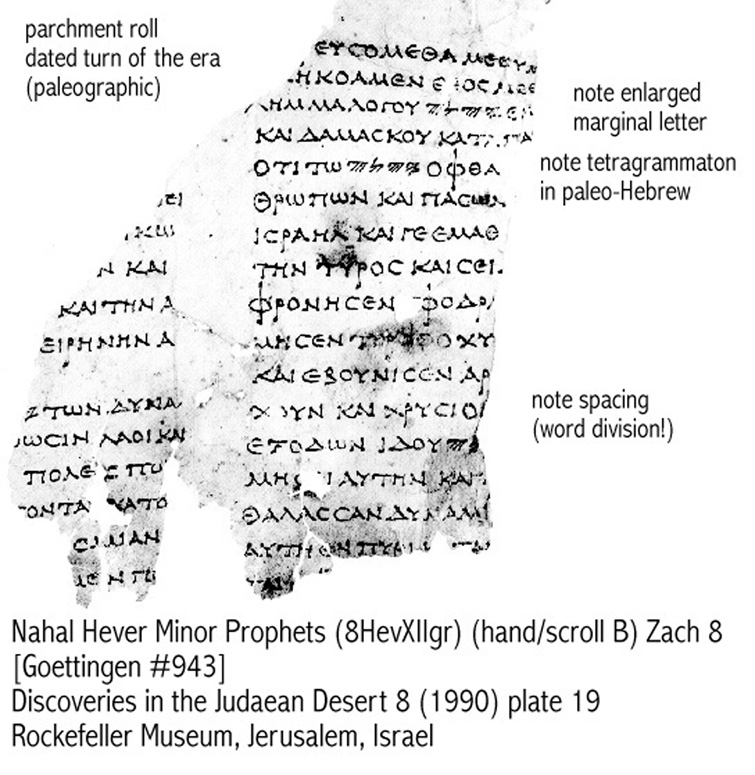
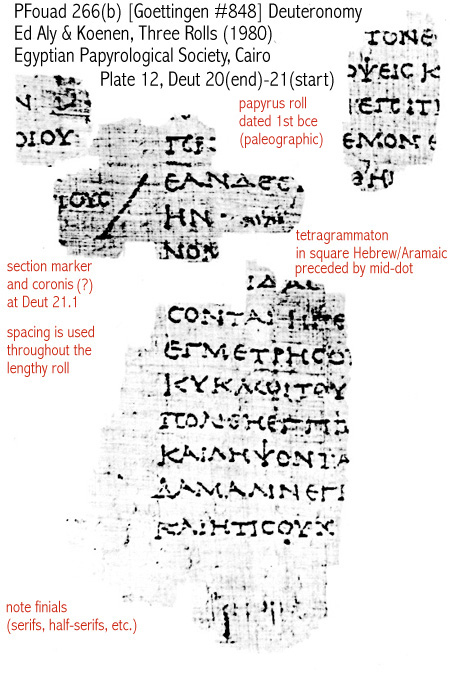
Though we have fragments of a Greek text of the book of Exodus dating as far back as 100 BC (see 7QLXXEx, whose contemporaries at one point early in the first century CE included 4QLevLXXb, 8HevXIIqr [A and B hands], and PFouad266b, all of which use a form of the divine name), the oldest existing Greek texts of the above-translated/underlined Hebrew parts of Exodus 3:15 are the late 4th century CE Codex Vaticanus and the 5th century CE Codex Alexandrinus. These later copies of earlier Greek Old Testament texts contain written 'substitutions' for the divine name in Exodus 3:15, in this case, a "sacred" abbreviation for the Greek word for "Lord." With this in mind, the English translation of Exodus 3:15 according to these Codexes, in relevant part, is as follows (compare with the Hebrew text translated and underlined in the preceding paragraph): "This is what you will say to the sons of Israel, 'Lord [abbreviation for Kyrios] ... he has sent me to you. This is my name [Greek: touto mou estin onoma] for all time [Greek: aionion] and my memorial for generation after generation."
The only meaningful difference between the Hebrew and Greek texts here involves the use of the divine name versus a "substitute" abbreviation for the Greek word for "Lord." Yet, this substitution of the divine name with "Lord" redefines the name of "the God of Abraham, the God of Isaac, and the God of Jacob," a description also used in Exodus 3:15, so that this God's "name" and "memorial" are no longer YHWH, "Jaho(h)-ah," known also as "Jah" by Moses (Exodus 15:2; 17:16), but "Lord." Christian Witnesses of Jah reject the later substitution, or even any early substitution of the actual name of the God of Moses used in Exodus 3:15, so that we continue to embrace the name of that same God according the best possible pronunciation and use of the divine name in our own language. There is nothing to contradict our claim to this tradition in the actual writings of Moses, but only in later, false traditions wrongly associated with his name, including copies of translations of his writings that practice substitution of the one name which is in Moses' writings held up and above all others.
The reading of Exodus 3:15 according to Philo contradicts the actual use of the divine name in Exodus 3:15! Philo's extended reading of Exodus 3:15 suggests Philo's view of the use of "names" or for a "name" of 'the one/Being' is more related to Greek Platonic thinking than it is to any genuinely Mosaic traditions, as I will show further below by additional examples. However, given Philo's connection with Judaism and its teaching concerning the power of God's spirit and prophecy, Philo may also have relied on his own claim to unique revelation through an 'inspired' voice he heard from his "own soul," for as he wrote in his work On the Cherubim 27 (available online here), with my underlining added:
I have also, on one occasion, heard a more ingenious train of reasoning from my own soul, which was accustomed frequently to be seized with a certain divine inspiration, even concerning matters which it could not explain even to itself; which now, if I am able to remember it accurately, I will relate. It told me that in the one living and true God there were two supreme and primary powers--goodness and authority; and that by his goodness he had created every thing, and by his authority he governed all that he had created.
Then there is this admission from Philo in his work On Dreams 2.252 (available online here):
And again, the invisible spirit which is accustomed to converse with me in an unseen manner prompts me with a suggestion, and says, O my friend, you seem to be ignorant of an important and most desirable matter which I will explain to you completely; for I have also in a most seasonable manner explained many other things to you also.
These and other related passages from Philo's writings are discussed in David M. Hay's article, "Philo's View of Himself as an Exegete: Inspired, But Not Authoritative," in The Studia Philonica Annual: Studies in Hellenistic Judaism, vol. 3, David T. Runia, ed. (Atlanta, Georgia: Scholars Press, 1991), pages 40-52. Though Hay (page 48) believes Philo "nowhere seems to put himself forward as [a] commanding personal religious authority such that he is able to determine issues of belief, action, or exegesis" (which, "commanding" aside, is not the case as we see in our subject text from Philo's On the Life of Moses 1.75, 76), Hay (pages 44-45) notes the parallel drawn by M. Pohlenz in which "Philo speaks as though he is inspired by a power akin to Socrates's daimon," that is, an attending spirit or demon.—Compare Plato's Apology of Socrates 40a-b (available online here).
It is not necessary to see all of Philo's deviations from the writings of Moses as resulting from an 'inner voice,' for in this instance involving the naming or non-naming of Moses' God, Philo appears clearly to have borrowed from Greek philosophy, specifically, from the philosophy of Plato. In his work Parmenides there is a discussion which wrongly views "time" as something in which "the one has no participation" (see 141c-e), which view of "time" is not based on the best available reasons (as I have argued elsewhere). Then in Parmenides 142a we read (with my underlining added):
It is not necessary to see all of Philo's deviations from the writings of Moses as resulting from an 'inner voice,' for in this instance involving the naming or non-naming of Moses' God, Philo appears clearly to have borrowed from Greek philosophy, specifically, from the philosophy of Plato. In his work Parmenides there is a discussion which wrongly views "time" as something in which "the one has no participation" (see 141c-e), which view of "time" is not based on the best available reasons (as I have argued elsewhere). Then in Parmenides 142a we read (with my underlining added):
“But can that which does not exist have anything pertaining or belonging to it?” “Of course not.” “Then the one has no name, nor is there any description or knowledge or perception or opinion of it.” “Evidently not.” “And it is neither named nor described nor thought of nor known, nor does any existing thing perceive it.” “Apparently not.”Compare Plato's comments about "the father and maker of all this universe" in Timaeus 28c:
But the father and maker of all this universe is past finding out; and even if we found him, to tell of him to all men would be impossible.Whether Philo of Alexandria was a Platonist or one who was simply so influenced by it that "Platonism remains for Philo a pillar of his thought which, if removed, would cause the whole edifice to totter and perhaps even collapse" (David T. Runia, Philo and the Church Fathers: A Collection of Papers by David T. Runia [Leiden: Brill, 1995], page 14), what Plato wrote and what Philo wrote after him as quoted above about "the one"/"God" not having a name is not rooted in anything in the actual, biblical tradition set forth in Moses' own writings.
In fact, such association with Plato contradicts what is in Moses' own writings open praise for the personal name of the God of Abraham, the God of Isaac, and the God of Jacob, a name which uniquely sets him apart from all other G-gods (Deuteronomy 6:1-14). The tradition of an openly named God being associated with Moses is confirmed by others who are otherwise unrelated to the Jewish biblical tradition. For example, the famous Greek historian Diodorus Siculus (first century BC), in his famous Library of History 1.94.2 (discussed further in the Addendum), wrote about the God "among the Jews" who is "invoked as Iao" (Greek: Iao), which through Anglicization becomes in English, "Jaho" or "Jaho(h)," as I also further explain in the Addendum to this Blog.
Yet, in spite of the clear biblical and related evidence which shows that Moses' God had a special and unique name, many have followed Philo or the "Philonic" tradition preceding, including, and extending beyond him into the church fathers of not naming the biblical God. Instead, a simple look at most English and other modern Bible translations strongly suggests that many who otherwise claim to believe in Moses and in what he taught about God and about the people of Israel follow a practice similar to that of Philo, that is, by using "Lord" in place of what stands for the actual holy name of Moses' God, even going so far as to expressly change the meaning of names by changing the elements of names and the resulting definition of names which contain a form of the divine name.
Let me here provide just such an example of this practice early in the Philonic tradition (in Philo himself) and then later in the church theologian Eusebius of Caeserea, by comparison with another early Jewish-Christian work of the 3rd/4th century, and which contains a list of names and their corresponding meanings. As we proceed forward, keep in mind that the Hebrew name Yehoshua' ("Joshua") combines the divine name Yeho and a form of the Hebrew noun yeshuah (note: final heh), which means "salvation." With the verb "is" understood in relation to these two elements, the resulting meaning in English is, "Jaho(h)-ah is salvation." In later biblical and other usage, the name Yehoshua' is shortened to the name Yeshua' (note: similar in sound but different in form from yeshuah), as is well explained with references by Werner Foerster (Theological Dictionary of the New Testament [TDNT] 3 [1965], page 284):
Joshua the son of Nun is [Yehoshua'] in Ex., Nu., Dt., Jos., Ju., 1 K. 16:34, 1 Ch. 7:27 and the Heb. of Sir. 46:1, but [Yeshua'] in Neh. 8:17. The high-priest Joshua, the son of Josedech, who returned with Zerubbabel from exile, is always called [Yehoshua'] in Hag. and Zech. and always [Yeshua'] in Ezr. and Neh. [Yehoshua'] is the name of two men in 1 S. 6:14, 18; 2 K. 23:8, while 2 Ch. 31:15 calls a Levite under Hezekiah [Yeshua'], and this form of the name is also found in post-exilic priestly and Levitical families and in the references to their return from exile under Zerubbabel and Joshua. The full form thus prevails up to c. 500, and after that (up to 1 Ch. 7:27 and Sir. 46:1) the shorter.Foerster goes on to note that the transliteration used by the Greek LXX translation of the Hebrew Old Testament adopts the shorter form Yeshua' in its use of the Greek Iesous, though the final aspirant is lost for reasons having to do with differences between Hebrew and Greek sounds (but see Foerster, "Iesous," page 287, note 29, who cites the use of a final Greek "a" in Aquila's second century CE Greek translation of Deuteronomy 1:38, namely, Iesoua [see the Addendum to this Blog for more on the use of final aspiration in Greek names]). So this is how we came to have the Greek name Iesous (and so also, ultimately, "Jesus") for Jewish figures such as Joshua, the son of Nun, and for Jesus of Nazareth, son of Joseph, son of David.—Joshua 1:1; Matthew 1:1-17; Luke 3:23, 31.
Now consider the following comparison of two definitions of the Greek name Iesous, first from Philo of Alexandria as found in his On the Change of Names (21.121-122 [an English translation of which is available online here]), and then from the definition given to Iesous in a 3rd/4th century CE Greek Jewish-Christian papyrus containing parts of what is known as an "onomasticon" (see my Third Edition of Jehovah's Witnesses Defended, pages 41-2, note 64), an early literary tool which was meant to help educate people who were not familiar with certain words or with their meanings:
Definition of the Greek Name Iesous ("Jesus")
by Philo of Alexandria (1st Century CE)
Transliteration of Greek into English: IĒSOUS SŌTĒRIA KURIOU
Translation into English: Jesus [means], "Salvation of the Lord"
by Philo of Alexandria (1st Century CE)
Transliteration of Greek into English: IĒSOUS SŌTĒRIA KURIOU
Translation into English: Jesus [means], "Salvation of the Lord"
Definition of the Greek Name Iesous ("Jesus")
in a Jewish-Christian Literary Tool (3rd/4th Century CE "Onomasticon")
in a Jewish-Christian Literary Tool (3rd/4th Century CE "Onomasticon")
Transliteration of Greek into English: IĒSOUS IŌ SŌTĒRIA
Translation into English: Jesus [means], "Jo(h) [related to 'Jao(h)'] is salvation"
As Foerster (page 289) rightly observes in connection with these two definitions of the same name, "Philo's explanation, while not wholly accurate, recognizes the two parts," but, "More exact is the interpretation in [the] pap. of the 3rd to 4th century A.D.: [IĒSOUS IŌ SŌTĒRIA]," also quoted above.
An image of the above quoted papyrus can be seen on the page opposite of page 405 in Adolf Deissmann's Light from the Ancient East, Lionel R.M. Strachan, trans. (Grand Rapids: Baker, 1978), with the text and with a transliteration of its contents on pages 405-406, both showing the longer Greek form of the divine name Iao used frequently as part of the meaning of other proper names, just like Io, both of which are recognized forms of the divine name of the biblical God (additional references showing the use of these forms are provided below and in the Addendum).
As a further example, consider the Anglicized "Judah" which in Greek is Ioudas and which the earlier-quoted "onomasticon" defines as, Iao + exomologesis (the latter of which is partially restored by Deissmann), which means something like, "Jaho(h) [is] praise!" This is very similar in meaning to the understanding associated with same name in its first occurrence in Genesis 29:35. Yet, all copies of the Greek LXX translation of Genesis 29:35 we have available today (which for this verse date to a time after the first century CE) follow in the tradition of Philo of Alexandria by defining the name "Judah"/Ioudas with a future form of the verb exomologeomai (and so, "I will praise!" which is related to the noun exomologesis used in the 3rd/4th century onomasticon) and a form of the Greek noun Kyrios, which means "Lord"!
Here is a comparison of the two definitions of the name "Judah" as given first in the onomasticon and then in later copies of the Greek LXX, both transliterated and then translated into English as follows:
Definition of the Greek Name Ioudas ("Judah")
In a Jewish-Christian Literary Tool (3rd/4th Century CE "Onomasticon")
In a Jewish-Christian Literary Tool (3rd/4th Century CE "Onomasticon")
Iouda[s] = Iao + exo[mo]logesis (a noun) means, "Jaho(h) [is] praise!"
Definition of the Greek Name Ioudas ("Judah")
According to Post-First Century CE Greek LXX Texts of Genesis 29:35
Ioudas = Exomologesomai (a verb) + Kyrio, meaning, "I will praise [the] Lord!"
In this case the primary Greek LXX texts of Genesis 29:35 use a form of the Greek word for "Lord" and in so doing change the theophoric element/name Iao to a new word (Kyrios, "Lord") which changes the original meaning of the name "Judah" from a name which associated "praise" with the named God "Jaho(h)" to a name which through re-definition associated "praise" with the "Lord." By contrast, the above-cited 3rd/4th onomasticon corresponds to the Hebrew text of Genesis 29:35, which also uses the actual divine name of God in association with the "praise," which is then made part of the meaning of the name "Judah," not "Lord," such as we find in post-first-century CE Greek LXX texts of Genesis 29:35. For a further discussion of the earlier-cited "onomasticon" and others which contain biblical names, see my Chapter 1 of my Third Edition of Jehovah's Witnesses Defended, note 64, on pages 41-42.
For further information about the use of the form of the divine name which is in Hebrew the two letters yod waw [YW]) and in Greek Io (with an iota and an omega or long "o" sound), as used in the 3rd/4th century CE above onomasticon's definition of Iesous, see the listing of [I]ŌSEPH and its meaning Iao + prosthemia ("addition") on page 406 of Deissmann's Light from the Ancient East. For more on the Semitic background of the form of the divine name, YŌ, see the table of "Names beginning with yw" on page 210 of A.R. Millard's article, "YW and YHW Names," VT 30.2 (1980), and the chronological table and discussion on page 19 of S.R. Driver's "The original form of the name 'Yahweh': evidence and conclusions," ZAW 46 (1928). See also Stig Norin, "YW-Names and YHW-Names: A Reply to A.R. Millard," VT 30.2 (1980), pages 239-240, the discussion in Freedman-O'Connor, "YHWH," Theological Dictionary of the Old Testament [TDOT] 5 (1986), pages 507-508, as well as my Third Edition of Jehovah's Witnesses Defended, note 37 on pages 28-29, note 39 on pages 29-30, and note 55 on pages 36-37.
Returning to the original and also to the eventual meanings of the name "Jesus," the earlier illustrated difference in meaning between the definitions given in Philo of Alexandria and in a 3rd/4th century CE "dictionary" of names, first in component parts and then also in the understood meaning of the name's component parts, the change in meaning becomes even more evident in the late 3rd/early 4th century theologian and church writer Eusebius of Caesarea. Consider now, what Eusebius wrote during about the same time the earlier quoted onomasticon with the divine names Io and Iao in it was written:
For, indeed, "ISOUA" [a transliteration by Eusebius of the Hebrew noun yeshuah] among the Hebrews means, "salvation," but they pronounce "IESOUS" as IŌSOUE. But "IŌSOUE" means, "IAŌ [is] salvation"; this means, "God [is] salvation." [Eusebius of Caesarea, Demonstratio Evangelica, 4.17.23; translated here from the Greek text as presented in Foerster in TDNT 3, pages 289-290 (another English version of which, but with numerous errors including "Jab" for "Iao," is available online here)].
Clearly, this shows a continuation of the substitution of the divine name for titles such as "God," even when the divine name is still used as an element in the proper name only to be removed from the definition by individuals such as Eusebius, because he chose to redefine "Iao" with "God" as part of the meaning of the name "Iesous." This is precisely what was accepted and promoted through the redefinition of divine-name-containing names in later copies of the Greek LXX, copies dating from the 4th to the 5th century CE which replace God's name with "Lord" when explaining the meaning of names such as "Judah" (see the discussion above concerning this name as found in later but some of our best available LXX Codexes of Genesis 29:35, and as defined in the subject 3rd/4th century CE onomasticon). Unfortunately, it also fits with Philonism as found in Philo's writings both as discussed earlier and as Philo wrote in his work On the Change of Names 14 (available online here), namely, "[N]o proper name could with propriety be assigned to him who is in truth the living God," and "even those powers which minister unto him do not announce his proper name to us," which Philo bases on what is not even a request for God's name in the response by the angel to Jacob's question according to Genesis 32:29.
Where it concerns the regular use and pronunciation of God's name, the results should be clear to anyone who actually makes such a comparison between the writings and teachings of Moses and the writings and teachings of Philo or which belong to the Philonic tradition. As for why so many post-first century CE theologians chose not to follow the true Mosaic tradition according to the best available texts of Moses' writings, in addition to the preceding and my discussion of the same subject elsewhere, note carefully the words in Runia's analysis here:
Similarly, before Paul’s testimony here in the book of Acts, Jesus is said to have shown his first followers "that everything [Greek: panta] written about [Jesus] in the law of Moses, the prophets, and the psalms must be fulfilled" (Luke 24:44). Now consider some of the things which "the law of Moses," "the psalms," and "the prophets" said would "take place" in connection with a foretold "prophet" and promised "Leader," the "Messiah" (with my underlining added):
What I want to emphasize is that Christianity could not have become the Christianity that we know, if it had not accepted the challenge posed by Greek philosophy with its trust in a world-view based on rational thought. ... The process of Hellenization took place, but it did not penetrate to Christianity's heart. This heart is to be located in the [best recorded] Gospel [histories]. ... Why then did Platonism win out? ... A comparison with the beginnings of Islamic thought is in this respect highly instructive. The first Arabic philosophers, the Asharitic school of the Mutakallimun [a mid-10th century CE Muslim group who in contrast to many church fathers] chose not to follow the path of Plato and Aristotle, but opted for a philosophy which combined a rigorous conception of divine omnipotence with a purely atomistic theory of the natural world. The church fathers could have gone in different directions, but preferred to follow the Platonist path which Philonism had opened up for them. [David T. Runia, Philo & the Church Fathers: A Collection of Papers by David T. Runia (Leiden: Brill, 1995), pages 16, 17; underlining and bracketed words added.]The "path" which the "church fathers" chose to follow was one which had already begun to eliminate from use the name of the God of Moses. Christian Witnesses of Jah, Jaho(h)-ah God do not follow in the tradition of Philo, or "Philonism" which includes and precedes him, or that of the post-first-century CE church fathers. We recognize their contribution to history, positive and negative, helpful and harmful, then as with anything else we can learn from it and use what is provided to help establish the better part of, in our case, the real or more accurate history of earliest Christian traditions, traditions which according to the earliest Christian texts have nothing expressly to do with Plato, with Philo, or with their traditions. Rather, Christian tradition is first of all a fulfillment of what was written in the Law and writings of "Moses," in "the Psalms," and in "Prophets" whose writings can be put to the test, not merely accepted apart from the best available reasons. Let me further explain exactly what I mean by this.
In the biblical book of Acts 11:20-26 we read about how after a group of Jesus' first century CE followers, including the apostles Paul and Barnabas, taught openly in ancient Antioch (located in what is now modern-day Turkey) many became believers in what took place in connection with Jesus before and since he died. In fact, it was here "in Antioch that the disciples were first called Christians" after bearing witness to Jesus in this area for an entire year (Acts 11:26). Later in Acts Chapters 25 and 26, Paul was brought before "King Agrippa" because of charges by his fellow Jews, those who became opponents to Paul's Christian ministry. However, those who were "bringing many and serious charges against" Paul "could not prove" what they were claiming.—Acts 26:7.
Therefore, before his accusers Paul spoke to King Agrippa with these words (with my underlining):
Acts 26:21-28 (New Revised Standard Version [NRSV], 1989)
(21)"For this reason the Jews seized me [Paul] in the temple and tried to kill me.
(22) To this day I have had help from God, and so I stand here, testifying to both small and great, saying nothing but what the prophets and Moses said would take place:
(23) that the Messiah must suffer, and that, by being the first to rise from the dead, he would proclaim light both to our people and to the Gentiles."
(24) While he was making this defense, Festus exclaimed, "You are out of your mind, Paul! Too much learning is driving you insane!"
(25) But Paul said, "I am not out of my mind, most excellent Festus, but I am speaking the sober truth.
(26) Indeed the king knows about these things, and to him I speak freely; for I am certain that none of these things has escaped his notice, for this was not done in a corner.
(27) King Agrippa, do you believe the prophets? I know that you believe."
(28) Agrippa said to Paul, "Are you so quickly persuading me to become a Christian?"
The above conversation plainly reveals the basis upon which the earliest Christians and others were persuaded or convinced, namely, by what was foretold to occur in the ancient Jewish books of "the prophets and Moses" (Acts 26:22 [Greek: hoi prophetai ... kai Mouses]). Further, here it was offered openly to present evidence which could be tested as it had to do directly with what was known to have taken place in connection with Jesus of Nazareth, since what had happened was "not done in a corner."
This is why Paul appealed to the best available evidence, believing as he did that because of the openness of the events which had taken place that nothing had "escaped [the king's] notice." At least this is Paul's argument according to Acts 26:21-28, so much so that Paul 'testified' or bore witness before the king and before others on that day about things "both small and great," but "saying nothing but what the prophets and Moses said would take place."—Acts 26:22.
This is why Paul appealed to the best available evidence, believing as he did that because of the openness of the events which had taken place that nothing had "escaped [the king's] notice." At least this is Paul's argument according to Acts 26:21-28, so much so that Paul 'testified' or bore witness before the king and before others on that day about things "both small and great," but "saying nothing but what the prophets and Moses said would take place."—Acts 26:22.
Similarly, before Paul’s testimony here in the book of Acts, Jesus is said to have shown his first followers "that everything [Greek: panta] written about [Jesus] in the law of Moses, the prophets, and the psalms must be fulfilled" (Luke 24:44). Now consider some of the things which "the law of Moses," "the psalms," and "the prophets" said would "take place" in connection with a foretold "prophet" and promised "Leader," the "Messiah" (with my underlining added):
"The Law of Moses"
Deuteronomy 18:18-19 (New American Standard Bible [NASB], 1995)
(18) 'I will raise up a prophet from among their countrymen like you, and I will put My words in his mouth, and he shall speak to them all that I command him.
(19) 'It shall come about that whoever will not listen to My words which he shall speak in My name, I Myself will require it of him.
"The Psalms"
Psalm 2:1-3 (NRSV) and Psalm 45:17 (NRSV)
(1) Why do the nations conspire, and the peoples plot in vain?
(2) The kings of the earth set themselves, and the rulers take counsel together, against the LORD [YHWH] and his anointed, saying,
(3) "Let us burst their bonds as under, and cast their cords from us." ...
(17) I will cause your name to be celebrated in all generations; therefore, the peoples will praise you forever and ever.
"The Prophets"
Isaiah 11:2-3 (Jewish Publication Society [JPS], 1917)
Micah 5:4 (New International Version [NIV], 1984)
Micah 5:4 (New International Version [NIV], 1984)
(2) And the spirit of the LORD [YHWH, "Jaho(h)-ah"] shall rest upon him, the spirit of wisdom and understanding, the spirit of counsel and might, the spirit of knowledge and of the fear of the LORD [YHWH, "Jaho(h)-ah"].
(3)And his delight shall be in the fear of the LORD [YHWH, "Jaho(h)-ah"]; and he shall not judge after the sight of his eyes, neither decide after the hearing of his ears;
(4) He will stand and shepherd his flock in the strength of the LORD [YHWH, "Jaho(h)-ah"], in the majesty of the name of the LORD [YHWH, "Jaho(h)-ah"] his God. And they will live securely, for then his greatness will reach to the ends of the earth.
Though not one of the above quoted English translations reveals the name of the God of the foretold Messiah, it actually occurs twice in Micah 5:4 and three times in the above selection from Isaiah 11:2-3 (in Deuteronomy 18:18-19 Jah is the speaker, and so his name is assumed throughout as he speaks, with his name occurring nearly 20 times in the rest of Chapter 18 alone). Before returning to this issue concerning the use and significance of the divine name in relation to the fulfillment of pre-Christian prophecies involving the divine name by Jesus of Nazareth, let us look again at the above cited texts from "the Law of Moses," from "the psalms," and from "the prophets" in the light of 1) the actual pre-Christian textual evidence for the cited texts and 2) in the light of New Testament texts from the best historical records of Jesus' life and teachings.
1. "The Law of Moses"
a.Texts and Summary: Deuteronomy 18:18-19 - He will have Jah's/Jaho(h)-ah's 'words put into his mouth,' so that he will 'speak' Jah's words in Jaho(h)-ah's "name."
a.Texts and Summary: Deuteronomy 18:18-19 - He will have Jah's/Jaho(h)-ah's 'words put into his mouth,' so that he will 'speak' Jah's words in Jaho(h)-ah's "name."
b. Pre-Christian Text Evidence: 4QDeutf = 4Q33, fragments 10-12, dated to the 2nd/1st century BC.
c. New Testament Fulfillment(s): All of the following translations are from the NASB (1995), with my underlining added.
John 5:43 (Jesus said): "I have come in My Father's name, and you do not receive Me; if another comes in his own name, you will receive him";The Old Testament quotation in John 12:13 is from none other than Psalm 118:25-26, which in the Hebrew text uses the divine name four (4) times in these two verses alone, as well as throughout this chapter of the Psalms, including the use of the form for "Jah" six (6) times (twice in verse 5, once in verse 14, once in verse 17, once in verse 18, once in verse 19). There is no pre-Christian text of Deuteronomy 18 or of Psalm 118:25-26 which foretell a Messiah who would come "in the name of the LORD." The pre-Christian texts of these prophecies support only the belief in one who actually did or who still may come in the name of the God of Moses, and in the name of the God of the Psalms.
John 10:25: "Jesus answered them, 'I told you, and you do not believe; the works that I do in My Father's name, these testify of Me'";
John 12:12-13 (Jesus said): "On the next day the large crowd who had come to the feast, when they heard that Jesus was coming to Jerusalem, took the branches of the palm trees and went out to meet Him, and began to shout, 'Hosanna! BLESSED IS HE WHO COMES IN THE NAME OF THE LORD, even the King of Israel.'"
2. "The Psalms"
a. Texts and Summary: Psalm 2:1-3; 45:17 - In addition to texts such as Psalm 118:25-26 and John 12:13 (discussed briefly above, but also further in relation to their supporting evidence after 3., below), the Psalms speak of "nations," including its "kings" and "rulers," who would "conspire" and "plot" against "Jaho(h)-ah and his anointed one." But the "anointed one," the one who was foretold to be "anointed more than his partners" (kings) who preceded him on Jah's throne (Psalm 45:6-7; compare Hebrews 1:8-9), is said to "cause your [= Jaho(h)-ah's] name to be celebrated in all generations," meaning as is thereafter clearly expressed further in Psalm 45:17, "the peoples will praise you [= Jaho(h)-ah] forever and ever."
a. Texts and Summary: Psalm 2:1-3; 45:17 - In addition to texts such as Psalm 118:25-26 and John 12:13 (discussed briefly above, but also further in relation to their supporting evidence after 3., below), the Psalms speak of "nations," including its "kings" and "rulers," who would "conspire" and "plot" against "Jaho(h)-ah and his anointed one." But the "anointed one," the one who was foretold to be "anointed more than his partners" (kings) who preceded him on Jah's throne (Psalm 45:6-7; compare Hebrews 1:8-9), is said to "cause your [= Jaho(h)-ah's] name to be celebrated in all generations," meaning as is thereafter clearly expressed further in Psalm 45:17, "the peoples will praise you [= Jaho(h)-ah] forever and ever."
b. Pre-Christian Text Evidence: 11Q7 = 11QPsc, fragments 1-2, dated to around the 1st century BC.
c. New Testament Fulfillment(s): Acts 4:19-31, for the fulfillment of Psalm 2:1-3, showing that it was against Jesus and against Jaho(h)-ah that the "nations," "kings," and "rulers" 'plotted', not some nameless God or a God named "Lord" which, though a fitting title, is not what was foretold would take place according to the pre-Christian text and prophecy of this Psalm. Revelation 19:1-6 and 11-21 for the continuation and fulfillment of Psalm 2 in which Jaho(h)-ah praised as "Jah" four (4) times in verses 1-6 followed by the acting out of the events foretold in Psalm 2 in Revelation 19:11-21, which describe the final battle between Jah and his "anointed one" and the "nations." These are the events by which, ultimately, Jah's "name" will be "celebrated in all generations," because "the peoples will praise [him] forever and ever."—Psalms 45:17.
3. "The Prophets"
a. Texts and Summary: Isaiah 11:2-3; Micah 5:1-3 - The "spirit of Jaho(h)-ah" will come to "rest upon him," including a spirit of "fear of Jaho(h)-ah," for "his delight shall be in the fear of Jaho(h)-ah." He will "stand and shepherd with Jaho(h)-ah's strength, in the majesty of the name of Jaho(h)-ah, his God."
3. "The Prophets"
a. Texts and Summary: Isaiah 11:2-3; Micah 5:1-3 - The "spirit of Jaho(h)-ah" will come to "rest upon him," including a spirit of "fear of Jaho(h)-ah," for "his delight shall be in the fear of Jaho(h)-ah." He will "stand and shepherd with Jaho(h)-ah's strength, in the majesty of the name of Jaho(h)-ah, his God."
b. Pre-Christian Text Evidence: Isaiah - 1QIsaa, column 10, dated to the late 4th to the late 2nd century BC; Micah - 4QXIIf = 4Q81, fragment 5, dated to the middle to late first century BC, and 8HevXIIgr. (see DJD 8, pages 40-41, plate VI, col. 8), dated to the late 1st century BC or early 1st century CE (example of Hand A and Hand B).
c. New Testament Fulfillment(s): All of the following translations are from the English Standard Version (ESV [2001]), with my underlining added:
Matthew 3:16: And when Jesus was baptized, immediately he went up from the water, and behold, the heavens were opened to him, and he saw the Spirit of God descending like a dove and coming to rest on him;
Luke 12:4-5 (Jesus said): "I tell you, my friends, do not fear those who kill the body, and after that have nothing more that they can do. But I will warn you whom to fear: fear him who, after he has killed, has authority to cast into hell [which has become a much misused word for what is in Greek: ge'enna]. Yes, I tell you, fear him!
Hebrews 5:7: In the days of his flesh, Jesus offered up prayers and supplications, with loud cries and tears, to him who was able to save him from death, and he was heard because of his reverence" ("reverence" = the Greek word eulabeia, which is used for "reverent awe in the presence of God" [BDAG, page 407]; compare the use of the same word in Hebrews 12:28).
John 6:38 (Jesus said): For I have come down from heaven, not to do my own will but the will of him who sent me.
John 7:15-17: The Jews therefore marveled, saying, "How is it that this man has learning, when he has never studied?" So Jesus answered them, "My teaching is not mine, but his who sent me. If anyone's will is to do God's will, he will know whether the teaching is from God or whether I am speaking on my own authority.
John 8:28 (Jesus said): "I do nothing on my own authority, but [I] speak just as the Father taught me."
John 8:38 (Jesus said): "I speak of what I have seen with my Father."
John 8:40 (Jesus said): "[I] told you the truth that I heard from God."
John 8:42 (Jesus said): "I came from God and I am here. I came not of my own accord, but he sent me."
John 8:55 (Jesus said): "I keep [my Father's] word."
John 12:49-50 (Jesus said): "For I have not spoken on my own authority, but the Father who sent me has himself given me a commandment--what to say and what to speak. And I know that his commandment is eternal life. What I say, therefore, I say as the Father has told me."
John 14:10 (Jesus said): "The words that I say to you I do not speak on my own authority, but the Father who dwells in me does his works."
John 14:24 (Jesus said): "[T]he word that you hear is not mine but the Father's who sent me."
John 14:31 (Jesus said): "I do as the Father has commanded me."
John 17:4 (Jesus said): "I glorified you on earth, having accomplished the work that you gave me to do."
See also the citations of John 5:43, 10:25, and 12:12-13, under 1.,c., above, which also have to do expressly with the fulfillment of Micah 5:3 where it concerns Jesus' actions done "in the majesty of the name of Jaho(h)-ah, his God." Christian Witnesses of Jah, Jaho(h)-ah God, contend that it is impossible to proclaim Jesus of Nazareth as the fulfillment of these texts without also accepting his use of the divine name, the "name" in which he "came" in fulfillment of Deuteronomy 18 and Micah 5. Christian Witnesses of Jah, Jaho(h)-ah God believe it is impossible to teach Jesus of Nazareth as the fulfillment of the above cited, pre-Christian texts and to at the same time fail to recognize that the "nations," "kings," and "rulers" who stood against Jesus also stood against Jaho(h)-ah God, as foretold in Psalm 2.
Christian Witnesses of Jah believe Jesus 'came' in Jaho(h)-ah's name in fulfillment of these and other texts. For example, we believe that on the basis of the best available text of Psalm 118:25-26 that its use in John 12:12-13 should also contain the divine name. Otherwise, there remains a legitimate question as to whether Jesus of Nazareth actually fulfilled pre-Christian prophetic texts. Indeed, according to the Hebrew text of Psalm 118:25-26, the earliest text of which is found in the Great Psalm Scroll (11QPsa [an image of which can be seen here]) which is dated to 30 to 50 CE (see Martin Abegg, Jr., Peter Flint, and Eugene Ulrich [New York: HarperCollins, 1999], page 545), the name of Moses' God is used in a distinctly older Hebrew script all throughout this scroll (see the Addendum to this Blog for more on the use of this script and other forms of the divine name used in or in relation to biblical texts).
The existence of this scroll alone shows that anyone quoting from it or from a similar copy (and then from memory) upon Jesus' arrival in Jerusalem according to John 12:12-13 would have used God's name, unless he or she chose not to use it. The fact that later copies of this account as represented in the texts of P66 (late second century CE) and P75 (3rd century CE) use an abbreviation for "Lord" as a substitute for the divine name in which Jesus was to have come does not require that anyone reject the good reasons provided by the source material represented by 11QPsa, that is, when it comes to presenting the best argument for the pre-Christian belief in a Messiah who came or who would come in the name of the God of Moses.
The existence of this scroll alone shows that anyone quoting from it or from a similar copy (and then from memory) upon Jesus' arrival in Jerusalem according to John 12:12-13 would have used God's name, unless he or she chose not to use it. The fact that later copies of this account as represented in the texts of P66 (late second century CE) and P75 (3rd century CE) use an abbreviation for "Lord" as a substitute for the divine name in which Jesus was to have come does not require that anyone reject the good reasons provided by the source material represented by 11QPsa, that is, when it comes to presenting the best argument for the pre-Christian belief in a Messiah who came or who would come in the name of the God of Moses.
Though our defense of some of our beliefs can at times seem involved or complex, that is often in response to claims which are equally involved and even confusing. Our beliefs are actually quite simple, as they involve decisions made according to the best available reasons. As for true simplicity, let me quote Jesus of Nazareth in a conversation he is recorded as having had with a Jewish "lawyer" (Greek: nomikos) according to Luke 10:25-28 (my translation and my underlining):
Suddenly, a certain lawyer got up from where he was sitting in order to test Jesus, saying, "Teacher, by doing what will I inherit everlasting life?" Then Jesus said to him, "What has been written in the Law? How do you read openly [Greek: pos anaginoskeis] when answering this question?" Then the lawyer answered and said, "'You must love [Jaho(h)-ah] your God from your whole heart, and with all of your soul with all of your strength, and with all of your mind, and you must love your neighbor as yourself.'" So Jesus said to him, "You answered correctly [Greek: Orthos apekrithes]. Do what you just said, and you will live."
Though in our available copies of Luke's account, the earliest of which is P75 (3rd century CE), we find an abbreviation for "Lord" used as a substitute for the divine name (just like we find used in John 12:13), Christian Witnesses of Jah do not follow those who favor this reading which does not contain the quotation of Deuteronomy 6:5 which is based on the best available reasons, reasons which include the Hebrew text's and the earliest Greek text of Deuteronomy's use of the divine name "YHWH" (where preserved, in other parts of Deuteronomy), and in the absence of any indication about the text of Deuteronomy in the first century CE which credibly suggests the divine name was not used here originally by Moses.
Though we have portions of the Greek text of Deuteronomy which date from the 2nd century BCE (see 4LXXDeut [4Q122] and PRyl458]), the earliest Greek LXX text to preserve a portion of the book of Deuteronomy which contains an instance where in the Hebrew text the divine name occurs is PFouad266b, from the 1st century BC. This text does, in fact, use an Aramaic form of the tetragrammaton right in the middle of the Greek translation, corresponding with the reading preserved in the Masoretic text, which is supported by the reading of 4QDeutp (4Q43). Therefore, we believe the best available reasons support a reading of the pre-Christian text of Deuteronomy 6:5 which uses the divine name there and in any source, including Luke 10:27, which claims to quote Deuteronomy 6:5 in its pre-Christian form "correctly," as Jesus of Nazareth said had been done according to Luke 10:28.
Christian Witnesses of Jah worship Jah as the source of life, and we follow the teachings of Jesus of Nazareth because we believe he came in Jah's name to lead us to Jah, even while working with those who may not worship or follow either one of them as others believe they should (compare John 4:22-25), so long as those who do not do so are not 'fighting' against us or taking advantage of others for their own selfish gain in Jah's, in Jesus', or in anyone else's names.—Luke 9:50; 21:8.
We respect all life and the right of each person to decide what he or she will do. We simply believe the fact of our life and some of the best available evidence from our history strongly indicate there is intentional intelligence responsible for our universe, and that the name of this intentional intelligence is "Jah," or in its longer, English form, "Jehovah" and now, "Jaho(h)-ah," for reasons which are explained further in the Addendum below.
See here for more information about the beliefs of Christian Witnesses of Jah. See here to get a copy of the Third Edition of Jehovah's Witnesses Defended. Though we are "Jehovah's Witnesses" we do not support the complete ministry of the Watchtower Bible and Tract Society. By 'defending' "Jehovah's Witnesses" I am trying to defend and to further establish how each 'individual' can be a 'witness' for Moses' God Jaho(h)-ah, whom we also call "Jah," for we believe that where we can we should help others, though we will each be judged "individually" by the eternal life who gave life to life, whom we believe history knows and will know best as "Jah."—Exodus 15:2; 17:16; Psalm 115:118; Isaiah 12:2; Revelation 2:23; 19:1-6; 20:11-13.
*ADDENDUM*
On the Use of 'Jah,' 'Jaho(h),' and 'Jaho(h)-ah' as Anglicized Pronunciations of the Divine Name
Here I will capture and briefly expand upon some of the key points involved in the discussion about the pronunciation of the divine name from Chapter 1 of my Third Edition of Jehovah's Witnesses Defended: An Answer to Scholars and Critics (Murrieta, CA: Elihu Books, 2009). In this chapter (pages 28-30) I reference the use of the four-letter form of the divine name (transliterated into English as, YHWH) on the Moabite Stone (dated to between 840-830 BCE) and in late 6th century BCE Hebrew inscriptions discovered while excavating a citadel on the biblical Arad (see Judges 1:16), as well as on inscriptions unearthed in what is considered the biblical city of Lachish (see Jeremiah 34:7).
After citing the Hebrew grammar of "Gesenius-Kautzsch," which indicates that on the "Mesha" or Moabite Stone mentioned earlier the final heh (H) is "employed ... as an indication of a final o" sound (see Gesenius' Hebrew Grammar, translated and edited by E. Kautzsch, Second Edition, revised by A.E. Cowley [Oxford: Clarendon Press, 1910], section 7b, page 36), D.D. Luckenbill, "The Pronunciation of the Name of the God of Israel," American Journal of Semitic Languages and Literatures 40.4 (July, 1924), pages 280-281, writes (with my bracketed transliterations of Hebrew words into English characters):
I believe that the presence of the final [H (heh)] in the name in the Mesha [Moabite] inscription does make the pointing of this name as an imperfect [verb ending] in [-eH] questionable, if not highly improbable ... A final [H (heh)] (when used as a vowel-letter) in this inscription seems to stand invariably for an o, not an è.Compare A. Murtonen, A Philological and Literary Treatise on Old Testament Divine Names (Helsinki, 1952), page 55, who responds to this evidence by writing that "even if it [that is, the above quoted claim that the final heh of the divine name on the Moabite Stone stands for an o sound] were correct, it would prove nothing about the pronunciation of a Hebrew name," whereas MacLaurin sees this much differently, believing the Moabite inscription was "written by a non-Jew showing that the full form of the name was known outside Israel at this period" ("The Origin of the Tetragrammaton," page 446). Though seeing the four letters of the divine name on the Moabite Stone as "four consonants" at the time of the writing of the inscription, R. Laird Harris notes:
Even in Moabite a final h did not usually represent a vowel ē. It would be odd indeed if Mesha had copied the name of the Hebrew deity in a Moabite orthography and added letters that weren't there. And even the final h in Moabite usually indicated an a or an o vowel.["The Pronunciation of the Tetragram," in The Law and the Prophets: Old Testament Studies Prepared in Honor of Oswald Thompson Allis, ed. John H. Skilton (Phillipsburg, New Jersey: Presbyterian and Reformed Publishing, 1974), page 223.]The fact is, many of the difficulties associated with the pronunciation of the divine name seem to often exist apart from a consideration of the best phonetic evidence, which evidence is the most credible means of determining the actual pronunciation of the name, that is, rather than offering speculative verbal roots which are often disagreeable to the best available phonetic evidence, evidence which actually strongly supports Yaho and Yaho(h)-ah, in English "Jaho" and "Jaho(h)-ah," for the three- (YHW) and four-letter (YHWH) forms of the name as I will show here, further. But in continuation first of this point about the relationship between the divine name and ancient Semitic verb roots, consider the following from D.N. Freedman and M.P. O'Connor, "YHWH," in TDOT 5 (Grand Rapids: Eerdmans, 1986), page 512 (with my bracketed words added):
Since the Hebrew verbal system dictates [based on the assumption of the derivation of the Name from an earlier verbal root] the ending ē, we can conclude that the pronunciation of the Tetragrammaton in the biblical period was yahwēh. The other forms can be explained on the basis of various phonological processes. This development is connected with the shift of the Tetragrammaton from a verb to a proper noun, which lightens the grammatical burden of the word.
Compare this with Harris ("The Pronunciation of the Tetragram," pages 222, 223, 224) who, after noting a "number of very difficult problems so far unresolved" as it relates to the attempted "derivation" of the divine name from two (one early and the other later) forms of the Hebrew verb "to be," writes (with my underlining added):
The Name sounds something like the verb to be, which is obvious enough, but the details cannot be pressed. Why base anything on the expression, "I will be what I will be" [Exodus 3:14], whether it is hiphil or qal or imperfect or participle (as some have suggested), if the Name may not have any etymological connection with the verb anyhow? We ought to be delivered at last from the endless debate as to whether the name means "be," "create," "will be," "will become," "will be present," etc. It may mean none of these things. ... The Name is explained by the attributes of God revealed in the Word. As to the pronunciation of the Name, ... some weight should be given to the pronunciation of names containing the divine element. ... The elements concerned are yaho- at the beginning of names and -yah or -yahu at the end. ... Also to be noticed is the abbreviated form Yah, used about forty times. Albright declares that the short form yehō- has arisen as a jussive from the longer imperfect yahweh. In this he is assuming the verbal origin of the form. But it would seem that in many cases the form yehō- should be read as a noun combined with the verbal element. For example, Jeho-nathan, "[= Yaho] has given." Jehoiachin, "[= Yaho] will establish." Supporting this view is the fact that yehō- at the beginning is interchangeable with -yah or -yahu at the end: Jehoiachin, Coniah, Jechoniah. It is hard to argue that -yah is a jussive. Instead, it could well be admitted that yah- and yehō- are merely short forms of the longer name. If the longer form of the Name were derived from a noun, the final vowel would most naturally be the -u of the old nominative case. We would then have only one vowel without some evidence: ya ho w- hu.
The best available evidence we have actually supports the pronunciation Yaho(h) for both the three- (YHW) and four-letter (YHWH) forms of the divine name, with some evidence also pointing to a final aspirant ending in "-ah," as I will show further below. But in addition to this, others have argued that while "the Name is not based on the non-Hebrew verb 'to be'" it is based on the pronoun hu which in Hebrew means "he," and which often stands for or refers to (as pronouns can do) the person of Jaho(h)-ah. See James A. Montgomery, "The Hebrew Divine Name and the Personal HŪ," JBL 43 (1944), pages 161-163 (the quote is from page 163), who cites 2 Kings 2:14 and Jeremiah 5:12 as examples of this usage.
While the use of the pronoun hu may in some way relate to the pronunciation of the divine name as I intend to show is, in fact, the case when it comes to aspirant endings and the divine name, the best evidence available, from a wide variety of sources over a long period of time, supports the use of the Anglicized forms "Jah," "Jaho(h)," and "Jaho(h)-ah." These forms are independent of speculative theories about potential, original Semitic verbal roots, and they are instead based primarily on the best available phonetic evidence.
Where it concerns the pronunciation of the divine name, the phonetic evidence suggesting a non-verbal root for the name's origin is the best available evidence we possess concerning the pronunciation of the divine name by ancient Jewish people, though this does not mean the divine name loses any of the verbal associations which are otherwise associated with its use in biblical texts. Rather, it is more a question of what is the name and also what verbal associations from biblical texts Jewish or other historical people (such as the Greek historian Diodorus Siculus) attach to or associate with their use of the divine name for the God of Moses.
For example, the Greek forms of the divine name Iao and Iaou were given various meanings or indications by different users at different times, and these meanings or associations are either related in some sense to verbal ideas loosely (if at all) connected with biblical concepts and teachings, or they are expressly associated with verbal ideas taught openly about Jaho(h)-ah in biblical texts. The late 2nd, early 3rd century CE work Pistis Sophia gives us an example of the former by referring three times (in Coptic) to "IAO" and then explaining its meaning as follows:
Here again, then, we have direct testimony that "the tetragrammaton" (Greek: to tetragrammaton) was pronounced "Iaou" which stands either for Yaho(h) or Yahu(h), since the Hebrew "four letters" affixed to the high priest has a final heh. This is basically the same or a very similar pronunciation given for the four Hebrew letters of the tetragrammaton form by Jerome when he refers to the pronunciation of the "four letters" of the Hebrew name of God as, Yaho, which I have Anglicized as "Jaho(h)," or with a final aspirant as, "Jaho(h)-ah." But as I will show Jerome is more descriptive in singling out each Hebrew letter by name.
Greek phonetic transliterations of the divine name for Moses' God which are not based on an assumed Hebrew verbal root and conjugation are capable of representing all of the verbal ideas rightly associated with the name of God. With this in mind let me return to the question of the divine name's possible verbal origin, first by citing E.C.B. MacLaurin, "YHWH: The Origin of the Tetragrammaton," VT 12 (1962), pages 440, 441, 442:
While the use of the pronoun hu may in some way relate to the pronunciation of the divine name as I intend to show is, in fact, the case when it comes to aspirant endings and the divine name, the best evidence available, from a wide variety of sources over a long period of time, supports the use of the Anglicized forms "Jah," "Jaho(h)," and "Jaho(h)-ah." These forms are independent of speculative theories about potential, original Semitic verbal roots, and they are instead based primarily on the best available phonetic evidence.
Where it concerns the pronunciation of the divine name, the phonetic evidence suggesting a non-verbal root for the name's origin is the best available evidence we possess concerning the pronunciation of the divine name by ancient Jewish people, though this does not mean the divine name loses any of the verbal associations which are otherwise associated with its use in biblical texts. Rather, it is more a question of what is the name and also what verbal associations from biblical texts Jewish or other historical people (such as the Greek historian Diodorus Siculus) attach to or associate with their use of the divine name for the God of Moses.
For example, the Greek forms of the divine name Iao and Iaou were given various meanings or indications by different users at different times, and these meanings or associations are either related in some sense to verbal ideas loosely (if at all) connected with biblical concepts and teachings, or they are expressly associated with verbal ideas taught openly about Jaho(h)-ah in biblical texts. The late 2nd, early 3rd century CE work Pistis Sophia gives us an example of the former by referring three times (in Coptic) to "IAO" and then explaining its meaning as follows:
'I - Everything has come forth. A - They will return within. O - There will be the End of all ends.' [According to the translation by F.C. Burkitt, "Pistis Sophia Again," JTS 26 (1925), page 391.]Though different in form and likely also in meaning, this is not too far from the verbal ideas associated by Clement of Alexandria (who lived from around 150 to 220 CE) with the form of the divine name Iaou in association with Exodus 3:14. As I note in my Third Edition of Jehovah's Witnesses Defended, page 43, note 66, in his work The Stromata (see ANF 2, Book 5, chapter 6, page 452 [available online here]), Clement writes that "the mystic name of four letters [Greek: to tetragrammaton] which was affixed to those alone to whom the adytum was accessible, is called Jave [Greek: Iaou], which is interpreted, 'Who is and shall be.'" Clement then adds, "The name of God, too, among the Greeks contains four letters," showing that the pronunciation Iaou is for the pronunciation of the Hebrew "tetragrammaton."
Here again, then, we have direct testimony that "the tetragrammaton" (Greek: to tetragrammaton) was pronounced "Iaou" which stands either for Yaho(h) or Yahu(h), since the Hebrew "four letters" affixed to the high priest has a final heh. This is basically the same or a very similar pronunciation given for the four Hebrew letters of the tetragrammaton form by Jerome when he refers to the pronunciation of the "four letters" of the Hebrew name of God as, Yaho, which I have Anglicized as "Jaho(h)," or with a final aspirant as, "Jaho(h)-ah." But as I will show Jerome is more descriptive in singling out each Hebrew letter by name.
Greek phonetic transliterations of the divine name for Moses' God which are not based on an assumed Hebrew verbal root and conjugation are capable of representing all of the verbal ideas rightly associated with the name of God. With this in mind let me return to the question of the divine name's possible verbal origin, first by citing E.C.B. MacLaurin, "YHWH: The Origin of the Tetragrammaton," VT 12 (1962), pages 440, 441, 442:
The traditional meaning of YHWH is given in the account (Ex. iii 14) of the divine revelation to Moses as "'ehyeh 'ašer 'ehyeh". There are several difficulties to the general interpretation given to this tradition even if it be agreed that the form is verbal: a) it would require a verb in the first person singular Qal whereas the prefix in YHWH is third person and the pointing would probably indicate a hiphil; b) the root of the verb "to be" is hyh, and there is no evidence that it was ever hwh Canaanite, although as Thierry has pointed out the verb, HWH usually rendered "to become", can have the meaning of "to be" in Gen. xxvii 29; Is. xvi 4. However this etymology cannot be accepted as it would leave unexplained other phenomena associated with the sacred name. Nevertheless the existence of this root when associated with the revelation of Exodus iii 14 by priestly scholars may have played some part in obscuring the true meaning of the sacred name. ... One would also expect a word ending in -ĕh (as the commonly accepted form Yahweh is said to do) to form its construct in -ĕh but the Massoretes show no knowledge of this ... the root of the word cannot be determined. We are not dealing with some remote prehistoric term but with a Sacred Name given to a literate people in historic times, and it is unthinkable that the meaning, if any, should have been lost with some obscure root which must be sought in the cognate languages. It is much more likely that the meaning was plain to all until the tradition arose that the Name was too sacred to be pronounced by ordinary men or for some other reason fell out of use.The "tradition" of not pronouncing the divine name has nothing to do with anything expressly taught anywhere in the Hebrew Old Testament or with anything taught about the divine name in the Greek New Testament. Whether we know the true origin of the divine name is also not relevant to our answering the questions: 1) What are the best pronunciations of the name according to the best available phonetic evidence? and 2) What are the verbal ideas associated with the use of the name in the best available, most credible historical testimonies, writings, and inscriptions?
The pronunciation of the name with a final -o sound (as in "Yaho"/"Jaho(h)"), rather than with some other final vowel such as an -e or -u, is expressly tied to the pronunciation of the four-letter, tetragrammaton form used by Jerome, who late in the 4th or early in the 5th century CE wrote the following about the then-known pronunciation of the "four letters" of the Hebrew divine name YHWH (with my underlining added):
The name of the Lord in Hebrew language contains four letters, Yod He Waw He; it is the proper name of God and can be pronounced as Yahô [Latin: legi potest IAHO; from Jerome's commentary on Psalm 8, as translated in G.J. Thierry's "The Pronunciation of the Tetragrammaton," Oudtestamentische Studiën 5 (1948), page 34; see also A. Lukyn Williams, "The Tetragrammaton—Jahweh, Name or Surrogate?" ZAW 54 (1936), page 266, under 1].
What Jerome here writes, namely, "four letters" of the divine name "can be pronounced as Yahô," agrees with the pronunciation favored by Luckenbill for the same four-letter form, which is also consistent with Clement of Alexandria's pronunciation for "the tetragrammaton" which I noted earlier, and which best fits the most credible historical evidence, which includes Diodorus Siculus (from around 30 BC), whom I mentioned earlier. Concerning the pronunciation of the name of Moses' God, Diodorus wrote approximately 30 years before Jesus of Nazareth and he documented "among the Jews" there is "the god who is invoked as Iao."—See Library of History 1.94.2 (on page 321 of The Loeb Classical Library series, volume 1 of 10 [1933 (1946)]).
About two hundred years after Diodorus completed this Library of History the famous Christian apologist Justin Martyr (who died around 165 CE) reaffirmed the testimony of Diodorus by citing him when writing to other Greeks about various credible histories which were at that time (in Justin's day) still associated with "Moses." Note how Justin writes concerning this subject, noting especially Justin's final citation, in which he quotes the part from Diodorus which I also quoted in this paragraph (with my underlining added):
About two hundred years after Diodorus completed this Library of History the famous Christian apologist Justin Martyr (who died around 165 CE) reaffirmed the testimony of Diodorus by citing him when writing to other Greeks about various credible histories which were at that time (in Justin's day) still associated with "Moses." Note how Justin writes concerning this subject, noting especially Justin's final citation, in which he quotes the part from Diodorus which I also quoted in this paragraph (with my underlining added):
I will begin, then, with our first prophet and lawgiver, Moses; first explaining the times in which he lived, on authorities which among you are worthy of all credit. ... And your most renowned historian Diodorus, who employed thirty whole years in epitomizing the libraries, and who, as he himself wrote, travelled over both Asia and Europe for the sake of great accuracy, and thus became an eye-witness of very many things, wrote forty entire books of his own history. And he in the first book, having said that he had learned from the Egyptian priests that Moses was an ancient lawgiver, and even the first, wrote of him in these very words: "For subsequent to the ancient manner of living in Egypt which gods and heroes are fabled to have regulated, they say that Moses first persuaded the people to use written laws, and to live by them; and he is recorded to have been a man both great of soul and of great faculty in social matters." Then, having proceeded a little further, and wishing to mention the ancient lawgivers, he mentions Moses first. For he spoke in these words: "Among the Jews they say that Moses ascribed his laws to that God who is called Jehovah [Greek: Iao]."[Justin Martyr, Hortatory Address to the Greeks,ANF volume 1, chapter 9, page 277 (online link: http://www.ccel.org/ccel/schaff/anf01.viii.vi.ix.html); see also Jehovah's Witnesses Defended, Third Edition, pages 40-41, note 60; see also my note 61 on pages 41-42, and my note 68 on pages 44-45.]It was never a question of whether Justin knew of the name, but whether Justin or any other Christian or Jew actually used it (see my discussion here for Justin's and others' non-biblical reasons for 'not naming God,' in spite of the fact God names himself thousands of times in the very historical records or laws cited or accepted by Justin and by others [such as Diodorus]). The same is true for each and every single one of us, today. Further, the pronunciation "Iao" is supported in the regular use of the three-letter form (YHW) by "a Jewish garrison with a full-size Temple" on the island of Elephantine near Aswan, Egypt, in papyri found there and dated to the 5th through the 4th century BC.—See Bezalel Porten, The Elephantine Papyri in English: Three Millennia of Cross-Cultural Continuity and Change (Leiden: Brill, 1996), page 18 for his discussion of the "full-size Temple" evidenced by the Elephantine papyri.
Separate from the regular and frequent use of the three-letter form of the divine name YHW in Aramaic (which well corresponds to the Greek phonetic form "Iao" testified to by Diodorus and by others [see my citation and discussion of Tertullian, below]), these papyri show us what I believe is a fulfillment of the prophecy of Isaiah 19:16-25. According to Arie van der Kooij, "The Old Greek of Isaiah 19:16-25: Translation and Interpretation," in the VI Congress of the International Organization for Septuagint and Cognate Studies, Claude E. Cox, ed. (SBLSCSS 23; Atlanta, Georgia: Scholars Press, 1987), page 137, the use of the Greek word thysiasterion (= an "altar") in Isaiah 19:19 (LXX) "is used only when a legitimate altar is meant; if this is not the case, the word [bomos ([illegitimate] 'altar')] occurs." On page 138 of his article Kooij states the significance of this conclusion (with my underlining added):
Apart from our text [Isaiah 19:19] the rendering [thysiasterion] is found in [Isaiah] 6:6; 57:7; 60:7, and in these three instances it refers to the altar of the temple of Jerusalem. It means that LXX Isa 19:19 speaks of a legitimate, i.e. Jewish, altar in Egypt.See my Jehovah's Witnesses Defended, Third Edition, page 31, note 44, for a similar discussion with a listing of the uses of YHW and the form YHH in these Aramaic papyri from Elephantine, the later of which I believe to be merely another, though less common way of representing the pronunciation "Yahô," which I believe is the same pronunciation attributed to those Jews and others who elsewhere used the four-letter form of the divine name, YHWH, such as on the Moabite Stone, and on the Ketef Hinnom 7th/6th century BCE biblical inscriptions on tiny silver scrolls or amulets (note that in line 1 of these silver scrolls [in KH1] we have only "YHW," but in lines 12, 14, and 17 we find "YHWH"; and in KH2 the divine name is incomplete though used in part in lines 2, 8-9 (as shown in the transcription of the scrolls given here [note: last accessed September 17, 2011]; but "YHWH" is shown in line 6 of NH2). This pronunciation, Yahô or, Anglicized as I prefer, "Jaho(h)," is also what we find best or most reported through other credible, historical sources such as Diodorus, as well as what we find in the writings of Origen (see below), Clement of Alexandria, Tertullian (see below), Jerome, and others.—For further details on early forms of the divine name, see my Third Edition of Jehovah's Witnesses Defended, pages 28-56.
[09/17/2011 Update: I revised this paragraph in form, style, content, and I updated or verified the active links.]
Further, and perhaps most important of all where it concerns the most ancient and credible biblical texts' representation of the pronunciation of the divine name of the God of Moses, the form "Iao" is found in Greek letters in with the rest of the biblical text of Greek LXX fragment (from Qumran) 4QLevLXXb! Combine this biblical witness which transliterates the Hebrew tetragrammaton with the Greek phonetic letters Iao together with the highly revealing testimony of Tertullian, a late 2nd, early 3rd century CE apologist who used Christianity when addressing "Valentinians" ("gnostic" followers of Valentinus, who was active during the early to middle parts of the second century CE). Tertullian cites these gnostics' use of the divine name "IAO" in their exclamations, and then Tertullian writes that they do this because "the name IAO comes to be found in the scriptures" (Latin: inde inuenitur Iao in scripturis)!
For the English text of the above, see Tertullian's work Against the Valentinians in ANF 3, chapter 14, page 511, available online here; for the Latin text which I have provided here in relevant part, see Corpus Scriptorum Ecclesiasticorum Latinorum, vol. 47, Aemilii Kroymann, Q. Sept. Florent. Tertulliani Opera, part 3 [Academiae Litterarum Caesareae Vindobonensis, 1906], page 193). Therefore, we have evidence here from Tertullian's writings which shows that nearly three hundred years after Jesus of Nazareth Tertullian noted that others took the divine name "IAO" from then-existing or from earlier copies of "the scriptures." Complementing Tertullian's testimony here is that of Origen (who lived from around 185 to 253 CE) who in his work Contra Celsus Book VI, chapter 32 (available here for online reading of the ANF series), writes (with my underlining and bracketed words added):
Looking at the evidence from the use of and references to the divine name "Iao" and "Jah" as they are found in "the scriptures" according to 4QLevLXXb, the citations in Tertullian's Against the Valentinians and from Origen's Contra Celsus, as well as the use of the name "Jah" four (4) times in Revelation 19. These references provide further evidence that in biblical texts (plural) the form of the divine name pronounced Iao was used as a stand-alone name, just like the two- and four-letter forms of the divine name..
Further, and perhaps most important of all where it concerns the most ancient and credible biblical texts' representation of the pronunciation of the divine name of the God of Moses, the form "Iao" is found in Greek letters in with the rest of the biblical text of Greek LXX fragment (from Qumran) 4QLevLXXb! Combine this biblical witness which transliterates the Hebrew tetragrammaton with the Greek phonetic letters Iao together with the highly revealing testimony of Tertullian, a late 2nd, early 3rd century CE apologist who used Christianity when addressing "Valentinians" ("gnostic" followers of Valentinus, who was active during the early to middle parts of the second century CE). Tertullian cites these gnostics' use of the divine name "IAO" in their exclamations, and then Tertullian writes that they do this because "the name IAO comes to be found in the scriptures" (Latin: inde inuenitur Iao in scripturis)!
For the English text of the above, see Tertullian's work Against the Valentinians in ANF 3, chapter 14, page 511, available online here; for the Latin text which I have provided here in relevant part, see Corpus Scriptorum Ecclesiasticorum Latinorum, vol. 47, Aemilii Kroymann, Q. Sept. Florent. Tertulliani Opera, part 3 [Academiae Litterarum Caesareae Vindobonensis, 1906], page 193). Therefore, we have evidence here from Tertullian's writings which shows that nearly three hundred years after Jesus of Nazareth Tertullian noted that others took the divine name "IAO" from then-existing or from earlier copies of "the scriptures." Complementing Tertullian's testimony here is that of Origen (who lived from around 185 to 253 CE) who in his work Contra Celsus Book VI, chapter 32 (available here for online reading of the ANF series), writes (with my underlining and bracketed words added):
It must be noticed, too, that those who have drawn up this array of fictions, have, from neither understanding magic, nor discriminating the meaning of holy Scripture, thrown everything into confusion; seeing that they have borrowed from magic the names of Ialdabaoth, and Astaphæus, and Horæus, and from the Hebrew Scriptures him who is termed in Hebrew Iao or Jah [the best manuscripts here read IAOIA, that is, both names IAO and IA (see my Third Edition, note 65, pages 42-43)], and Sabaoth, and Adonæus, and Eloæus. Now the names taken from the Scriptures are names of one and the same God; which, not being understood by the enemies of God, as even themselves acknowledge, led to their imagining that Iao was a different God, and Sabaoth another, and Adonæus, whom the Scriptures term Adonai, a third besides, and that Eloæus, whom the prophets name in Hebrew Eloi, was also different.
Once again we see from early, recorded testimony that the names "Iao" or in English "Jaho(h)" and "Ia" or "Jah" were found by others in "the scriptures," and they either used the name they found or they did not, just as we see with many today who know very well the divine name is used throughout the Hebrew Bible and in Revelation Chapter 19, but who do not use it, choosing instead to use substitute words for the actual name of the Christian God Jah, Jaho(h)-ah God.
Looking at the evidence from the use of and references to the divine name "Iao" and "Jah" as they are found in "the scriptures" according to 4QLevLXXb, the citations in Tertullian's Against the Valentinians and from Origen's Contra Celsus, as well as the use of the name "Jah" four (4) times in Revelation 19. These references provide further evidence that in biblical texts (plural) the form of the divine name pronounced Iao was used as a stand-alone name, just like the two- and four-letter forms of the divine name..
Of course, the two- and three-letter forms of the name are also used regularly as such in the Hebrew text as a part of other proper names. For example, "Jehohanan" = YHW (Yaho / "Jaho[h]") + hanan ("has shown favor") in Ezra 10:6. Indeed, in the Greek LXX the uses of the three-letter form YHW "are uniformly rendered [Iao]."—Leroy Waterman, "Method in the Study of the Tetragrammaton," AJSLL 43.1 (October, 1926), page 3; underlining added.
In addition to its use four times in Revelation 19:1-6, the divine name was more than likely also used by Jesus and his first followers when "they were singing praises" (Matthew 26:30; Mark 14:26), as these were likely from the biblical Psalms. Indeed, it is hard to imagine Jesus of Nazareth being so selective in "singing praises" to God with his first followers that he would have avoided use of the divine name of his God found all throughout the Psalms and in which the divine name is 'praised' some 598 times (according to my review of the 4th edition of the Biblia Hebraica Stuttgartensia Hebrew Bible).—See Psalms 1:2, 6; 2:2, 7, 11; 3:2, 4, 5, 6, 8; 4:4 (twice), 6, 7, 9; 5:2, 4, 7, 9, 13; 6:2, 3 (twice), 4, 5, 9, 10 (twice); 7:2, 4, 7, 9 (twice), 18 (twice); 8:2, 10; 9:2, 10, 11, 14, 17, 20, 21; 10:1, 3, 12, 16, 17; 11:4 (twice), 5, 7; 12:2, 4, 6, 7, 8; 13:2, 4; 14:2, 4, 6, 7; 15:1, 4; 16:5, 7, 8; 17:1, 13, 14; 18:1 (twice), 2, 3, 4, 7, 14, 16, 19, 21, 22, 25, 29, 31, 32, 42, 47, 50; 19:8 (twice), 9 (twice), 10 (twice), 15; 20:2, 6, 7, 8, 10; 21:2, 10, 14; 22:9, 20, 24, 27, 28; 23:1, 6; 24:3, 5, 8 (twice), 10; 25:1, 4, 6, 7, 8, 10, 11, 12, 14, 15; 26:1, 2, 6, 8, 12; 27:1 (twice), 4 (three times), 7, 8, 11, 13, 14 (twice); 28:1, 5, 6, 7, 8; 29:3 (twice), 4 (twice), 5 (twice), 7, 8 (twice), 9, 10 (twice), 11 (twice); 30:2, 3, 4, 8, 9, 11 (twice), 13; 31:2, 6, 7, 10, 15, 18, 22, 24 (twice); 32:2; 33:4, 5, 6, 10, 11, 12, 13, 18, 22; 34:2, 5, 8, 9, 10, 11, 12, 16, 17, 19, 20, 23; 35:1, 5, 6, 10, 22, 24, 27; 36:1, 6, 7; 37:4, 5, 9, 17, 18, 20, 24, 28, 33, 34, 40; 38:2, 16, 22; 39:5, 13; 40:2, 5, 6, 10, 12, 14 (twice), 17; 41:2, 3, 4, 5, 11, 14; 42:9; 46:8, 9, 12; 47:3, 6; 48:2, 9; 50:1; 54:8; 55:23; 58:7; 59:4, 6, 9; 68:17, 27; 69:7, 14, 17, 34; 70:2, 6; 71:1, 5, 16,; 72:18; 73:28; 74:18; 75:9; 78:4, 21; 79:5; 80:5, 20; 81:11, 16; 83:17, 19; 84:2, 3, 4, 9, 12 (twice), 13; 85:2, 8, 9, 13; 86:1, 6, 11, 17; 87:2, 6; 88:2, 10, 14, 15; 89:2, 6, 9, 16, 47, 52, 53; 90:13; 91:9; 92:5, 6, 9, 10, 14, 16; 93:1 (twice), 3, 4, 5; 94:1, 3, 5, 11, 14, 17, 18, 22, 23; 95:3, 6; 96:4, 10, 13; 97:1, 5, 8, 9, 10; 98:2, 6, 9; 99:1, 2, 5, 6, 8, 9 (twice); 100:2, 3, 5; 101:1, 8; 102:1, 2, 13, 16, 17, 20, 22, 23; 103:1, 2, 6, 8, 13, 17, 19, 20, 21, 22 (twice); 104:1 (twice), 16, 24, 31 (twice), 35; 105:3, 4, 7, 19; 106:2, 4, 16, 25, 34, 40, 47, 48; 107:2, 6, 13, 19, 24, 28, 43; 108:4; 109:14, 15, 20, 21, 26, 27, 30; 110:1, 2, 4; 111:1, 2, 4, 10; 112:1; 113:1 (twice), 2, 3, 4; 115:1, 11, 12, 13, 14; 116:1, 4 (twice), 5, 6, 7, 9, 13, 15, 16, 17, 19; 117:1, 2; 118:4, 6, 7, 10, 11, 12, 15, 16 (twice), 23, 24, 25 (twice), 26 (twice), 27; 119:1, 12, 31, 33, 41, 52, 55, 57, 64, 65, 75, 89, 107, 108, 137, 145, 149, 151, 156, 159, 166, 169, 174; 120:1, 2; 121:2, 5 (twice), 7, 8; 122:1, 4, 9; 123:2, 3; 124:1, 2, 6, 8; 125:4, 5; 126:1, 2, 3, 4; 127:1 (twice), 3; 128:1, 4, 5; 129:4, 8 (twice); 130:1, 5, 7 (twice); 131:1, 3; 132:1, 8, 11, 13; 133:3; 134:1 (three times), 2, 3; 135:1 (twice), 2, 3, 5, 6, 13 (twice), 14, 19 (twice), 20 (three times), 21; 137:4, 7; 138:4, 5 (twice), 6, 8 (twice); 139:1, 4, 21; 140:2, 5, 7, 8, 9, 13; 141:1, 3, 8; 142:2 (twice), 6; 143:1, 7, 9, 11; 144:1, 3, 5; 145:3, 8, 9, 10, 14, 17, 18, 20, 21; 146:1, 2, 5, 7, 8 (three times), 9, 10; 147:2, 6, 11, 12; 148:1, 5, 7, 13; 149:4.
Click here to see a fragment of the book of Psalms from the Dead Sea Scrolls dated to the time when Jesus of Nazareth was alive as a man, with the divine name in an older Hebrew script which, according to Jonathan Siegel, was used not to avoid pronunciation (since even entire texts [such as 11Q1(PaleoLev)] from the Dead Sea region are written in paleo-Hebrew script!), but rather "to insure that under no conditions would the Name be erased," since "the permanence of the Divine Name, rather than the context in which such a Name occurs, is the basis for the Qumran practice" (Jonathan P. Siegel, "The Employment of Paleo-Hebrew Characters for the Divine Name at Qumran in the Light of Tannaitic Sources," HUCA 42 [1971], pages 169, 171). Siegal also notes a parallel between this practice involving paleo-Hebrew characters for the divine name and the "gold tetragrammata of the Torah scroll of the Alexandrians in Jerusalem," which similarly "could not be erased."—J.P. Siegal, "The Alexandrians in Jerusalem and their Torah Scroll with Gold Tetragrammata," Israel Exploration Journal 22 (1972), 42-43.
Jesus and his first followers would had to have avoided pronouncing the name of God that is in all of the above listed psalms whenever he and his first followers were "singing praises" (Matthew 26:30; Mark 14:26), that is, if we hold to a belief which says that the one who came in Jaho(h)-ah's name did not, in fact, also use the name in which he came according to prophecy (Deuteronomy 18:18-19; Micah 5:3). Just in singing from the Psalms alone it would have been unlikely that Jesus or his first followers would have done so without using the very name which is found hundreds of times throughout all of the above referenced Psalms. Still, nowhere in the Bible are we told to use only one pronunciation of Moses' God's name, and nowhere does the Bible tell us to use only transliterated Hebrew pronunciations of ancient names in other languages.
While the Bible nowhere requires precise pronunciation of God's name in one language or according to a particular dialect, as I have tried to show here and elsewhere we should use forms of the name in our own language which are based on the best available evidence, not those which contradict it. Further, there is no biblical basis at all for ceasing to use or to justify no longer pronouncing the divine name according to the best available evidence. In English, I believe the evidence best supports the forms "Jah," "Jaho(h)," and "Jaho(h)-ah" for the divine name of Moses' God. The use of (h) to represent the final heh of the four-letter form indicates its presence, but it also serves to remind readers that in spite of the final heh the four-letter form is most likely pronounced just like the three-letter form, YHW/Iao, which form is used as part of biblical proper names and in texts such as 4QLXXLevb, as well as by non-Jews (Diodorus) who reported on the Jewish pronunciation before Jesus of Nazareth. As Williams put it:
Yet, for good reasons we can in English indicate final aspiration where ancient Greeks could not do so very easily, if at all. This is why I have added "-ah" to what I consider the Anglicized form of the divine name that is based on the best available evidence. "Jaho(h)" is based on the best available evidence for the pronunciation of both the three- and the four-letter forms of the biblical God's name, but with the simple addition of "-ah" one can represent textually and phonetically a form of the name capable of multiple uses, either as a stand-alone form in "Jaho(h)" like we see in the ancient Greek LXX fragment 4QLevLXXb, or as "Jaho(h)-ah" based on the good reasons associated with the use of final aspiration in poetic and other texts and in the light of the use of final aspiration for pronouns which refer to the biblical God. With this in mind, consider what I wrote on pages 53-55 of my Third Edition of Jehovah's Witnesses Defended:What then was the true Name? It was almost certainly JĀHÔH. For this satisfies the real evidence [which Williams then summarizes, in part, but which I have discussed as needed here, along with additional evidence]. ... 6. I may be asked how I would account for the fourth letter of the Tetragrammaton, the final H? It must not be forgotten that the Greek word [Iao] throws no light on this question, for it is almost impossible to represent "H" in Greek save by a rough breathing, which is not of much use at the end of a word. [Williams, "The Tetragrammaton—Jahweh, Name or Surrogate?"pages 266, 267.]
[T]he final letter of the four-letter form of the divine name found on the Moabite Stone and found elsewhere in- and outside of the Bible (that is, the final heh [H]), likely marks further the long “o” sound that is also represented by the third letter of the divine name, the letter waw [W]. This would explain the use of the three-letter form of the divine name instead of the four-letter form in proper names in the Bible and in other early literature. It is also consistent with the use of the three-letter form of the divine name found in the Elephantine papyri and it is consistent with the ancient and most well-known Greek form of the divine name, [Iao]. Personal names that include the three-letter form of the divine name do not correspond to a form that leads to a pronunciation of “Yahweh.” Rather, the best evidence supports pronunciations such as “Yaho”/“Yeho” or “Yahu”/“Yehu” [see note 89 on page 53 for some of the evidence] for the three-letter form of the divine name standing alone (as in the Aramaic papyri from Elephantine) or as part of other personal names in- and outside of the Bible. Whether combined with a final heh (the fourth letter of the tetragrammaton [H]) or seen as the equivalent of the tetragrammaton in pronunciation without this fourth letter, the evidence associated with the three-letter form of the divine name in Hebrew, Aramaic, and in Greek (Iao) does not support the pronunciation “Yahweh.” It is also possible that the final heh in the tetragrammaton could represent an aspirated sound that is additional to the “o” sound associated with the third letter (waw), which would result in a pronunciation along the lines of “Yaho-ah.” As noted earlier in this chapter where I presented the various Greek forms of the divine name in figure 1.1 [on pages 39-40], the form ["Jawth," with a Greek omega or long "o" with what is in the English translation "Ja" together with a final "th," likely representing through the Latin text what was an original Greek theta which] is said by Irenaeus [c. 130-c. 200 CE] to be “long and aspirated” while the form ["Jaoth," with a Greek omicron and the "th"/theta ending] is said to be “written shortly” [see Against Heresies, ANF 1, pages 412-413, available online here]. It is possible, then, that the form Iaoth in Greek uses a Greek [theta] to mark final aspiration either in association with the final “o” sound of [Iao], or to mark another common type of Semitic aspiration, concerning which Buchanan writes:
One of the variants in Dead Sea Scroll Hebrew often has a final aspirant, ah, which the Masoretic text lacks. For example the Hebrew for “he” and “she” according to the Masoretic text is HW’ and HY’ (hû’ and hî’), but the Dead Sea Scrolls Hebrew has HW’H and HY’H (hû’âh and hî’âh). Also Masoretic words like LKM and LHM (lâkem and lâhem) have as their Dead Sea Scroll equivalents, LKMH and LHMH (lâkemâh and lâhemâh). It is possible that the Dead Sea scribes copied the texts as they were correctly pronounced in New Testament times, since Arabic spells its words the way the Masoretes did but pronounces them the way the Dead Sea Scroll scribes spelled them, with the unspelled aspirant at the end pronounced. For example the Arabic word for “he” is spelled hû’, but pronounced, hû’âh. If this vocalization were applied to the Hebrew YHW, it might be pronounced, Yahûwâh or Yahôwâh [this section quoted from George W. Buchanan, "Some Unfinished Business with the Dead Sea Scrolls," RevQ 13 (1988), page 415, as cited in my note 91].
See also MacLaurin, "YHWH: The Origin of the Tetragrammaton," page 458, who notes that the Hebrew pronoun hu (= "he") is hu’ah in "26 out of the 95 occurrences" in Qumran documents and in Arabic (see also Harris, "The Pronunciation of the Tetragram," page 219). Buchanan has also noted sections in the poetic parts of the Bible (compare Exodus 15:1, 6, and 17) which "sound rough and unrhythmical when the Tetragrammaton is pronounced 'Yahweh' but smooth and poetic when pronounced 'Yahowah,'" or with a final "-ah" sound (Buchanan, "Some Unfinished Business with the Dead Sea Scrolls," page 418; see also my Jehovah's Witnesses Defended, Third Edition, pages 35-36). Related to this James A. Montgomery, "Notes from the Samaritan," JBL 25 (1906), page 50, writes:
Now Kautzsch has argued that the rhyming of YHWH in the Samaritan hymns proves that the pronunciation is Yahwe. This is indeed true of the two passages he cites from Heidenheim, Bibliotheca Samaritana, ii. pp. 25, 54, in both of which YHWH rhymes with words ending in segol; but in all the remaining cases of the rhyming of YHWH in the same collection of liturgical pieces, it rhymes with words terminating in a. So p. 48, top; p. 85, bis; p. 112; pp. 198-199, where YHWH occurs in the last line of nine successive quatrains all rhyming a [underlining added].
Therefore, even the tradition of "Yahweh" associated with the alleged pronunciation of the divine name by Samaritans, as given in several (see below) 5th CE Greek transliterations is not free from problems having to due with rhyming patterns in texts which do not fit with the alleged "e"-sound ending for the Samaritan pronunciation of the divine name. Further, see the discussion in my Three Dissertations on the Teachings of Jehovah's Witnesses (Murrieta, CA: Elihu Books, 2002), note 32, pages 223-224, in which evidence is provided showing that the Samaritans appear to have actually preferred a pronunciation similar to "Yahwa" (= J.A. Montgomery's proposal), while the Greek forms Iabe and Iabai which are also associated with this tradition may be nothing more than "faulty transcriptions of incantatory formulae, derived from Samaritan magical texts" (S. Low, The Principles of Samaritan Bible Exegesis [Leiden: Brill, 1977], page 273).
Whatever the case may be for the Samaritan pronunciation, the pronunciation "Iabe" in Greek (on which many today base their pronunciation of the name as "Yahweh") has nothing to do with the pronunciation of the divine name as given in the same historical sources according to ancient Jewish tradition existing at the same time. In fact, according to the critical edition by Natalio Fernández Marcos and Angel Sáenz-Badillos, Theodoreti Cyrensis Quaestiones in Octateuchum (Madrid, 1979), page 112 (15.17-18), late 4th to middle 5th century CE bishop Theodoret of Cyrrhus, who tells us about the Samaritan pronunciation, wrote as follows, Kalousi de auto samareitai men Iabe, Ioudaioi de Ia, which means when translated, 'The Samaritans pronounce it [the divine name] 'Iabe,' but the Jews pronounce it 'Ia'" (underlining added), which is in English, "Jah," the God of Moses (Exodus 15:2; 17:16), the God of the Psalms (115:18), the God of Isaiah (12:2), the God of the Jews (as noted here by Theodoret [compare also John 8:54]), and the God of all those alive at the time of Revelation 19:1-6.—See also my Jehovah's Witnesses Defended, Third Edition, page 44, note 67.
While the us of a final aspirant such as "-ah" for the final syllable of the pronunciation of the divine name is consistent with the rhyming patterns of biblical texts which rely on parallel, final aspirants, the difficulty in representing sounds such as the Hebrew heh (H) and other guttural sounds in Greek may account for the lack of transliterated, longer forms (the short form Ia = "Jah" has a final aspirant as part of its single syllable pronunciation) of the name with a final aspirant..
Compare August Tholuck, "On the Hypothesis of the Egyptian or Indian Origin of the Name Jehovah," Biblical Repository 4.13 (1834), page 106, who notes that the form Iao, received in part through Diodorus, "is wanting" in the guttural sound "because the Greeks do not in general express [H (heh)] nor even [CH (chet)] in their orthography." Further, see Speiser ("The Pronunciation of Hebrew Based Chiefly on the Transliterations in the Hexapla: The Vowels," JQR 24 [1933-34], page 33) who notes the related difficulty Origin had when transliterating the Hebrew Old Testament into Greek, since he had "only one letter available for the representation of the Hebrew a-vowels: the Greek a.".
On page 24 of his article Speiser points out that in the "earliest forms of the Greek alphabet" the vowel letter eta was used as "a mark of aspiration." This may be in part why Origin uses eta to end his transliteration of the "Ia" part of the Greek Allelouia used in LXX Psalm 146:1.—See Origin's commentary on Psalm 2 in J.P. Migne, Patrologiae Graeca (Paris, 1857-66), vol. 12, column 1104; see my citation of this text on page 43 (continuation of note 65) of my Third Edition of Jehovah's Witnesses Defended.
Though some late, obscure, incantational and, hence, often seemingly overly expressive phonetic forms of the divine name in Greek do contain a final "a" indicative of an attempt to capture an aspirated, final "-ah" sound (see, for example, the Greek form iota, epsilon, omega, alpha, which corresponds phonetically to the Anglicized "Jehovah," used in a third century CE magical papyrus text of Pap. Gr. CXXI 1.528-540 [located at the British Museum; transliteration underlined; note: Iao and other forms of the name are used throughout this papyrus (cited in my Second Edition of Jehovah's Witnesses Defended [2000], page 9, note 25)]). The more common Greek equivalents to the more accepted forms of the divine name lack a final aspirant ending in "-ah" (such as "Iao"). But this is also true of other Hebrew names with a final aspirant in their original form.
Indeed, as noted in the introductory part of the main text of this Blog, we have this very thing in the history of the Anglicized name "Jesus," which comes to us ultimately from the Hebrew name which in English is transliterated primarily as Yehoshua' in biblical books written before the exile of the Jews in 587 BC, and primarily as Yeshua' after the exile according to the texts cited by Werner Foerster in his article on the meaning of the name Iesous (see TDNT 3 [1965], page 284 [quoted in the main discussion of this Blog]).
However, not one of the Greek forms used to transliterate either the Hebrew form Yehoshua' or Yeshua' of the Hebrew name for "Jesus" throughout the Greek LXX and the New Testament include the final aspiration for the original Semitic pronunciations of this name. It is always Iesous or a declined form of this name in Greek, but not regularly in a form such as Iesoua, where the final a might serve to indicate final aspiration, which we do find once in Aquila's second century CE Greek translation in which, according to Foerster (TDNT 3, page 287, note 29), Aquila uses Iesoua "only" in Deuteronomy 1:38 as a transliteration for "Joshua," where the LXX uses Iesous.
According to the Göttingen Septuaginta 3.2, Deuteronomium (John William Wevers [Vandenhoeck & Ruprecht, 1977]), Aquila's reading for this text includes not only the final aspiration by means of final a, but the form used by Aquila here for "Joshua" actually also contains the initial form of the divine name, IŌ (and so the full form of Aquila's transliteration is, IŌSOUA), which form of the divine name is also used in the 3rd/4th century CE onomasticon discussed in the main text of this article.
Indeed, as noted in the introductory part of the main text of this Blog, we have this very thing in the history of the Anglicized name "Jesus," which comes to us ultimately from the Hebrew name which in English is transliterated primarily as Yehoshua' in biblical books written before the exile of the Jews in 587 BC, and primarily as Yeshua' after the exile according to the texts cited by Werner Foerster in his article on the meaning of the name Iesous (see TDNT 3 [1965], page 284 [quoted in the main discussion of this Blog]).
However, not one of the Greek forms used to transliterate either the Hebrew form Yehoshua' or Yeshua' of the Hebrew name for "Jesus" throughout the Greek LXX and the New Testament include the final aspiration for the original Semitic pronunciations of this name. It is always Iesous or a declined form of this name in Greek, but not regularly in a form such as Iesoua, where the final a might serve to indicate final aspiration, which we do find once in Aquila's second century CE Greek translation in which, according to Foerster (TDNT 3, page 287, note 29), Aquila uses Iesoua "only" in Deuteronomy 1:38 as a transliteration for "Joshua," where the LXX uses Iesous.
According to the Göttingen Septuaginta 3.2, Deuteronomium (John William Wevers [Vandenhoeck & Ruprecht, 1977]), Aquila's reading for this text includes not only the final aspiration by means of final a, but the form used by Aquila here for "Joshua" actually also contains the initial form of the divine name, IŌ (and so the full form of Aquila's transliteration is, IŌSOUA), which form of the divine name is also used in the 3rd/4th century CE onomasticon discussed in the main text of this article.
If we base our English pronunciation of the divine name on either the best available Hebrew or Greek forms and related good reasons, then nothing like the ending in "Yahweh" appears, while the Anglicized "Jaho(h)-ah" is based on good reasons for all three forms of the divine name, YH ("Jah"), YHW/YHWH ("Jaho[h]"), and "Jaho(h)-ah" with a final aspirant. Using such forms of the divine name will allow Christians and others to actually use the name of God in association with the Old Testament prophecies having to do directly with the coming of Jesus of Nazareth, prophecies which are supported by datable, pre-Christian texts such as Deuteronomy 18:18-19, Psalm Chapter 2, 45:17, 118:25-6, Isaiah 11:1-3, and Micah 5:1-4.