Sunday, March 9, 2014

The "Sharpest Rule"

The fourth update letter for my pending work, The "Sharpest Rule": A Review and Restatement of Greek's Most Tragic Rule is now available on the Elihu Books Topic Index, and also on the Elihu Books and Media page next to the publication image. 

[07/01/2026 Update: These letters were available on an older version of the Elihu Books web site, and so the links to them have been removed. See the link at the end of this article to a recent video which reviews and shows the letters. As I still intend to complete this work, I have left the above paragraph unrevised but for removing the links.]

In my fourth publication update letter dated March 9, 2014, there is another exception to Sharp's rule, to the Sharper rule, and a further example of the Sharpest rule from the writings of Josephus, from his Jewish Antiquities 2.117. Also, there is a revised, shortened form of the Sharpest rule presented in light of this exception and based my present draft of the "Sharpest Rule," which is pending publication.

The revised form of the Sharpest rule is as follows:

When reading or when translating ancient Greek, if the Greek understanding is expressed with two or more substantives (= nouns, pronouns, or other terms used as nouns), if they are separated by the conjunction kai (“and”), and if only the first substantive has the article and all substantives connected by kai are in grammatical agreement with the first term, whether they are common, personal substantives or even if they are proper substantives or terms with fixed significance for one or more well-known persons, the reader/translator must first determine the significance of the involved substantives rather than use syntax alone to determine to how many subjects the substantives apply.

[07/01/2026 Update: See the link at the end of this article below for an updated, shorter version of the Sharpest Rule.]

As I write in my March 9, 2014, update letter, Jah willing I will be able to publish my book on this subject in the near future. If not, then I am confident the Sharpest rule and many examples which show its importance in use over and against Sharp’s rule, and even the Sharper rule, are already apparent from my update letters to this point, as well as from my other writings on this subject. 

[07/01/2026 Update: For more on these update letters and my other writings on Sharp's rule, the Sharper rule, and the Sharpest rule, see the video, "The Bible and the Trinity in Conflict #27: Sharp's Rule, Wallace's Sharper Rule & Stafford's Sharpest Rule" (01/28/2024).]


Wednesday, January 1, 2014

Evolution Issues: American Belief Opinion Poll

Using a survey of 1,983 adults in all 50 states from March 21 to April 8, 2013, a poll conducted by the Pew Research Center's Religion and Public Life Project showed about 1/3 of Americans reject the belief in evolution, apparently as it is commonly taught in public schools and elsewhere in "science" settings, though the frequently unqualified use of "evolution" in the article makes it difficult to account for some of the ideas mentioned or to explain just what it is some of those polled really believe.

When it comes to the poll's results, I thought it would be closer to 2/3+ who would reject the idea as far as it concerns unintelligent evolution being the origin of life or the cause of new, functional species of life, not to mention seeds and plants and a whole lot of trees, birds, insects, and other functional, living things obviously designed for life on this earth, versus randomly forming on their own which, given the amount of time to date, would have resulted in billions of unfit life forms surrounded by some viable mutations which continue functioning/living, etc. 

Yet, that's not what we see, at all.

Though this poll leaves a good deal out of what is involved in such a question, it does describe the belief of some non-evolutionists as involving "a supreme being [who] guided the evolution of living things."

Is that supposed to mean such a being "guided" triggers like lightning, comets, or volcanic eruptions to stimulate cell growth or mutation when, in fact, such things only destroy and never, ever have they been shown to create new life or to evolve existing life? If so, then that is not what many non-evolutionists actually believe.

If by "guided" it is meant many who reject traditional evolution theories like Darwinism believe a Creator or intelligent being(s) designed and caused life on earth to come about and to evolve through the processes of reproduction and growth within each species, then that is something I find many more people are embracing than ever before, and it is what many have taught and believed long before anyone ever considered adding evolution (as understood by Darwin and by others) to the mix of ideas about the origin of life and the existence of so many varied and wonderful creatures, all in one planet!

Everything has a purpose, and random mutations would not be batting 100% in terms of fitness or purpose in this earth if they were all unintelligently evolved, guided, or produced.

Further, no one I know and who also believes in a Creator or in intelligent creation of life as we know it rejects the idea we can "evolve" in the sense of change within a species over time. That's obviously a part of the design of fleshly creatures, which is why we can exercise and grow new tissue in response to demands placed upon us. But that is not the same thing at all as mutating a hyena into a whale!

Evolutions actually believe such things as a whale originating from a land animal like a hyena in part due to the whale's ability to breathe air, which has to be explained somehow, if not by a Creator, since life originally came from the sea, meaning (if evolution as taught in schools is true) evolution not only somehow produced a whale from cells in the ocean but the ocean’s cells first evolved into a land animal (like a hyena) but then re(de)-evolved into a sea creature, one able to breathe air, only now with no legs and with a new tail and a blow-hole all in a perfect shape able to travel the deep blue seas!

Chance mutation? If so, then it is not only one of such highly unlikely chances which would have to have resulted, but billions of them, as many as there are different life forms now and in times past.

It is for these and for many, many other reasons people like me have and will continue to reject biological evolution as the cause of life or as the cause of the existence of new species over time. There is, in fact, not one scientific experiment which has shown anything occurring that is at all like what many evolutionists claim, since all such experiments are in fact, not random or accidental but "guided" by beings "supreme" to their experiments, namely, the intelligent scientists who arranged and conducted the experiment(s) in the first place, whether or not they realize and accept they are causal members in the chain of events leading to their lab results.

Tuesday, June 25, 2013

Evolution Issues: Seeds, Plants, and Trees

To some, the odds of evolving life from non-life (unless we accept life is eternal) are preferable to the likelihood life was created, or that it was made by an intelligent being or beings who are beyond humankind in terms of ability and power.

This brief, but powerful article highlights one of the less noticed marvels in our creation, in this case plants doing math, or showing "smarts" you might say, which I believe came from the same one who put these instructions in seeds to become plants and trees in the first place.
The article could have been 10-20 times longer, that is, had the author chose to get a little deeper into the phenomena of plants, not to mention the seeds which produce them, all of which to me show without controversy someone designed the seeds, just like we design computer programs, but which are not alive and which cannot keep us alive, like plants do.

I accept and I respect everyone's views, including those which deny we or seeds were intelligently made or there even is a God. I would never think less of someone just for believing differently than me, no matter how "obvious" I may think something is: We should respect other people's opinions, as long as someone seriously believes them for what they consider a good reason, for by doing so we show true coexistence with everyone, not just with those who act or who think like we do.

However, I cannot see or even think up an alternate theory or set of facts credibly explaining and showing (= science) how seeds came to be in the earth other than by means of intelligent design. Seeds do not and cannot form by accident or by random chance over time; no example (not one) exists to show this can be done apart from intelligent design or control. The evolution of seeds, like the evolution of life, is therefore not scientific.

It is a scientific theory, which is essentially in this case the same as science fiction, since there is no evidence but only the theory, a theory made popular because some "smart" people thought it up one day and then decided it fit with a mixture of old bones, some of which are not even human, and most of which are almost never from the time we are told, and which "time" is usually determined by suspect dating methods which are not always fully disclosed. Further, field findings are rarely, if ever, peer-reviewed in published academic journals before the field findings are published.

That is why when it comes to evolution we do not have even one example of a creature in transition from one species to another. All creatures, and I mean all of us, are perfectly formed for our specific, definable purpose(s), including plants and seeds, and if there is any mutation it has never been shown to survive and to continue to evolve into another completely different species. The only evolution which ever seems right (because it actually happens) is when we humans do it, such as with breeding dogs and cats, which is but another example of the very type of molding and evolving which may be done when Jah changes living creatures and corresponding changes to the environment.

All things are in a systemic balance, from the seeds to the plants, from humans to the air we breathe, from the movement of the earth around the sun to the moon as it moves around the earth. None of these things are randomly occurring, and nor was their creation random or by chance. It was planned, all of it, and it (systemic creations) works exactly as it was designed..unless humans get in the way. Then anything appears possible!

Yet, consider what Genesis says about seeds, and about plants, written thousands of years ago, by one (Moses) who, though he had records of ancient times available to him when he was raised in Egypt, claimed to have received a good part of his information from God himself:

Genesis 1:11

(Hebrew Text Translation)
11 So God said, "The earth must spout grass; plant growth must produce seed, yielding fruit trees which make fruit according to each tree type, which is based on the seed sown in each tree that is upon the earth." And it came about just like that.
 (Greek [LXX] Text Translation)
11 Then God said, "The earth must produce plant vegetation sowing seed according to each plant type and based on each plant’s similarity, and productive trees making fruit based on each tree's seed, which is in each tree according to its type upon the earth." So it came about just like that.
"Seed"
 

"Trees"
[image]


"Plant Growth"


"Fruit"


In the end, evolution is a theory with lots of holes and tons of "missing links," which is really code for, "We have no evidence really connecting the species, but we believe we came from them anyway"! Intelligent design happens every day, in all kinds of ways, and so it is really only a question of whether we are the product of the same creative process(es) we see and participate in all the time.

Saturday, May 4, 2013

The Fuente Magna Bowl: Another Ancient Sumerian Flood Connection?

Most of us know something about the story of the Great Flood through the biblical history of Noah and the ark, from Genesis Chapter 6 through the end of Chapter 9. A lesser known but still somewhat familiar story which contains a similar account of our past is known as the "Epic of Gilgamesh," a Sumerian history which tells the story of a god named "Anu" providing "information of (the time) before the Flood" to a man named "Gilgamesh."—Tablet 1 (as translated by Maureen Gallery Kovacs).

Tablet 1 of the Epic of Gilgamesh from ancient Sumer also speaks of how Gilgamesh "crossed the ocean, the vast seas, to the rising sun," "explored the world regions, seeking life," and how he "restored the sanctuaries [or, 'cities'] that the Flood had destroyed." Whether Gilgamesh is meant to correspond to the figure of Noah in the Bible is unclear, though I doubt it based on some of the extended descriptions given to Gilgamesh in the Sumerian story. Rather, it appears more likely Gilgamesh was another ancient but prominent figure who was active in certain, memorable ways during certain periods after the Flood, particularly among the Sumerians.

Yet, there is no doubt that in some important respects the Epic of Gilgamesh supports the biblical story of a Great Flood which destroyed an earlier earth and all of the inhabited regions, many of which are now located below the earth's oceans, great lakes, or below sand brought up from the waters which "became increasingly, forcefully strong," according to the tradition carried on through Noah and those with him.—Genesis 7:19.

While the Sumerian story of Gilgamesh has often been viewed as complimentary of the biblical account of the Great Flood, last century additional evidence was found which may provide yet another link between the pre-Flood world of Noah/Gilgamesh and the post-Flood world of the Sumerians and other cultures of ancient Mesopotamia.

Proto-Sumerian writing has been identified on a bowl known as the "Fuente Magna" near the famous Lake Titicaca, in Bolivia/Peru, South America, which is a long way from the location of the Sumerian we are used to seeing from ancient Sumer in what used to be known as Mesopotamia.

Space View of Lake Titicaca (Bolivia/Peru, South America)
 

Lake Titicaca (shown above) is the highest navigable body of water in the world, at nearly 13,000 feet above sea level in the Andes mountains, under which there is also an ancient, submerged and destroyed city.

Image of Submerged Lake Titicaca City Wall
 

Image of Submerged Lake Titicaca City Statue
 

Because of its location and the fact it is buried under a lake that is 3,232 square miles, it is likely the cause of this city's destruction was the water from the Great Flood, which in biblical writings is said to have risen "above all the high mountains which are under all the sky heavens."—Genesis 7:19.

This incredible elevation of earth's sea waters is further supported by the type of sea horse found in Lake Titicaca.

Lake Titicaca Sea Horse
 

Such a creature appears clearly to have come to this area from a time when the sea water was high enough to deposit sea horses along with the sea water we see now covering the city below Lake Titicaca.

Given this and other evidence of a global flood, which includes many other sunken cities such as those located in the Black Sea, off the coasts of Japan and India, off the coast of Cuba, and even in the North Atlantic Ocean, I believe the proto-Sumerian script on the Fuente Magna bowl best explains the appearance of later Sumerian in the area of ancient, southern Mesopotamia: This occurred by way of the Great Flood, after the re-population of the earth near and eventually including what came to be known as Sumer in the post-Flood world.

While archaeologists continue to have trouble with dating some of these and other underwater ruins, due largely to the fact that they often date material in deposits surrounding the ruins rather than the actual ruins, these sunken cities are evidence of a time when many advanced cultures existed on the earth, but which were subsequently destroyed forever by a flood which would had to have occurred at a much faster rate than is often attributed to large, polar ice-cap meltdowns, a common but unlikely theory by some used to try and explain how these cities, in all parts of the earth, came to be underwater around the same time the Great Flood of Noah is believed to have occurred.

The best available evidence suggests someone like Noah or those with him and/or their descendants used a form of proto-Sumerian like we see on the Fuente Magna bowl. Then after the Flood, as humans spread from the area now known as Turkey into what was once known as southern Mesopotamia, they developed and expanded their language from proto-Sumerian to the form of Sumerian we see from findings in ancient Sumer today.

This is reasonable, too, when you consider after the Flood humans would have been left with whatever language or writing they were already using, since that is what they knew. It further means proto-Sumerian such as we find on the Fuente Magna bowl was at least one of the pre-Flood languages, if not part of the only one, which eventually became many.

Fuente Magna Bowl with Proto-Sumerian Script (found near Lake Titicaca, Bolivia/Peru)
 

Writing Sample from Ancient Sumer (from what was once southern Mesopotamia)
 

These scripts show a connection between the world before the Great Flood and the early world which would have developed through someone like Noah and those with him as well as their descendants after the Flood.

A translation of the text on the bowl shows there is also a connection between the goddess "Nia" (who is named on the Fuente Magna bowl) worshiped near Lake Titicaca and the same Egyptian goddess, with the same name in ancient Greek ("Nia").

See further the University of California, Riverside, Faculty's Archeology page article, "The Fuente Magna of Pokotia Bolivia" (link good as of May 4, 2013), which contains both transliterations and translations of the proto-Sumerian writing on the Fuente Magna bowl.

However, I disagree with the UCR Faculty article that "the Fuente Magna was probably crafted by Sumerian people who settled in Bolivia sometime after 2500 BC." I also do not see it matters much at all if the "Sumerians used seaworthy ships that were known to sail to the distant Indian Subcontinent."

This migration of people from the area now known as Turkey (see the reference to "the mountains of Ararat" in Genesis 8:4) eventually resulted in many post-Flood people settling "east" in the areas of "Shinar," identified as Babylon but which could also refer to Sumer, and which almost certainly includes southern Mesopotamia (Genesis 11:1; compare 24:10). But that does not explain how the Fuente Magna bowl could have got to the area surrounding Lake Titicaca.

Indeed, if the script brought to Bolivia around 2500 BCE was Sumerian, it would not have been proto-Sumerian, but the more advanced form of Sumerian from the area of Sumer which would have been in existence for 500-1000 years by 2500 BCE, not the earlier script which by its form appears to be much earlier than the Sumerian of Mesopotamia, which could date to between 3500-3000 BCE.

This is in large part why I make the connection between these two related scripts and the Great Flood, since for me it is the evidence of the Flood which most credibly explains the appearance of an earlier form of Sumerian existing first in South America and then in a more advanced form of Sumerian from near the very area where Noah and those with him landed and became "scattered islands of nations upon the earth after the Cataclysm [= the Flood]."—Genesis 10:32 (Greek Septuagint).

Evidence continues to surface showing us important views into the pre-Flood world and how it relates to the early post-Flood world, its people, and even their language(s). This will prove helpful in putting together a more accurate history of ancient peoples and events than we tend to see presented in mainstream archaeology and in many textbooks written by many who claim to be "scientists" but who often do not follow the very scientific principles or facts showing our real history on this planet. 

Hopefully, the better we all consider and connect the best available evidence the more accurate we will be when it comes to what we have reasons to believe, versus what we think may be true apart from the best available evidence.

Monday, March 11, 2013

The Textual Reliability of John's Revelation

If you were to read a copy of Homer’s Iliad (originally written around the mid-7th century BCE)[1] the text or translation you would likely be using is based primarily on a 10th century CE complete text.[2] It could also be based in part on some earlier quotations of Homer’s work by Plato, Aristotle, Herodotus, and others, as well as on some fragmentary papyri dating from the 3rd century BCE to the 7th century CE.[3] Further, there are many variations between the medieval texts and the earlier Homeric papyri, which is why to this day many “modern editors find the multiformity of the papyri and early [Homeric] quotations disturbing.”[4]

In spite of textual history separating our most complete text of the Iliad from the original by about eighteen hundred years, the Iliad as it existed in 1871-1873 (separated from the original by over twenty-eight hundred years) was accurate enough for amateur archaeologist Heinrich Schliemann to use to help locate the famous city of Troy, once believed to have never existed, now believed to have been inhabited from about 3000 BCE until sometime in the 13th century BCE.[5]

In the writings of the first century CE Jewish war veteran and historian Josephus we learn much about Jewish territory and rule during the first and second centuries BCE and into the first century CE, as well as a good deal concerning the many internal and external conflicts which eventually led to war with the Romans and to the devastation of Jerusalem in 70 CE. Josephus also tells us about remote locations like Masada, and details about what took place there from the siege wall the Romans built upon natural bedrock (and for which evidence was excavated in the 1990s[6]), to the number and use of lots by those who committed suicide rather than risk being captured by the Romans.[7]

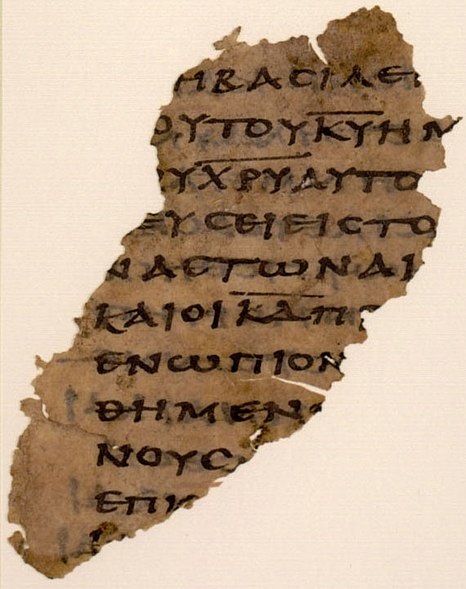
In spite of these ancient accuracies from these ancient texts, the best available manuscripts for Josephus’ account of the Jewish war with the Romans date from the 10th – 12th centuries,[8] about a thousand years after the account was originally written, with the earliest fragment for this account dated to the late 3rd century.[9] By comparison with both the Iliad and Josephus in terms of its textual history, “John’s Revelation”[10] is supported by several early Greek papyri which all date within two hundred and twenty-five (225) to two hundred and fifty (250) years, to as early as one hundred (100) years from the date of the original writing of Revelation.[11] Also among the available papyri are P85 (4th century) containing Revelation 9:19-10:2, 5-9, and P43 (6th/7th century) containing Revelation 2:12-13;15:8-16:2.

4th Century Codex Sinaiticus Showing Revelation 2:19-20 
(with punctuation and with corrections by a second hand)

 
John’s Revelation is also found in complete Greek versions in the 4th century Codex Sinaiticus and in the late 4th/early 5th century Codex A (Alexandrinus), as well as in the 5th century Codex C (Ephraemi Rescriptus). Another complete Greek version of this work comes to us in uncial 046 dated to the 10th century, with other partial Greek editions of Revelation found in uncial 0169 (4th century), uncial 0163 (5th century), Codex Porphyrianus (9th century), uncial 051 (10th century), uncial 052 (10th century), and P. Oxy. 4500 (uncial 0308), a Greek fragment from the 4th century containing Revelation 11:15-16; 11:17-18.


4th Century P. Oxy. 4500 (Uncial 0308)  
Showing Parts of Revelation Chapter 11


To these could be added many Latin manuscripts of John’s Revelation, including Codex Hafnianus (6th century), Fragmentum Sinaiticum for Revelation 20-21 dated to the 10th century, and a lectionary text in the Liber Comicus of the 9th century, as well as texts supporting Jerome’s 4th century Latin Vulgate (which includes Revelation), such as the mid-6th century Codex Fuldensis, the early-mid 8th century Codex Amiatinus, and the 9th century Codices Cavensis and Sangermanensis.

In spite of this wealth of early and later textual support through to the 10th century, I am occasionally asked about the textual credibility for John’s Revelation in light of the textual support for other books of the New Testament, as if by comparison there may be less reason for believing we have a reliable copy of John’s Revelation than we do for other writings from around the time of the first century CE. At times I have even caught myself reflecting similarly about the textual support for John's Revelation, likely for several reasons.

John’s Revelation may at times be put into a different class or category from other New Testament books because it is not included in some important early New Testament texts. For example, the Old Syriac (Curetonian and Sinaiticus [late 2nd – 5th centuries]) does not include John's Revelation, nor does the Syriac Peshitta version (early 5th century).[12] (But the 6th century Syriac Philoxenian/Harclean version does include Revelation.) Perhaps more important, John’s Revelation is not in one of our best New Testament witnesses, the 4th century Codex Vaticanus (B).

However, while it would have been nice to have available today a witness to John’s Revelation from this excellent New Testament text, John’s Revelation is not “missing” from Codex B in the sense it was never included; we simply do not have it as part of the remaining portion of Codex B.

Yet, while this gives us one less witness to the text of John’s Revelation from our main uncial New Testament manuscripts, the extent of the remaining support from a good number of early and later witnesses to its text should give anyone sufficient confidence to believe we have a reliable copy of John’s original Revelation for use today, even if it is not the actual copy he wrote.

Each time I consider the reliability of the text of John's Revelation, though it is much different than either the Illiad or the writings of Josephus in terms of its content, two things stand out as well: 1) It is unclear whether John's Revelation was originally written or received in Greek; however, 2) the Greek text of Revelation we have today is based on a good amount of important early papyri and other credible, ancient texts, not to mention the many quotations of John's Revelation in the writings of numerous Christians from the second century CE forward which I have not here discussed.[13]

The excellent textual and historical testimony for John’s Revelation is most evident when it is compared with other ancient Greek works, such as those by Homer or by Josephus, whose writings come to us from the same quarter century or so period as John’s Revelation (70 – 100 CE).

Indeed, if these writings with their comparatively limited textual history come to us with much content fit for use in defining and in reconstructing parts of our past, then perhaps the reliability of the text of John's Revelation will do the same, or prove beneficial in other ways as a reliable text and reference to early Christianity. If nothing else, we have good reasons to believe the text of John's Revelation is more reliable, textually, than other reasonably reliable, non-biblical, historical writings.


NOTES

[1] See M.S. Silk, Homer—The Iliad, Second Edition (Cambridge: Cambridge University Press, 2004 [1987]), pages 3-4, who notes the dating of the Iliad must be based on several factors since “there is no contemporary information about its date either in absolute terms or in relation to other dateable events.”

[2] Venetus A (Codex Marcianus Graecus 454 [822]). Other texts of the Iliad from around the same time include the 11th century CE Venetus B or Marcianus Graecus Z. 453 (821), and the 12-13th centuries CE Marcianus Graecus Z. 458 (841).

[3] Among these are P. Oxy. 20 (2nd century CE) and P. Oxy. 21 (1st to 2nd century CE). Also supporting the text of the Iliad are Codex Cryptoferratensis (098) and Codex Nitriensis (027). The latter contains a small portion of 2 Corinthians 11 dated to the 7th century CE, as well as a 10th century CE copy of the Iliad, and the former contains (among other works) parts of the Great Message of Luke and the Iliad, both dated to the 6th century CE.

[4] Casey Dué, “Homeric Papyri and the Homeric Multitext,” The Homer Multitext (July 12, 2010).

[5] For a brief but informative online review of the history of Troy and its rediscovery in the 19th and 20th centuries by Schliemann and others, see this presentation about “Troy” (last accessed March 11, 2013) by the University of Cincinnati.

[6] See Dan Gill, “A natural spur at Masada,Nature 364 (12 August 1993), pages 569-570. See here for an image of what remains of the Roman siege ramp.

[7] See here for images of these lots; compare with Josephus, War of the Jews 7.395:
They then chose ten men by lot out of them, to slay all the rest; every one of whom laid himself down by his wife and children on the ground, and threw his arms about them, and they offered their necks to the stroke of those who by lot executed that melancholy office [Whiston, The Works of Josephus (Hendrickson, 1987), Book 7, Chapter 9.1]. 
[8] See the listing of the main manuscripts for The Jewish War here.

[9] According to Ingrid Hjelm, The Samaritans and Early Judaism: A Literary Analysis (Sheffield: Sheffield Academic Press, 2000), page 191, this is Pap. Graec. Vindob. 29810, which contains only Book 2.576-579 and 582-584. 

[10] This is the inscription (Apokalypsis Iōannou) of the book in Sinaiticus ('aleph), Alexandrinus (A), and Ephraemi Rescriptus (C). For other inscriptions see Phillip W. Comfort, New Testament Text and Translation Commentary (Carol Stream, IL: Tyndale, 2008), page 809; Bruce M. Metzger, The Text of the New Testament: Its Transmission, Corruption, and Restoration, Third, Enlarged Edition (Oxford: Oxford University Press, 1992), page 205. The New Testament book of Revelation comes to us as a Christian work apparently by one of Jesus of Nazareth’s original followers, “John,” written sometime from the later middle part to the end of the first century CE.

[11] The earliest witness to the text of John’s Revelation is P98 (200 – 250 CE), which contains only Revelation 1:13-20; 2:1. Other papyri include P18 (230 – 280 CE), P24 (290 – 325 CE), P47 (250 – 300 CE), and P115 (230 – 280 CE). P47 and P115 contain the largest portions of the text of Revelation among these papyri.

[12] Also, other New Testament documents are not included in the Peshitta version, including 2 Peter, 3 John, and Jude.

[13] The earliest explicit references to John's Revelation appear to be in Chapter 34 of Clement's First Letter (late first century CE) and in Chapter 3 of the longer version of Ignatius' Letter to the Smyrnaens (early second century ?), in the Fragments of Papias (60 - 140 CE), and in Chapter 81 of Justin Martyr's (105 - 165 CE) Dialogue with Trypho. See also G. Mussies, The Morphology of Koine Greek as Used in the Apocalypse of St. John: A Study in Bilingualism (SNT 37; Leiden, Brill: 1971), pages 37-38.

Wednesday, June 20, 2012

"Body" or "Ears"? The Readings of Psalm 39:7(LXX), Psalm 40:6 (Hebrew), and Hebrews 10:5

Here is a new Q&A I put "upon the lampstand" today, on Elihu Books, which I hope will help clarify some of the textual issues and understanding surrounding the most likely reading in the source text quoted by the author of the letter to Hebrews, Chapter 10, Verse 5.

In my new Q&A I try to give a helpful, descriptive summary of the best available evidence, and then also indicate how Christians today understand this early Jewish, Christian reference in Hebrews 10:5, by answering this question:

Why does the Greek text of the New Testament book of Hebrews 10:5 use “body” in its quotation of Psalm 39:7/40:6, when the Hebrew Masoretic Text of the quoted Psalm uses “ears,” not “body”?(June 17, 2012)

Scroll down to the bottom of the page to get the most recent Q&A, in this case, the one cited above for 2012.

You can comment on the article or on any directly related issue in this thread on the Christian Witnesses of Jah Forum.

Sunday, June 3, 2012

Why No "Y" in Forms of the Divine Name in English?

According to Webster’s II, New Riverside University Dictionary, page 1227, a word is "transliterated" if its letters in one language are represented "in the corresponding characters of another alphabet" (page 1227). For example, the Greek name represented by the characters Ιησους is "transliterated" into English as either Iesous or Iēsous, with ē representing a long "e" sound. This is not, however, the English form of the name, but the Greek form represented in the English “corresponding characters.” 

A word or name can then be further made into English, for example, Iēsous as “Jesus,” the Modern, Anglicized form of the Greek name, which is based on the earlier Hebrew name Yehōshua' ("Joshua"), which combines the divine name Yehō and a form of the Hebrew noun yeshuah, meaning "salvation" (notice the final heh [h] in the transliteration, making it different from the name of similar sound discussed below).

The verb "is" is understood in relation to these two elements, with the resulting meaning in English, "Jaho(h)-ah/Yaho(h)-ah is salvation." In later biblical and other usage, the name Yehoshua' was shortened to Yeshua'. See the explanation by Werner Foerster (Theological Dictionary of the New Testament [TDNT] 3 [1965], page 284), cited with further discussion of these and related issues in my article, "'Christian' Witnesses of Jah, Jaho(h)-ah God," Watching the Ministry (April 2, 2011).

As for why there is no "Y" in most English forms of either the original names for "Jesus" or for "Jah," but instead the Anglicized "J" (even though in English we do have a "y" character), the answer is simple: English does not regularly, in writing or verbally, communicate ancient names by means of transliterations. That is why we say "Jeremiah," "Joshua," "Jehu," and many other ancient Hebrew names without using the transliteration Y for the initial Hebrew yod ( י ) character.

Sometimes this is done, as in this very article, but that is because I am discussing transliterations in relation to Anglicized forms of ancient names. While in English the Hebrew yod or "y" sound can be represented, the practice of making foreign words English predominates our usage and they become the best, ongoing means of accurate representation and communication with other English persons. Anglicized forms of names such as "Jesus" and "Jehovah" are far more familiar to us (and within the range of accurate representation) than either Yehoshua' / Yeshua' or Yehowah, and that is true for most other Anglicized forms of ancient biblical names in comparison to their transliterated forms.

By contrast, the “-weh” in Yahweh has nothing to do with accurately transliterating or with Anglicizing the divine name, in any of its best and most ancient Hebrew and Aramaic forms, and even its best Greek Jewish forms, as shown in the chart in Chapter 1 of my Third Edition of Jehovah's Witnesses Defended, beginning on page 40.

For these reasons, I choose to continue to use accurate, Anglicized forms of ancient names unless I am writing an article or giving a comment having to do with using transliterated forms, or how these forms should simply lead us to the best Anglicized or other-language forms of the original words for most of our native-language communications. This is in large part because we should not allow the process of coming up with better/the best English, transliterated form(s) further remove us from consistent, accurate language usage and communication using Anglicized forms of the same ancient names.

Better it is, I think (in English), to continue to use primarily those forms of ancient names provided by the process of accurately making accurate forms of ancient names a part of our own language through Anglicization. This way, too, more people who may not yet know much or anything about transliterations or about the pronunciation of transliterated characters can still be comfortable in their own language when regularly speaking ancient words to others. 

At this point, I do not see that using a transliterated "Y" instead of an Anglicized "J" is the best way to make further use of the divine name popular or more welcome in English. But I am convinced that while this discussion may continue the question about whether to use a form like "Yahweh" has been sufficiently answered, so that we should start to see and hear "Yahweh" less and less as a credible transliteration of the divine name, and "Jah"/"Yah" and "J/Yaho(h)-ah" more and more, even in spite of many academics and others who continue to fail to reconsider the best available evidence.

Wednesday, February 1, 2012

A Letter from Jesus' Half Sibling (Jude): A New Translation

A half sibling is one who shares the same mother with another person, but a different father. When it comes to biblical Christianity, Jesus' real "father" is said to be none other than the God of Moses, Jah (Exodus 15:2; 17:16; Psalm 68:4; 102:18; 115:17; Isaiah 12:2; 26:4; 38:11; Revelation 19:1-6). The Christian belief expressed clearly and frequently in biblical writings is the God of Moses caused his "firstborn," heavenly spirit Son to be born through a woman, "Mary" (Matthew 1:16-20; Mark 6:3; Luke 1:27-56; John 19:25; Hebrews 1:6). The union of God's spirit with a human woman's seed brought about, in Christian belief, a perfect human in the likeness of the first man, Adam (Genesis 1:26). That is why Jesus is referred to as "the Last Adam" in the writings of first century Christians.—1 Corinthians 15:45; compare Romans 5:14.

Whether "Jude" is one who was raised with Jesus does not affect the clear teachings provided in this letter, teachings which powerfully address a great concern, even one which overrides Jude's preferred subject, namely, the salvation he shared in common with other Christians living during his time. More important even than this, Jude felt it necessary to warn Christians about some who had "infiltrated the congregations" (Jude 3, 4), persons who were subverting the faith of others which reached the point where it disrupted the early Christians' ability to meet together to share in the eating of unleavened bread and drinking wine moderately in remembrance of Jesus' life and death, with the hope of his eventual return.—Matthew 26:26-29; Mark 14:22-25; Luke 22:19-20; Acts 1:11; 1 Corinthians 11:20-34; compare Revelation 3:20; 19:9.

In his warning to the early Christians, Jude drives his point home with a series of ancient events and texts, many of which not only show what will happen to those who intentionally cause others to stumble (Luke 17:2), but in providing his warning Jude also makes it clear that before Jesus came to earth to live as a man he lived in heaven as a spirit being, and there he served as Jah's great angel, even as the one who led the Israelites out of Egypt (Jude 5). According to P72, Jude also, like John (1:1), calls Jesus "a divine being" (theos) or "a god" in the biblical sense of being one of God's S/sons, one given life by the Father in his own divine image.—Compare John 1:18; 5:26; 6:57; Colossians 1:15.

If you have never before read Jude's letter, or if it has been some time since you last read it, consider my new translation of Jude according to the third century text of P72 in my new Elihu Online Papers 5, "The Letter of Jude: A New Translation According to the Text of P72" (January 18, 2012). Remember as you read through it that even though Jude opens his letter by seemingly distancing himself from Jesus as a relative by referring only to "James" as his brother, "James" is also one of Jesus' half siblings (Matthew 13:55). When you consider how Jude proceeds to describe Jesus and his prehuman existence as a divine being, as the angel who led Israel out of Egypt, then it is not too difficult to see why Jude chose not to emphasize his partial, human relationship to Jesus and instead decided to keep Jesus set apart from him in this respect.—Compare John 8:23.

Speakers, Speech Patterns, and God’s “Spirit” in Isaiah with Special Reference to Isaiah 48:16

In the Bible book bearing his name, from the opening chapter to the final one, Isaiah regularly speaks for and as God using first person ref...