Around 40 BC the Roman Empire made Herod “the Great” King of Judea. In spite of his spectacular building projects, which included a new temple complex in Jerusalem, according to the New Testament record of Jesus’ life, written by his student Matthew, near the end of Herod’s reign an event occurred which caused an already paranoid and insane ruler to sink to perhaps his lowest level yet by ordering the murder of thousands of infants (Matthew 2:1-18). According to the Britannica Online Encyclopedia (underlining added):
[Herod] was prone to violent attacks of jealousy; his sister Salome (not to be confused with her great-niece, Herodias’ daughter Salome) made good use of his natural suspicions and poisoned his mind against his wife in order to wreck the union. In the end Herod murdered Mariamne, her two sons, her brother, her grandfather, and her mother, a woman of the vilest stamp who had often aided his sister Salome’s schemes. ... In his last years Herod ... was in great pain and in mental and physical disorder. He altered his will three times and finally disinherited and killed his firstborn, Antipater. The slaying, shortly before his death, of the infants of Bethlehem was wholly consistent with the disarray into which he had fallen.
The reasons for which Herod is said to have killed so many young children are given by Matthew in his account, namely, because “astrologers” from “the east” saw a “star” which to them indicated the birth of “the king of the Jews” (Matthew 2:1-2). When these eastern astrologers appeared before Herod to tell him of their sight, and of its import, that is when Herod became “disturbed” or “frightened” according to Matthew 2:3. Herod then summoned “all of the high priests and scholars of the people” to see if they could tell him “where the Christ is to be born” (Matthew 2:4). The high priests and scholars available to Herod responded by quoting a portion of the book known as “Micah.” Here is how Matthew (2:5-6) recorded what took place:
Then the high priests and scholars of the people said to [Herod], “In Bethlehem of Judea, for this is how it has been written through the prophet [Micah]: ‘And you, Bethlehem, land of Judah, you are not at all the least significant among the rulers of Judah, for out of you will come forth the one who is ruling, who will shepherd my people Israel.’”
The Jewish high priests and scholars gave Herod prophetic information from the writings of the prophet Micah, which indicated the physical location of the foretold birth of the one who would ‘lead’ (or ‘rule’) Israel. This prophecy threatened Herod’s rule (compare John 11:48), as did news which indicated its pending fulfillment, namely, the visit from the east. Indeed, when Herod realized he could no longer use the astrologers to find the child (Matthew 2:16-18), he decided the only way to help protect his position and his place was to murder thousands of children who might, in fact, be this foretold Messiah or “Christ.”
Unrelated to the account in Matthew Chapter 2 concerning the human birth of the one foretold to rule Israel is what Micah describes after he writes about the future place from which the “Messiah” would come (Bethlehem). Micah, in fact, describes the pre-Bethlehem “origin,” “activities,” “sayings,” or perhaps even the “star” (see below) of this future leader, according to a translation of Micah 5:1(2) which here follows from the text of our modern printed Hebrew Bible (BHS, 4th ed.), followed by a translation of the Greek text of Micah 5:1(2), which text has support from one of the best available textual witnesses, the Dead Sea Scroll fragment known as 8HevXIIgr.
Further, because of its belonging to the Dead Sea Scrolls and because the evidence we have for the text of Micah 5:1(2) can be credibly dated to a time before there is any witness to the birth or historical existence of Jesus of Nazareth, we can determine if Micah was, in fact, a reliable “prophet” whose predictions in Jah’s name came true concerning Jesus of Nazareth’s place of birth (compare Deuteronomy 18:22), or if Micah was simply another Jewish religious writer with much to say about his and about his people’s past and present conditions and hopes. Consider (with my underlining and bracketed comments added):
Translation of the Hebrew Text (BHS, 4th Ed.) of Micah 5:1-3
(1) And you, Bethlehem, also known as Ephrathah, you who are too small to be among the thousands of Judah, from you will go out he who will rule over Israel, whose origin [or, 'origins'] is from the beginning, [or, ‘from earlier,’ ‘from ancient (times)’; Hebrew: the preposition min and the word qedem[1]]
from the days of old [or, ‘from ancient times’; Hebrew:
‘olam].
(2) Therefore, he will give them up until the time when she finishes laboring and actually gives birth. And then the remaining ones of his brothers will return to the sons of Israel.
(3) That is when he will stand and shepherd with Jaho(h)'s strength, in the majesty of the name of Jaho(h), his God. They will continue to live because he will be known [or, ‘become great,’ ‘grow’] to the farthest corner of the earth.
Translation of the Greek (Rahlfs’ LXX) Text of Micah 5:1-3
(1) And you, Bethlehem, house of Ephratha, you who are the smallest among the thousands of Judah, out of you will come forth the one who is to rule in Israel, and whose origins [or, 'goings forth,' 'sayings' (see discussion below)] are from the beginning [Greek: ap arches[2]], from ancient times [or, 'out of days of a past age'].
(2) Because of this, he will give them up until the time when she who is in labor actually does give birth, and then the remaining ones of his brothers will return to [or, ‘for’] the sons of Israel.
(3) And then he will stand up strong [Greek: a form of histemi[3]] and he will come to inspect and to shepherd his flock in the strength of the Lord [Jaho(h)], and they will exist in the glory of the name of the Lord [Jaho(h)], their God, for he will be glorified [or, ‘exalted’ (compare Philippians 2:9-11)] to the farthest corners of the earth.
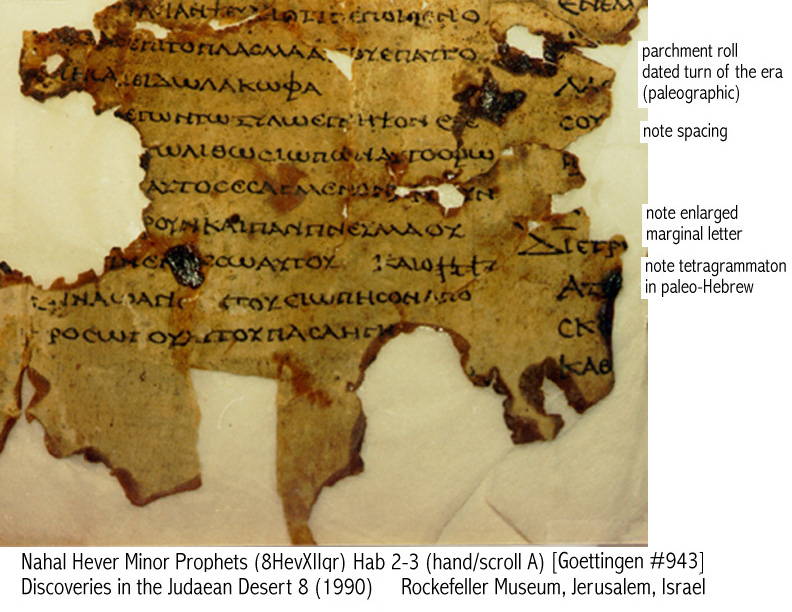
The oldest and most complete pre-Christian Greek text of Micah 5:1(2) is known as 8HevXIIgr, or “The Greek Minor Prophets Scroll.”[4] Though Tov’s reproduction in DJD 8, plate VI, col. 8, gives good portions of Micah 4:6-5:4(5)a, here is a rough scan of the image of the plate (which is not at all as clear as you will find in Tov’s volume [see my note 4]), containing parts of Micah 5:1(2) along with the two Greek (one in uncial script and the other in modern printed Greek) transcriptions of the text which are also provided in DJD 8, pages 40-41:
Clearer images of other portions of 8HevXIIgr (also known as Göttingen 943) can be viewed online here for the first hand (which is the same hand for our text in Micah 5:1[2]) and here for the second hand, both of which use Hebrew/Aramaic forms of the divine name in the middle of the Greek text, not substitutes such as “Lord” or “God” for the divine name.
Along with adding considerable quality and credibility to the text and to the prophecy of Micah 5:1(2), in as much as this text’s best witness appears to predate the birth of Christianity by approximately fifty (50) or more years,[5] we have also a clear description of the understanding associated with the preexistence of the future leader from Bethlehem, whose “origin(s)/going forths/activities/sayings” (Greek LXX: καὶ αἱ ἔξοδοι αὐτοῦ; kai hai exodoi autou) are said to be “from the beginning, from ancient days” (Greek LXX: ἀπ’ ἀρχῆς ἐξ ἡμερῶν αἰῶνος; ap’ arches ex hemeron aionos).
In this case it appears the Greek LXX reading hai exodoi corresponds in meaning to the feminine, plural form of the Hebrew noun motsa’ used in Micah 5:1(2), though the Hebrew plural may be used with the singular idea of “origin” or “source” (or even “star,” for which see below) rather than represent a numerical plural. Both the Hebrew and Greek plural forms of the words used in Micah 5:1(2) can also convey the meanings, “origins,” “activities,” or “sayings” / “utterances,”[6], as I will now further demonstrate.
[07/02/2026 Update: The above paragraph was slightly reworded but without changing any meaning.]
Motsa’ is related to the verb yatsa’ and it regularly means “place or act of going forth, issue, export, source, spring.”[7] Hillers claims the nominal plural of motsa’ah related to yatsa’ in Micah 5:1(2) is “too rare a word to permit a more precise rendering [than ‘rising’] on the basis of usage,” claiming, “this is, in effect, the only occurrence.”[8] Yet, as I will now show the usage for motsa’ and for related terms is not very difficult to isolate. Indeed, rarely is there an impassable limitation on determining the more precise meaning of the term in most instances.
As noted earlier and as I will here show through a review of motsa’ and related terms, the verbal idea of “going out from” is often abstracted into a noun meaning “origin,” or “source,” and even “star” (see below). It is also used for concrete references such as an “exit,” a “mine,” and even for a “toilet.” Further, motsa’ in the singular and in the plural will be seen to have been regularly used in the Old Testament for the ‘activity’ of an already-existing person. Consider:
Genesis 38:25: The singular participial form of motsa’ is used of Tamar as “she was being brought out” (NRSV) to be killed.
Numbers 14:37: Here the plural participle mootsi’ay is used of the “bad report” that was “brought out” (NASB) to “Moses and Aaron and all the assembly” (Numbers 13:26, 31-32).
Numbers 23:22: The verb motsy’am is used in reference to the Israelites whom Jah “brought forth from” Egypt.
Numbers 24:8: The singular participle motsy’o is used by Balaam again in reference to the Israelites whom Jah “brought forth from” Egypt.
Numbers 30:13: Here motsa’ is used in the sense of an “utterance,” or of those words which “go forth from” a person’s mouth as speech.
Numbers 33:2: Here a plural form of motsa’ is used twice for the “departure” or “goings forth” of the Israelites from Egypt, which “goings forth” are then described in the balance of Numbers Chapter 33.
Deuteronomy 8:3: Here motsa’ is used to describe the “going out” of the words from Jah’s “mouth.”
Deuteronomy 23:(23)24: Here motsa’ is used again in reference to words which “come forth/go out from” the mouth of an Israelite who makes a vow to Jah.
2 Samuel 3:25: Here a form of motsa’ it is used by Joab when speaking of Abner’s spying on David’s “going out,” “leaving,” or on the “start” of David’s affairs.
2 Samuel 5:2: It is used of David’s “bringing out” (motsi') of the Israelites which he did for war and for assembly, similar to Joshua (1 Samuel 18:1-16; compare Numbers 27:17-18).
2 Samuel 22:49: It is used to describe David as “brought out from” (motsi'i) his enemies by God.
1 Kings 10:28: Here motsa’ is used for the “export” of Solomon’s horses from Egypt.
2 Kings 2:21: Here motsa’ is used for the “source” or “flow” of the city’s “bad water.”
2 Kings 10:27: Here the plural form motsa’ot is used for “places of going out,” referring collectively to the “toilet” into which the house of Ba’al was made.
1 Chronicles 2:46: Here motsa’ is used as a proper name (“Motsa”) for one of the children of Ephah and Caleb.
1 Chronicles 8:36, 37, 42, 43: Here again motsa’ is used four times as a proper name for the same person.
1 Chronicles 9:42, 43: Here motsa’ is again used twice as a proper name.
2 Chronicles 1:16: Here motsa’ is again used for the “export” of Solomon’s horses from Egypt.
2 Chronicles 9:28: Here it is used for the horses whom others were “bringing out from” (motsi'im) Egypt to Solomon.
2 Chronicles 32:30: Here motsa’ is again used in reference to a “source” or a “flow” of water, namely, the “waters of Gihon” which Hezekiah “stopped up.”
Nehemiah 6:19: Here it is used in reference to the origin of the “words” from Nehemiah, which were then “brought out from” him to Tobiah.
Job 28:1: Here motsa’ is used for a “source” or a “mine” of “silver.”
Job 38:27: The use of motsa’ here is for the “source” or “place of going forth” for the earth’s “grass.”
Psalm 19:(6)7: Here motsa’o is used for the “sun” which “goes forth from” the “end of the heavens,” “like a mighty one to run a race” (verse 5[6]).
Psalm 65:(8)9: Here the plural form motsa’ey is used of the “comings/goings forth” of the “morning and evening.” But see discussion below concerning this verse and the possible meaning of “stars” for motsa’ey here and for related forms elsewhere.
Psalm 68:6(7): Here motsi’ is used of those whom Jaho(h) “brings out from” prison bonds. Psalm 68:7(8) uses a similar word ($d[cb [which uses the preposition be and the verb yatsa’]) of God who “goes out from” (aycwm) his “holy dwelling” (verse 5) to lead his people in the wilderness. This same use of be+yatsa’ for “going/goes out from” a location or from a person occurs frequently in the Hebrew Bible (see Genesis 12:4 [wtacb]; 35:18 [tacb (for the “going forth/releasing” of Rachel’s life back to God; compare Ecclesiastes 12:7 with Job 27:3)]; Exodus 5:20 [~tacb]; 13:8 [ytacb]; 23:16 [tacb (for the “going out”/“expiration” of the year)]; Leviticus 27:21 [wtacb (used of the “field”)]; Numbers 12:12 [wtacb (for a child’s “coming out from” a mother’s womb)]; Deuteronomy 4:45 [~tacb]; 4:46 [~tacb]; 23:[4]5 [~ktacb]; 24:9 [~ktacb]; 25:17 [~ktacb]; 28:6 [$tacb]; 28:19 [$tacb]; 33:18 [$tacb]; Joshua 2:10 [~ktacb]; Judges 5:4 [~tacb]; 5:5 [~tacb]; 1 Samuel 21:[5]6 [ytacb]; 25:37 [tacb (for wine’s “going out from” Nabal)]; 1 Kings 8:9 [~tacb]; 8:10 [tacb]; 2 Kings 11:8 [wtacb]; 2 Chronicles 5:10 [~tacb]; 5:11 [tacb]; 20:21 [tacb]; Job 29:7 [ytacb]; Psalm 81:[5]6 [wtacb]; 105:38 [~tacb]; 114:1 [tacb]; Isaiah 13:10 [wtacb (for the visual of the sun’s “coming/going forth”; compare Psalm 65:[8]9)]; Ezekiel 10:19 [~tacb]; 27:33 [tacb (for the “going forth” of merchandise across the sea)]; 47:3 [tacb]; Haggai 2:5 [~ktacb]).
Psalm 75:(6)7: Here motsa’ is used for the “place of going forth” of the sun, or to the “beginning”/“coming forth” of day, which is in the “east.”
Psalm 89:35: Here motsa’ is used for the ‘command’ (compare verse 31) of Jaho(h) which “goes out” (acwm) from him.
Psalm 107:33, 35: Here the plural form motsa’ey is used twice for “sources,” or collectively as a “source,” a “spring.” or a “pool” of “water.”
Psalm 135:7: Here motse’ is used of the “wind,” which Jah “brings out.”
Proverbs 10:18: Here a participial form of motsa’ is used for the one “sending out” “slander.”
Isaiah 41:18: Here the plural form motsa’ey is used for “sources,” or collectively as the “source” or “spring” of the dry land’s “water.”
Isaiah 54:16: It is used here of one who “brings forth” (motsi') a weapon through “labor.”
Isaiah 58:11: Here the singular form motsa’ is used for a “source” or “spring” of water.
Jeremiah 17:16: Here motsa’ is used again for the command which “goes forth from” (acwm) Jah.
Jeremiah 38:22, 23: Here the plural participle mootsa’ot is used of those who were “brought out” to the princes of Babylon, and in Jeremiah 38:23 it is similarly used to describe how the soon-to-be-captured wives and sons of Judah would be “brought out” (~yacwm) to the “Chaldeans.”
Ezekiel 12:4: Here motsa’ey is used for the “going forth” of Ezekiel as one “going into exile.”
Ezekiel 42:11: Here it is used of the “exits” (motsa'eyhen) of the dining rooms in the temple plan.
Ezekiel 43:11: Here again a form of motsa’ is used for the “exits” or “places of going out” of the temple.
Ezekiel 44:5: Again a form of motsa’ is used for the “exits” or “places of going out” of the temple.
Daniel 9:25: Here motsa’ is used for the “going forth” of the “word to restore and rebuild Jerusalem.”
Hosea 6:3: Here a form of motsa’ is used for Jah who “goes forth” as the “dawn,” similar to the rest of the verse which speaks of Jah “coming forth” like the “rain” which ‘waters the earth.’
From the above review of the use of motsa’ and related words in the Hebrew Bible it is clear motsa’ can and often does mean “activity” by a person when it is used of a person, specifically activity which involves “going out from” another person or being “brought out” to other people (Genesis 38:25; 2 Samuel 3:25; Jeremiah 38:22, 23), or to other places such as from “Egypt” or from “prison” (Numbers 23:22; 33:2; Psalm 68:[6]7). It is also used for the “exits” of a building or temple (such as in Ezekiel 42:11; 43:11; 44:5) and for the ‘exporting’ of horses (1 Kings 10:28; 2 Chronicles 1:16), as well as for sayings, words, commands, vows, or reports that “go out from” other people.—See Numbers 14:37; 30:13; Deuteronomy 23:(23)24; Nehemiah 6:19; Jeremiah 17:16; Daniel 9:25.
My review of the use of motsa’ and related forms shows that it is also used as a plural form but with the collective sense of an “origin” or “source” of things such as “silver” (Job 28:1), “grass” (Job 38:27), for a “flow” of water (2 Kings 2:21; Psalm 107:33, 35; Isaiah 41:18), and even for a “toilet” (the original “[going]outhouse”! [2 Kings 10:27]). Motsa’ and related forms are also used for the apparent, visual “going forth” or “rising” of the “sun,” or to the “beginning” / “coming forth” of day (see Psalm 19:[6]7; 65:[8]9; 75:[6]7). It is also used as a proper name (1 Chronicles 2:46; 8:36, 37, 42, 43; 9:42, 43), as well as for the “wind” which Jah “brings out.”—Psalm 135:7.
In this light, it is difficult to understand why Hillers prefers the translation, “rising,” for motsa’ot in Micah 5:1(2), which he gives according to his own “thematic consideration” (see my note 7). However, according to Mitchell Dahood:
[Motsa’] is a poetic name for “star” in the following two passages, [Psalm] 65,9, ... “You make the morning and evening stars shout for joy”; cf. Job 38,7, ... “When the stars of morning shouted for joy together”. [Song of Solomon] 8,10, ... “So in his eyes I have become like the star of evening”.[9]
What is most clear from the use of motsa’ and related forms in the Hebrew Bible is that there is no example where it is used of a real, living person’s “activities” or of the “place from which he goes out” in such a way so that the same real person under discussion is no longer the very same person who is said to be ‘active’ or to have ‘gone forth from’ or ‘originated’ relative to the demonstrable senses for motsa’ documented above. Further, there is no instance of motsa’ which involves ‘naming’ or which denotes the “genealogy” or “descent” of the subject from an extended family line.[10] This will become more relevant as I now consider the use of the plural for motsa’ah again in Micah 5:1(2), this time in the light of the theological controversies between Christians and Jews which came about after the death of Jesus of Nazareth.
Consider, for example, the reading of the Targum (an Aramaic translation/interpretation) of Micah 5:1(2):
And you, O Bethlehem Ephrathah, you who were too small to be numbered among the thousands of the house of Judah, from you shall come forth before me the anointed One, to exercise dominion over Israel, he whose name was mentioned from of old, from ancient times.[11]
The above translation from the Targum to Micah is credibly datable to a time at least forty (40) or more years after the death of Jesus of Nazareth.[12] This may explain why this Targum represents a continuation of a rabbinic trend which came about after Christianity took root and began to spread, and which trend sought to transfer Old Testament and related literature’s presentation of a preexistent, heavenly being alongside God often identified as Jah’s “Word” and his “Wisdom” (but identified by Christians as the same being who then came to the earth as Jesus of Nazareth), to beings other than “Wisdom” such as “Enoch” or “Metatron.”[13]
In fact, as my review of motsa’ and related words shows clearly, the replacement of “whose origin/activities” with “whose name was mentioned” is not related to any sense of the Hebrew (or Greek) text of Micah 5:1(2). However, the idea of the ‘naming’ of the Messiah in heaven is consistent in date, in possible authorship, and certainly in content specifically as it relates to the ancient ‘naming of the Messiah’ with the text of 1 Enoch 48:3, “At that hour, that Son of Man was given a name, in the presence of the Lord of the Spirits.”[14]
However, consider 1 Enoch 48:3 together with 1 Enoch 46:1-3 and as part of 1 Enoch 48:2-6:
At that place, I saw the One to whom belongs the time before time. And his head was white like wool, and there was with him another individual, whose face was like that of a human being. His countenance was full of grace like that of one among the holy angels. And I asked the one—from among the angels—who was going with me, and who had revealed to me all the secrets regarding the One who was born of human beings, “Who is this, and from whence is he who is going as the prototype of the Before-Time?” And he answered me and said to me, “This is the Son of Man, to whom belongs righteousness, and with whom righteousness dwells. … At that hour, that Son of Man was given a name, in the presence of the Lord of the Spirits. He will become a staff for the righteous ones in order that they may lean on him and not fall. … All those who dwell upon the earth shall fall and worship him before him. … For this purpose he became the Chosen One; he was concealed in the presence of (the Lord of the Spirits) prior to the creation of the world, and for eternity.[15]
As I have written elsewhere concerning the expressions of real, personal preexistence in these texts:
Here we read that “prior to the creation of the world” a being “like that of one among the holy angels,” who is also called “the Son of Man” and the “prototype of the Before-Time,” was “given a name, in the presence of the Lord of Spirits.” This “Chosen One” is said to be “another individual” with “the One to whom belongs the time before time,” who is given honor and “worship” by all just like we read concerning Jesus in Philippians 2:9-11 and in Hebrews 1:6.[16]
Robert Hamerton-Kelly put the salient point very well in his dissertation on the preexistence of Jesus in early Judaism, “the ‘naming’ is not the act which brings the Son of Man into existence, rather it implies that He already is in existence.”[17] Hamerton-Kelly concludes:
There can be no serious doubt, therefore, that the Son of Man was a pre-mundane, pre-existent, heavenly being, who was reserved in heaven until the appropriate time for the exercise of His office as eschatological judge and king.[18]
Yet, according to George F. Moore, the Tannaim (a group of rabbinic teachers from around the first century CE to the end of the second century CE, and whose views are preserved in the Mishnah [200 CE]) “counted ‘the name of the Messiah’ among other things that preceded the world, but not the person of the Messiah.”[19] But Moore provides no evidence for this view and, in fact, he cites contradicting evidence which he then proceeds to contradict for no apparent reason when he writes:
When tours through the heavens came to be told of highly esteemed rabbis, as of Joshua ben Levi, for example, they also see the Messiah waiting for his hour; but it would be rash to impute to these Haggadist a belief in a ‘pre-existent Messiah.’”[20]
Therefore, those who rely on or who look to and use Targumic references or interpretations along with the views of various rabbis of the Tannaim for their view of the Messiah’s preexistence need to reconsider just what the rabbis did, in fact, teach. As for the reading in the Micah Targum, “he whose name was mentioned from of old,” the note to this part of Micah 5:1 in the translation by Cathcart and Gordon (cited in full in my note 11) refers to note 11 for the translation of Zechariah 4:7, which also speaks of the “anointed One whose name is told from of old.” The note to this translation in the Targum of Zechariah 4:7 by Cathcart and Gordon reads as follows, in relevant part:
C[ompare] the naming of the Son of Man “before the sun and signs were created” in 1 Enoch 48:3. While the [Targums] speak of the name of the messiah as preexistent, this does not necessarily exclude the idea of the messiah’s personal pre-existence, if 1 Enoch 48:1-6 is anything to go by. See, nevertheless, Moore, Judaism II [page] 344.[21]
In their edition of the Targum of the Minor Prophets Cathcart and Gordon give the same understanding of the preexistence of the Messiah in 1 Enoch in response to “Moore” as I have given here and previously, along with the explanations given even earlier by Hamerton-Kelly. Cathcart and Gordon also show they do not view the Targumic readings concerning the “naming” of the Messiah as necessarily indicating he was not preexistent; rather, as has been previously noted, the act of “naming” the Messiah in these texts indicates he already was in existence. This contradicts Moore’s view of the Jewish understanding of the Messiah’s real, personal preexistence during this time, as well as the view of many modern Unitarians and others who appear to prefer Tannaitic Judaism over first century Christian views of the Messiah.[22]
In contrast to the Targumic/Tannaitic view of Micah 5:1(2), the text of Micah 5:1(2) actually provides a clear contrast between the then-future birth of the “leader” from “Bethlehem” and this same subject’s pre-Bethlehem “goings forths” / “activities,” “origin(s),” or “sayings” which have occurred “from the beginning, from ancient days” (ap’ arches ex hemeron aionos). While some texts have different ending and starting verses for Micah Chapters 4 and 5, the Hebrew (Masoretic) text of Micah 5:1 also speaks of the “goings forths” / “activities,” “origin(s),” or “sayings” of this future leader as “from the beginning / ancient time” (Hebrew: miqedem). This description of the Messiah’s pre-Bethlehem “goings forths” / “activities,” “origin(s),” or “sayings” is further described in the Hebrew text as, “from days of old / ancient times” (mimay ‘olam).
There are simply no good reasons to here ignore or to fail to fully consider the use of the Greek plural form exodoi (from the noun exodos [from which we get, “Exodus”]) as a translation for and true indicator of the sense of mosta’ot in Micah 5:1(2). Indeed, exodos and related verbal and nominal forms are used 81 times in the Greek LXX. It is used frequently for the “activities,” “exit,” or ‘going(s) out” of Jah or of a person or of a tribe of people for various reasons, including for war (Numbers 35:36; Deuteronomy 33:18; Judges 5:4; 1 Samuel [1 Kings] 29:6; 2 Samuel [2 Kings] 3:22, 25; 11:1; 1 Kings [3 Kings] 2:37; 3:7; 2 Kings [4 Kings] 19:27; 1 Chronicles 20:1; 2 Chronicles 16:1; Psalm 18:7[19:6]; 120:8; Proverbs 24:27; Isaiah 37:28; Ezekiel 47:3).[23] It is used for the “departure” of the Israelites and for the ‘exporting’ of horses and other items from Egypt (Exodus 19:1; Numbers 33:38; Deuteronomy 16:3; 1 Kings [3 Kings] 6:1; 10:28, 29; 2 Chronicles 1:16; 9:28; Psalm 104:38; 113:1; Micah 7:15).[24] It is used of the “holiday” or “release” from (both translations from Brenton’s English LXX, as is) the “end” of religious servitude under or in relation to festivals, sabbaths, and assemblies (Leviticus 23:36; Numbers 29:35; Deuteronomy 16:8; 2 Chronicles 7:9; 23:8; Nehemiah 8:18; Psalm 28[29]:1). It is used of what “issues/goes forth from” the “heart,” namely, “life” (Proverbs 4:23).[25] It is used for “ways out” or “streets” (1 Samuel [1 Kings] 1:20; 2 Samuel [2 Kings] 22:43; 1 Kings [3 Kings] 21:34; Psalm 143:13; Proverbs 1:20; Isaiah 51:20; Jeremiah 11:13; Lamentations 2:19; 2:21; 4:1, 5, 8, 14). It is also used of a person’s “way” of life or “practice” (Proverbs 30:12),[26] and it is used once for the “going forth” of the command to rebuild Jerusalem (Daniel 9:25). It is used for the visual appearing of the “going forth” of the “sun” (Judges 5:31),[27] for the “outgoings of morning” (Brenton’s translation of Psalm 64:8[65:8]), and in reference to the “east” (Psalm 74:7). It is used of the “source” or “going forth” of the earth’s grass which Jah causes to “sprout” (Job 38:27), for the “going out” or “end” of an area and for the end of a year (Exodus 23:16; 1 Chronicles 5:16), as well as for the “origin,” “source,” or “flow” of water (2 Chronicles 32:20; Proverbs 25:26)[28] and for the “fallen” snow (Proverbs 25:13). It is also used of the “place of going out,” “opening(s),” or “exit(s)” of a building or temple (Ezekiel 42:11; 43:11; 44:5).[29] Finally, the Greek plural exodoi is used of the “appearance” or “coming forth” of the “stars” in Nehemiah 4:15.[30]
Of special interest we have two final uses of exodoi (that is, other than its use also as a translation for motsa’ot in Micah 5:1[2]) in the Septuagint book of Proverbs 8:35. This is a unique section of Wisdom literature which presents or describes the figure of “Wisdom” (in biblical and in related literature a truly existing, real personal being) as if she were “created” as “the beginning [Hebrew:tyvar; Greek: avrch.n] of Jah’s way, the earliest of his achievements of long ago” [Proverbs 8:22]). Wisdom is then described further as the one whom Jah “installed from the start” (verse 23), and as the one who was “brought forth as with labor pains” (verses 24, 25).[31] Consistent with this teaching, and also with what is said in Micah 5:1(2), in Proverbs 8:35 Wisdom says, “For my goings forth/sayings [exodoi] are the goings forth/sayings [exodoi] of life, and [in them] the will [or, ‘desire’] of the Lord [Jah] is prepared” (ai` ga.r e;xodoi, mou e;xodoi zwh/j kai. e`toima,zetai qe,lhsij para. kuri,ou).
Proverbs 8:35 provides a direct link to what is said in Micah 5:1(2) about the “goings forth” of the promised leader from Bethlehem, who is later identified as Jesus of Nazareth in the New Testament. Indeed, if we accept the “goings forth”/“sayings” of Wisdom in Proverbs 8:35 as the very same “goings forth”/“sayings” of Micah 5:1(2), then we have yet another significant indicator of identity between these two.[32]
The most likely, intended meanings appear to be that the “goings out from,” “activities,” or “sayings”/“utterances” of the future ruler from Bethlehem actually go back much farther, indeed, “from ancient times,” or “from the beginning.” Therefore, based on what took place after Micah’s prophecy in the person of Jesus of Nazareth, the very least which is taught in Micah 5:1(2) is that a foretold leader of Israel would be born in Bethlehem, one who was very ‘active’ in his “goings forth” or in his/her “sayings” or “utterances,” all of which have taught us “from the beginning” about the “will” of Jah God.—Proverbs 8:17-35.
Of course, with Hebrew plurals it is always possible there is more involved than a numerical plural.[33] In this light, it may be the case that as the “star” appeared to those in the “east” when Jesus of Nazareth received life on earth (Matthew 2:1-2) so, too, it may be that his “star” (= a collective use of motsa’ot) represents the time when he was given life by Jah God “from the beginning,” not simply as one of the “morning stars” or as one of the “sons of God” (Job 38:7), but as “the bright [or, ‘shining’ (o` lampro.j)] morning star,” as the “firstborn” Son and Word of Jah God, in addition to being “the root and the descendant of David.”—Micah 5:1(2); Hebrews 1:6; Revelation 19:1, 3, 4, 6, 13; 22:16.
Though the Greek LXX rendering of the plural for motsa’ah in Micah 5:1(2) is one which suggests something other than the subject’s “origin” or “start” of life, it is possible that, as is true also for Wisdom in Proverbs 8:21-31 and for the Word/Jesus of Nazareth in the New Testament (see John 1:18; 5:26; 6:57; Colossians 1:15-18; Hebrews 1:3; Revelation 3:14), the Messiah’s prehuman “goings forth from” actually involve a pre-Bethlehem “origin” or “source” of his life, a life given to him/her by Jah God “in/from the beginning” (Proverbs 8:22-23, 27-30; John 1:1, 2; 17:5; 1 John 1:1; 2:14; compare Wisdom 9:1, 9; Sirach 24:9), which is consistent with if not, in fact, also the teaching of the pre-Christian text of Micah 5:1(2).
[1] Compare the similar uses of
qedem for Wisdom’s creation in Proverbs 8:22 and 23.
[2] What is said here parallels what we read about “the Word” in 1 John 1:1 and “Wisdom” in Sirach 24:9. Compare also John 1:1 and Proverbs 8:23 with items 1) and 2) and notes 8, 9, and 10 in the my chart from, “Jah Loves Her, Wisdom, His Son, the Word,” in Watching the Ministry [October 18, 2010]).
[3] This is the same verb used for the time when “Michael, the Great Angel,” stands up strongly (as in Micah 5:3) for the “sons of Israel” in Daniel 12:1 (LXX). For more on the identity of Jesus of Nazareth with Michael the Archangel, see my Third Edition of Jehovah’s Witnesses Defended: An Answer to Scholars and Critics (Murrieta, CA: Elihu Books, 2009), note 68, pages 170-171.
[4] See Emanuel Tov, The Greek Minor Prophets Scroll From Nahal Hever (8HevXIIgr) (DJD 8; Oxford: Clarendon Press, rep. 1995). Another early but much more fragmentary witness to the text of Micah 5:1(2) from the Dead Sea Scrolls is 4QXIIf, published in Eugene Ulrich, Frank Moore Cross, Russell E. Fuller, Judith E. Sanderson, Patrick W. Skehan, and Emanuel Tov, Qumran Cave 4 (DJD 15; Oxford: Clarendon Press, 1997), plate XVLIII, and which contains the negative variant reading adopted in the main text of Martin Abegg, Jr., Peter Flint, and Eugene Ulrich, The Dead Sea Scrolls Bible (New York: Harper Collins, 1999), page 451, namely, “out of you [that is, ‘Bethlehem of Ephratha’] one shall
not [
al] come forth,” which negative appears to indicate a different point of human origin than “Bethlehem of Ephratha” for the promised “ruler.” Previously this fragment and its variant negative reading was cited, partially published, and discussed by Russell Fuller as, “4QMicah: A Small Fragment of a Manuscript of the Minor Prophets from Qumran, Cave IV,” Revue De Qumran 62.16 (December, 1993), pages 193-202.
[5] See Tov, The Greek Minor Prophets Scroll, pages 22-26, who tentatively dates the text to the later part of the first century BCE.
[6] Compare the following English translations of the plural for motsa’ah (the feminine form of motsa’) as used in Micah 5:1(2): “W/whose goings forth” (KJV/NKJV); “whose goings forth” (ASV [1901]); “whose goings forth” (JPS [1917]); “whose origin” (JPS [1985]); ‘“whose origin” (RSV/NRSV); “whose origin” (NAB); “Whose origins” (NIV [1984]); “whose origins” (NJB); “His goings forth” (NASB); “whose origin” (ESV [2001]). See also the definitions for motsa’ot given in the lexicons cited and underlined in relation to Micah 5:1(2) in note 7.
[7] Francis Brown, S.R. Driver, and Charles A. Briggs, The New Brown – Driver – Briggs – Gesenius Hebrew and English Lexicon: With an Appendix Containing the Biblical Aramaic (Peabody, Mass.: Hendrickson, 1979), page 425. On page 426 the plural form of motsa’ah used in Micah 5:1(2) is cited and translated collectively as, “his origin”. See also H.W.F. Gesenius’ Hebrew-Chaldee Lexicon to the Old Testament, Samuel P. Tregelles, trans. (Grand Rapids: Baker, 1991 [1979]), page 458, which gives “a going out,” “the place from which one goes out,” “that which goes out,” and other meanings for motsa’, with “origin, springing” for Micah 5:1. William L. Holladay, A Concise Hebrew and Aramaic Lexicon of the Old Testament (Grand Rapids: Eerdmans, 1988), page 187, who gives “exit,” “what comes out,” “going out” and “import” for motsa’ and “origin” for the feminine plural form used in Micah 5:1(2). H.D. Preuss, “
ac'y",”
TDOT 6, G. Johannes Botterweck, Helmer Ringgren, eds., David E. Green, trans. (Grand Rapids: Eerdmans, 1990), page 227, writes (with my underlining), “in the sense of ‘origin’ (exit = beginning) in Mic. 5:1 (2).” The Hebrew and Aramaic Lexicon of the Old Testament, Vol. II, translated and edited under M.E.J. Richardson (Leiden: Brill, 1995), page 559, gives “place of departure,” “exit, way out,” “pronouncement,” and “coming forth, appearance” for motsa’ and related forms and “origin” for the plural of motsa’ah used in Micah 5:1(2). David J.A. Clines, ed., The Dictionary of Classical Hebrew, Vol. V (Sheffield: Sheffield Academic Press, 2001), pages 183-184, gives “going out,” “place of going out,” “exit,” “way out,” “source,” “spring,” “mine” (or “source” for “silver” [Job 28:1]), “growing-place,” “act of going out,” “departure,” and other meanings for motsa’, as well as “origin” for the plural of motsa’ah used in Micah 5:1(2) (“his origin is from of old, from ancient days” [underlining added]).
[8] Delbert R. Hillers, Micah: A Commentary on the Book of the Prophet Micah, Paul D. Hanson and Loren Fisher, eds. (Philadelphia: Fortress Press, 1984), page 65.
[9] Mitchell Dahood, “Hebrew-Ugaritic Lexicography IV,” Biblica 47 (1966), page 416. See also Preuss, “
ac'y",”
page 227, who also references Dahood’s work and view of motsa’, citing also the texts of Psalm 65:9 and Song of Solomon 8:10 (as well as Job 38:7) for comparison in his note 8. Clines, ed., The Dictionary of Classical Hebrew, Vol. V, page 185, even lists “star, sparkler,” as a separate entry for motsa’, also citing Psalm 65:9 and Song of Solomon 8:10 as examples of this usage.
[10] Preuss, “
ac'y",”
page 227, gives 2 Chronicles 32:21 as the “only” instance where a form of the verb yatsa’ (but not motsa’ or motsa’ah) is used as a noun with the meaning of, “descendant,” though here the reference is to the relationship between “Sennacherib king of Assyria” and his “children” or “relatives” who were present upon his return from defeat, namely, the “children”/“relatives” who then killed Sennacherib even though they had “come out from his inward parts.” The idea of ‘descendency’ here, if any, is for the direct “going out” from Sennacherib’s “inward parts,” not necessarily because of having descended from a long family line or of having ‘gone out from’ persons other than Sennacherib. Hillers, Micah, page 66, wrongly links the idea of “rising” with motsa’ot in Micah 5:1(2), claiming:
The ancient “rising,” or origin, of the king is his descent from a ruling house that began nearly three centuries before Micah’s time, with David. Or if we are to think of David himself redivivus, the emphasis is on David as a figure from remote antiquity.
Yet, nothing of the sort is mentioned in Micah 5:1(2) as it relates to the use of motsa’ot for the “descent” from the house of David. In fact, motsa’ot is here used with other terms that clearly move its intended sense farther back to a time beyond the existence of the house of David, indeed, to “the beginning, to the days of old.” That is why Hillers next writes (with my underlining added):
At the same time, there is a strong flavor of myth here, for ‘of old’ has the suggestion ‘primeval, from the beginning, as an order of creation.
Precisely, though there is not clearly any “myth” at all behind it so much as there is a real personal being identified elsewhere in biblical and in other, related literature, namely, “Wisdom,” who like the Messiah of Micah 5:1(2) was “active” and who also had her “origin” “from the beginning” (see item 2] and notes 9, 10, and 11 in my chart in my article, “Jah Loves Her, Wisdom, His Son, the Word. Compare J.M.P. Smith, William Hayes Ward, and Julius A. Bewer, A Critical and Exegetical Commentary on Micah, Zephaniah, Nahum, Habakkuk, Obadiah and Joel (ICC; New York: Charles Scribner’s Sons, 1911), page 104, “Whose origins are from of old, from ancient days,” which they take here to mean, “he will belong to one of the oldest families, viz. the Davidic.” But, again, Micah 5:1(2) goes back much farther in describing the “origin(s)” or “activity”/“star”/“sayings” of the Messiah, so that “one of the oldest families” would have to indicate the ‘oldest family’ since the motsa’ot here is/are “from the beginning.” The Greek LXX rendering of matsa’ot with exodoi strongly suggests something else is in view, namely, the “goings forth,” “activities,” or “sayings”/“utterances” of the preexistent Messiah as the “Wisdom” and “Word” of God which are elsewhere, otherwise also said to have been “from the beginning.”—Compare Proverbs 8:22-23, 27-30; Wisdom 9:1, 9; Sirach 24:9; John 1:1, 2; 7:16-18; 8:23, 26-29; 17:5; 1 John 1:1; 2:14.
[11] From The Aramaic Bible, vol. 14, Kevin J. Cathcart and Robert P. Gordon, The Targum of the Minor Prophets (Wilmington, Delaware: Michael Glazier, Inc., 1989), page 122 (underlining added).
[12] Cathcart and Gordon, The Targum of the Minor Prophets, page 17, writes that there are “fairly clear indications of a post-A.D. 70 origin for various Tg. references,” and on page 18 that “the preponderance of evidence points to the period after A.D. 70 as that when significant work of composition or editing of Tg. Prophets was carried out.” On page 3 Cathcart and Gordon write the following where it concerns some of the evident tendencies of the Targumists:
As well as simplifying the words of Scripture, the Targumists also took it upon themselves to “contemporize” references, so that the ancient writers appear from time to time to be talking about places, institutions or events that belong to a period much later than their own. The general effect of such a policy is clearly to make Scripture appear the more relevant to the contemporary situation and, indeed, to foster the idea that the events and experiences of one’s own time are, in a sense, part of “canonical history.” ... the scribal class became the interpreters ... Scripture could become exceedingly plastic in Targumists’ hands as they pursued their self-appointed goals.
[14] E. Isaac, “1 (Ethiopic Apocalypse of) Enoch,” in The Old Testament Pseudepigrapha, vol. 1, James H. Charlesworth, ed. (New York, NY: Doubleday, 1983), page 34.
[15] Isaac, “1 (Ethiopic Apocalypse of) Enoch,” pages 34-35 (underlining added).
[16] Jehovah’s Witnesses Defended, Third Edition, page 228.
[17] Robert Gerald Hamerton-Kelly, “The Idea of Pre-Existence in Early Judaism: A Study in the Background of New Testament Theology” (Th.D. dissertation: Union Theological Seminary, 1966), page 69 (underlining added).
[18] Hamerton-Kelly, “The Idea of Pre-Existence in Early Judaism,” page 70. Further, as I also discuss on pages 229-230 of my Third Edition of Jehovah’s Witnesses Defended, in the book of 4 Ezra (late first century CE) God speaks of a time when “my son the Messiah shall be revealed with those who are with him” (7:28). But in 13:52 God says that “no one on earth can see my Son or those who are with him, except in the time of his day,” which implies that those in heaven may see him during the time in which he is “kept” by God (4 Ezra 12:32; 13:26; compare 1 Enoch 62:7). Consider also what is said in 4 Ezra 14:7-9 concerning the real preexistence of the Son of God, where God says the following to Ezra:
And now I say to you: Lay up in your heart the signs that I have shown you, the dreams that you have seen, and the interpretations that you have heard; for you shall be taken up from among men, and henceforth you shall live with my Son [which shows Jah’s “Son” already existed in heaven according to this text, that is, in order for others to ‘henceforth live with him’] and with those who are like you, until the times are ended [translation is from B.M. Metzger, “The Fourth Book of Ezra,” in The Old Testament Pseudepigrapha, vol. 1, pages 517-559 (underlining added)].
[19] George Foot Moore, Judaism in the First Centuries of the Christian Era: The Age of the Tannaim, vol. II (Cambridge: Harvard University Press, 1946), page 344.
[20] Moore, Judaism in the First Centuries of the Christian Era, vol. II, page 344, note 1 (underlining added).
[21] Cathcart and Gordon, The Targum of the Minor Prophets, page 194, note 11. They also reference the messianic Targum of Psalm 72:17, which in The Aramaic Bible, vol. 16, David M. Stec, The Targum of Psalms (Collegeville, Minnesota: Liturgical Press, 2004), page 140, reads, “even before the sun existed his name was being prepared,” which does not address whether the one whose “name was being prepared” actually existed before the name was “ready” or given to him; it does not say “he” was being “prepared,” rather that his “name” was being “prepared,” implying also (like 1 Enoch 48:3) that the one whose name was being made ready was already in existence without anything stated or implied to the contrary. In Christianity, the “name” this already-existing being is eventually given is “the Word of God.”—Revelation 19:13.
[22] For a further discussion of the Unitarian and Trinitarian views of the preexistence of Jesus of Nazareth in comparison with the earliest Christian and biblical Jewish teachings, see Chapter 3 of my Third Edition of Jehovah’s Witnesses Defended.
[23] See also Wisdom 3:2; Sirach (Ecclesiasticus) 50:5; Psalms of Solomon 4:14; Judith 13:3; 3 Maccabees 5:27.
[24] See also the Book of Odes 1:1 (a book that is included in Codex A and also included in Rahlfs’ printed edition of the LXX, after the book of Psalms).
[25] Compare Sirach (Ecclesiasticus) 40:1, which uses the singular exodou literally for the “going out” of the “sons of Adam” from their mother’s womb (ui`ou.j Adam avfV h`me,raj evxo,dou evk gastro.j mhtro.j auvtw/n).
[26] And, according to Wisdom 7:6, ultimately of their “way out”/“going out” of life (= their “death”). See also Sirach (Ecclesiasticus) 38:23 for a similar use of exodos involving the “departure” of a person’s “spirit” at death.
[27] Compare Sirach (Ecclesiasticus) 43:2.
[28] See also Sirach (Ecclesiasticus) 50:8.
[29] See also Judith 1:4.
[30] Dahood, “Hebrew-Ugaritic Lexicography IV,” page 417, writes that the “relationship between the root [yatsa’], ‘to shine’, and [motsa’], ‘star’ suggests that another nuance may be intended in [Nehemiah] 4,15 ... Perhaps the second phrase means ‘till the stars began to shine.’
[31] For a further discussion of creation of the figure of Wisdom in Proverbs 8:22-31, see my Third Edition of Jehovah’s Witnesses Defended, Chapter 5, pages 406-418. See also my online article, “Jah Loves Her, Wisdom, His Son, the Word.”
[32] In fact, understanding Wisdom’s exodoi in Proverbs 8:35 as the same exodoi spoken of in Micah 5:1(2) fits perfectly with the explicit teaching of the New Testament concerning the same point made by Wisdom in Proverbs 8:35, namely, that her “teachings”/“sayings” are “life.” Consider:
John 6:63, 67-68
“The sayings [ta. r`h,mata] which I have spoken to you are spirit and life [kai. zwh,].” ... Therefore, Jesus said to the twelve, “You do not desire to leave also, do you?” Simon Peter answered him, “Lord, to whom shall we go away? You have the words of unending life [r`h,mata zwh/j aivwni,ou e;ceij].”
See also John 12:47-50, which reads according to the NRSV (but with my bracketed additions):
“I do not judge anyone who hears my words [mou ... tw/n r`hma,twn] and does not keep them, for I came not to judge the world, but to save the world. The one who rejects me and does not receive my word [ta. r`h,mata, mou] has a judge; on the last day the word [o` lo,goj] that I have spoken will serve as judge, for I have not spoken on my own, but the Father who sent me has himself given me a commandment [evntolh.n] about what to say and what to speak. And I know that his commandment is eternal life [h` evntolh. auvtou/ zwh. aivw,nio,j evstin]. What I speak, therefore, I speak just as the Father has told me.”
And compare John 14:10, 15, 21, 24, which reads also according to the NRSV:
“Do you not believe that I am in the Father and the Father is in me? The words [ta. r`h,mata] that I say to you I do not speak on my own; but the Father who dwells in me does his works. ... If you love me, you will keep my commandments [ta.j evntola.j ta.j evma.j]. And I will ask the Father, and he will give you another Advocate, to be with you forever. They who have my commandments [ta.j evntola,j mou] and keep them are those who love me; and those who love me will be loved by my Father, and I will love them and reveal myself to them. ... Whoever does not love me does not keep my words [tou.j lo,gouj mou] ; and the word [o` lo,goj] that you hear is not mine, but is from the Father who sent me.”
[33] According to H.W.F. Gesenius, Gesenius’ Hebrew Grammar, E. Kautzsch, ed., A.E. Cowley, trans., 2d Eng. ed. (Oxford: Clarendon Press, 1980), sec. 124, page 396:
The plural is by no means used in Hebrew solely to express a number of individuals or separate objects, but may also denote them collectively. This use of the plural expresses either (a) a combination of various external constituent parts (plurals of local extension), or (b) a more or less intensive focusing of the characteristics inherent in the idea of the stem.
See also Bruce K. Waltke and M. O’Connor, An Introduction to Biblical Hebrew Syntax (Winona Lake, Indiana: Eisenbrauns, 1990), sec. 7.4-7.4.2, pages 118-121. For a discussion of several stunning arguments related to the plural form of words which is then used to try and support the metaphysics involved with the doctrine of the Trinity, see my Jehovah’s Witnesses Defended, Third Edition, pages 139-140.